Get Full Government Meeting Transcripts, Videos, & Alerts Forever!
Get email alerts on the Public Accommodations topic
No spam. Unsubscribe anytime.
Lengthy, emotional hearing on HB 121 over sex‑designated multi‑user facilities draws broad opposition and support
Summary
HB 121 would require covered public entities to designate multi‑user restrooms, changing rooms and sleeping quarters by biological sex and take 'reasonable steps' to prevent use by the opposite sex; proponents said it protects women and girls' privacy and safety, opponents—service providers, civil‑rights and trans advocates—said the bill is discriminatory, vague, unenforceable and risks funding and legal consequences for shelters and public agencies.
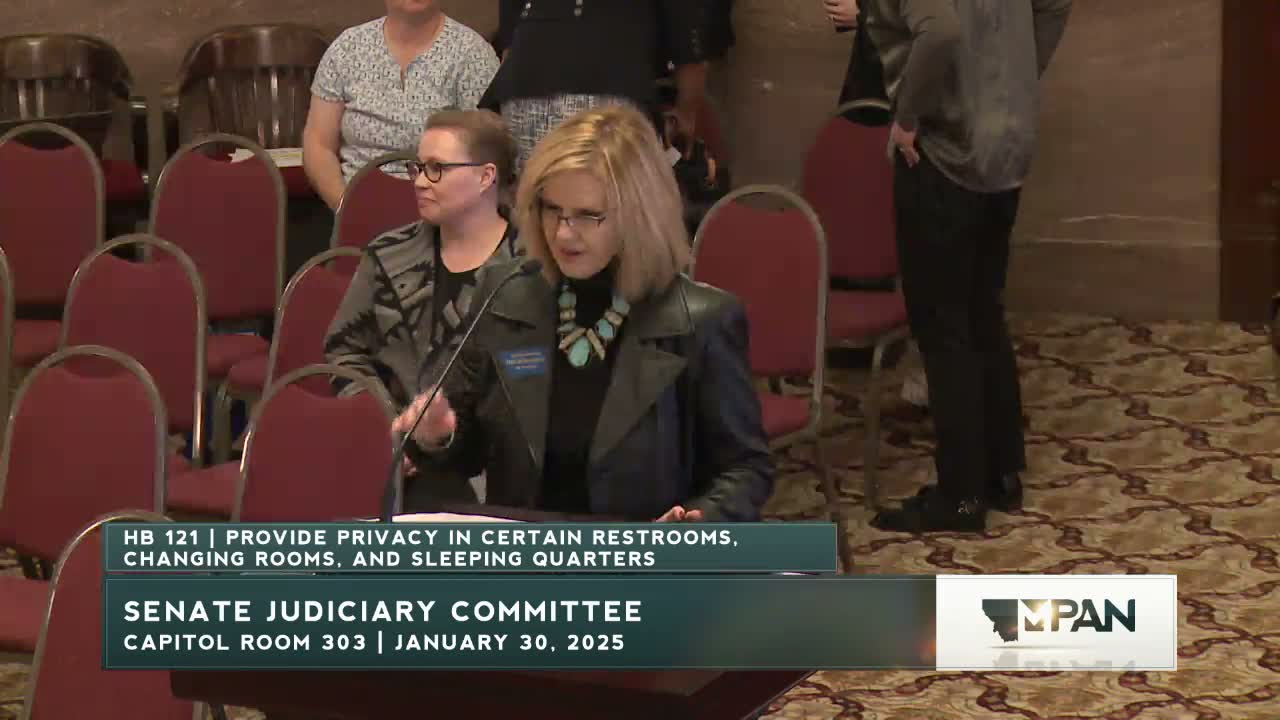
Representative Carrie Seekins Crow opened House Bill 121 as legislation to protect privacy and safety in intimate multi‑user public spaces by requiring entities to designate restrooms, locker rooms and sleeping quarters for male or female use and to take reasonable steps to ensure privacy. She framed the measure as protecting women and girls in schools, shelters and correctional facilities.
Proponents ranged from the lieutenant governor and conservative legal groups to private citizens who offered accounts of feeling unsafe or uncomfortable. Supporters described three main bill components: (1) facility designation of multi‑user spaces; (2) an obligation on covered entities to take ‘‘reasonable steps’’ to protect privacy; and (3) a private right of action allowing complainants to recover nominal damages and fees if an entity fails to take reasonable steps or gives explicit permission to the opposite sex to use a covered space.
Opponents included domestic‑violence‑shelter providers, the Montana Coalition Against Domestic and Sexual Violence, the ACLU of Montana, Planned Parenthood Advocates of Montana, the Montana Hospital Association, legal advocates and many transgender, nonbinary and intersex Montanans. They argued the bill is vague (terms such as “encounter” are undefined), would be difficult or impossible to enforce without invasive privacy violations, risks loss of federal funding for shelters that must comply with nondiscrimination conditions, creates litigation exposure and would put transgender and other marginalized people at increased risk of harassment and harm.
Committee members asked practical enforcement questions: Would the state require documentation such as birth certificates or chromosome testing? Sponsors and counsel said enforcement would fall to facilities and that implementation could vary by setting (correctional facilities versus libraries or shelters), with accommodations under ADA and options such as single‑occupancy restrooms. Counsel described the bill as flexible about how ‘‘reasonable steps’’ are met and emphasized exceptions for caregivers and ADA accommodations.
The hearing included sustained, emotional testimony from both sides, many written submissions, and back‑and‑forth about constitutional privacy and equal‑protection concerns. Witnesses cited potential fiscal impacts, including litigation and loss of federal grant funding for shelters. Representative Seekins Crow closed arguing the bill protects women’s constitutional right to privacy; the chair closed the hearing and noted the committee would reconvene.