Get Full Government Meeting Transcripts, Videos, & Alerts Forever!
Get email alerts on the Youth Court topic
No spam. Unsubscribe anytime.
Rep. Reavis pushes study to simplify Montana Youth Court Act
Summary
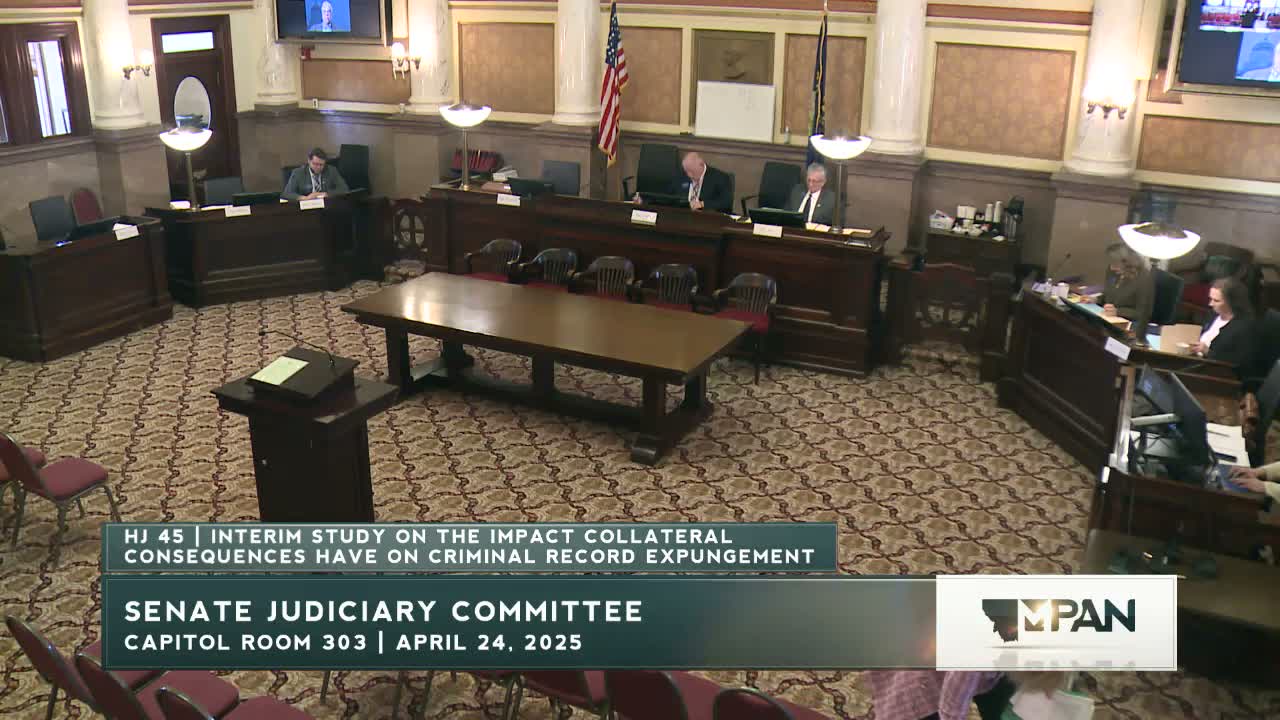
Representative James Reavis told the Senate Judiciary Committee HJ23 would bring stakeholders together to revise, simplify and streamline the Montana Youth Court Act, citing decades of piecemeal amendments and a court reversal tied to conflicting statutes; the committee concurred in executive action.
Representative James Reavis opened HJ23 as a study bill "to revise, simplify, and streamline the Montana Youth Court Act," saying the law — in effect since 1947 and scattered with cross-references — has become procedurally confusing for judges, lawyers, youth and families.
Reavis described a recent case (referenced as CL) in which the statute controlling one aspect of procedure conflicted with three related statutes and resulted in inconsistent county practices and an appellate reversal. "If this law had been written in a more straightforward manner, we would not have gotten the reversal," Reavis said, arguing that a study would let multiple stakeholders recommend procedural fixes rather than imposing substantive changes in a single bill.
Michelle Lyday, an employee of the Office of State Public Defender testifying on her own time, described the Youth Court Act as "the victim of many Band Aid fixes" and said the act is confusing even to seasoned lawyers, urging passage of HJ23 so families and practitioners can better understand proceedings.
Tom Billteen, Youth Court Services Bureau chief with the Office of Court Administrators, appeared as an informational witness and was made available for committee questions. After brief questioning about the motivating case, Reavis closed and urged support for a stakeholder-driven study focused on procedure.
At executive action, Senator Ricky moved to concur on HJ23; questions were called and the committee reported HJ23 out of committee on a voice vote, with proxy votes recorded in the hearing record.
Why it matters: The Youth Court Act governs how juveniles are processed through the juvenile justice system; a procedural study could reduce inconsistent outcomes and litigation by clarifying transfer hearings, dispositions and other youth-specific procedures.
Next steps: HJ23 was concurred in committee and will go to the floor for further consideration.