Get Full Government Meeting Transcripts, Videos, & Alerts Forever!
Get email alerts on the Victim Charging Policy topic
No spam. Unsubscribe anytime.
Prosecutors, police and victim advocates urge 'no' on bill letting assault victims decide misdemeanor charges
Summary
Senate Bill 273 would give alleged victims of non‑felony misdemeanor assault the sole authority to decide whether charges are filed; prosecutors, sheriffs, police and victim‑service groups told the committee the change could harm public safety, enable coercion or bribery, and place unfair burdens on victims.
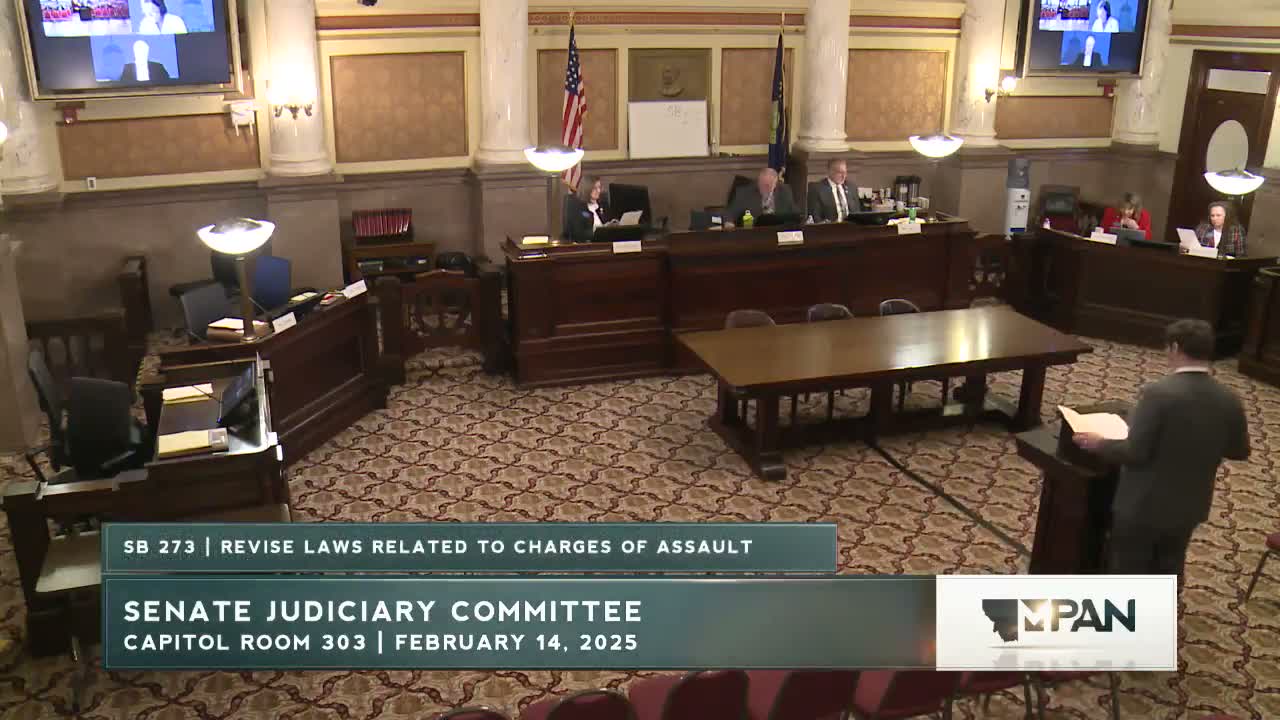
Senator Daniel Emmerich introduced Senate Bill 273 on Feb. 14, saying the measure would permit victims of nonfelony misdemeanor assault to determine whether charges are filed, with exceptions for victims who are developmentally disabled, physically disabled or suffering from severe mental illness.
"This is for the non felony misdemeanor assault statute," Emmerich said, adding the bill seeks to address cases he described as 'victimless' or where the alleged injury may not warrant prosecution.
Opponents across law enforcement and victim services urged rejection. Brian Thompson, representing the Montana Sheriffs and Peace Officers Association and the Montana County Attorneys Association, said charging is a state duty and that giving victims sole power to decide could enable bribery, intimidation or leverage by perpetrators and undermine public safety. "What this could create is a situation where the perpetrator of a crime could have some kind of leverage over the person who was a victim," Thompson said.
Daniel Berris, a deputy county attorney, echoed concerns, warning the law could expand beyond simple assault and produce perverse prosecutorial incentives. "I think the unintended consequences would be extremely negative for public safety," he said.
Dan Smith of the Montana Police Protective Association and city prosecutors from Bozeman and Missoula cited safety and practical problems with victim-directed charging. "If I you take that ability from me to arrest that person when I have good probable cause ... you would eliminate my possibility to protect future victims," Smith testified.
Victim‑service organizations also opposed the bill. Beth Brenneman of the Montana Coalition Against Domestic and Sexual Violence said the proposal would add an unfair burden on victims and noted the bill's exceptions do not include children. Erin Lambert, CEO of YWCA Billings, called it "bad policy" to ask harmed people to be the sole decision‑makers about prosecution.
Senators questioned scope and intent. Thompson and others clarified SB 273 does not apply to the partner family member assault (PFMA) statute, which requires charging in domestic partner contexts, but witnesses said many coercive relationships outside PFMA could be affected. Committee members also asked whether the bill would help victims when prosecutors decline to act; witnesses said victims have limited criminal recourse under current law aside from seeking intervention by the attorney general or filing civil suits.
Emmerich acknowledged the bill could be reworked. "I think that the current language causes problems ... amended it would probably be effective," he told the panel, and he said he would consider amendments.
What happens next: The committee closed the hearing on SB 273 without a recorded vote; the sponsor said he will work on amendments. Opponents urged a 'no' vote at the committee stage, citing risks to victim safety, witness tampering and public safety.