Get Full Government Meeting Transcripts, Videos, & Alerts Forever!
Get email alerts on the End Of Life Policy topic
No spam. Unsubscribe anytime.
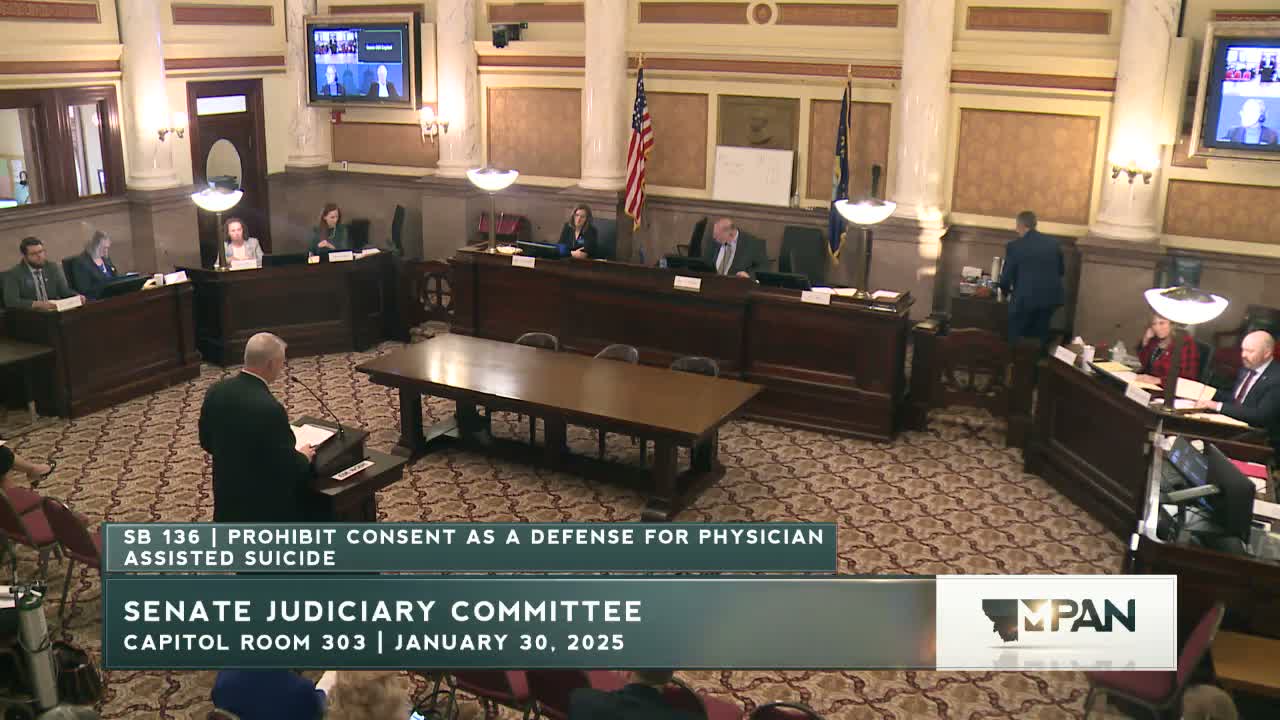
Heated testimony as Senate panel considers bill to bar consent defense for physician‑aid‑in‑dying
Summary
SB 136 would make patient consent not a legal defense to homicide charges in cases of physician‑aid‑in‑dying. Sponsors argued Baxter left a legal 'gray area' and cited international statistics and slippery‑slope risks; opponents, including terminally ill people, hospice clinicians, disability advocates and major medical organizations, urged rejection, saying Baxter and the Right of the Terminally Ill Act currently protect access and clinical safeguards. Committee requested a legal review note before executive action.
Senator Carl Glimm opened Senate Bill 136, saying the measure would provide legislative clarity by declaring that a patient's consent to physician‑aid‑in‑dying is not a defense to homicide. Glimm cited the Montana Supreme Court's 2009 Baxter decision as prompting legislative action and argued the bill is necessary to protect vulnerable people and prevent incremental expansion of assisted‑dying practices.
The hearing drew lengthy, sharply divided testimony. Supporters included Lieutenant Governor Kristin Juras, religious and pro‑life groups, and ethicists who described Baxter as leaving a legally ambiguous space that some had interpreted as permitting assisted dying. Proponents warned of a slippery slope they said was visible in other jurisdictions and urged the legislature to state a clear public policy against physician‑assisted dying.
Opponents included terminally ill Montanans, hospice and palliative physicians, the Montana Medical Association, the Montana Hospital Association, Compassion & Choices, disability‑rights organizations such as Not Dead Yet, and other health and legal advocates. Opponents described the existing practice in Montana as a carefully documented, clinician‑guided process for mentally capable, terminally ill adults, argued that criminalizing clinicians would reduce access to compassionate end‑of‑life care, and urged safeguards instead of prohibition. Several witnesses recounted personal experiences in which medical aid in dying provided a peaceful death when other measures failed.
Committee members asked detailed legal questions about Baxter and whether the Legislature can remove consent as a statutory defense. Senate staff said a legal review note addressing constitutional conformity was being drafted and would be available before executive action. Sponsor Glimm acknowledged an amendment would be proposed in executive action to clarify that palliative care is not affected.
No formal votes were taken during the hearing. The record shows the committee received extensive written and oral testimony from medical providers, patients, advocacy groups and legal experts on both sides; the chair closed the hearing after the sponsor’s remarks and signaled the bill would advance to further committee consideration.