Get Full Government Meeting Transcripts, Videos, & Alerts Forever!
Get email alerts on the Child Protection Ethics topic
No spam. Unsubscribe anytime.
Bill to impose formal conduct rules on child protection specialists draws opposition from DPHHS and COPP
Summary
Senate Bill 272 would create a rules-of-conduct regime for child protection specialists with complaints routed to the Commissioner of Political Practices; DPHHS and COPP warned it singles out workers, duplicates existing personnel rules, and would strain a small oversight office.
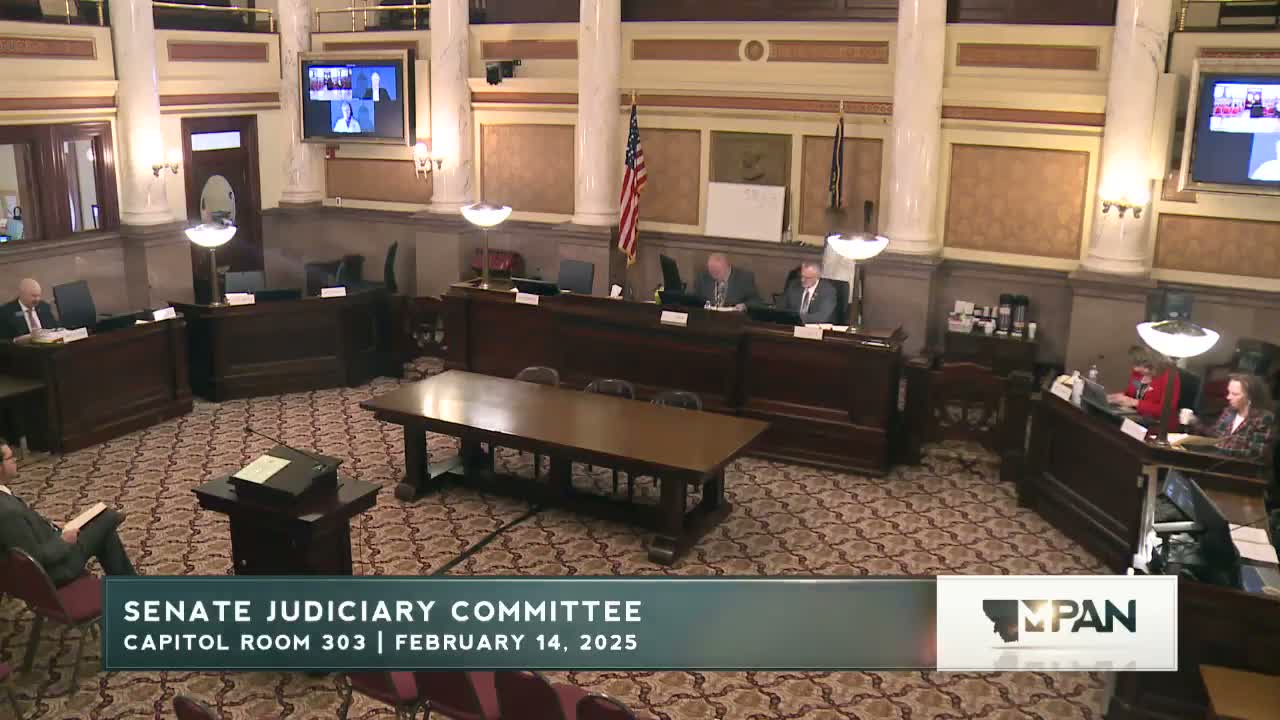
Senator Daniel Emmerich introduced Senate Bill 272 on Feb. 14 as legislation to establish rules of conduct for child protection specialists and to direct complaints to the Commissioner of Political Practices.
"This bill is designed to do is just create a simple rule of conduct for CPS workers," Emmerich said during the hearing, describing the measure as intended to draw clearer lines for specialist conduct.
The Department of Public Health and Human Services opposed the bill. Jesse Counts, executive director of the human services practice area at DPHHS, told the committee the measure would "single out one group of employees unnecessarily" and "does a disservice to the individuals who have spent their careers doing an incredibly difficult job." Counts said the behavior targeted by the bill is already addressable under existing employee codes and HR processes and that the Office of the Child and Family Ombudsman handles public complaints about the Child and Family Services Division.
The bill text directs complaints to the Commissioner of Political Practices (COPP). Scott Cook, representing COPP, appeared as an informational witness and described his office as a small agency of seven employees including the commissioner and three full-time compliance specialists. "There certainly are concerns if there is extra work added to the plate without any extra employees or resources," Cook said, warning that COPP would face capacity issues if new responsibilities were assigned without funding or staff.
Counts told the committee there are "approximately 450 people in the children and family services division," most of them child protection specialists who respond to difficult situations, often at night. He argued adding a statutory complaint route naming that job class would be duplicative and could unfairly assume misconduct where none exists.
Emmerich said the bill grew from drafting recommendations and from standards that mirror professional codes of conduct such as those for attorneys; he said the committee could consider alternate placement for enforcement and that he was open to amendments. "I'm more than happy to work with anybody on amendments, to and potentially find a better home for implementation," he said.
The committee did not take a final vote on SB 272 during the hearing. The sponsor told members he would work on amendments and explore whether enforcement belongs with COPP or another office.
What happens next: The hearing record remains open for the committee to consider amendments and to determine where enforcement should be placed; no committee action was recorded on SB 272 at the Feb. 14 session.