Get Full Government Meeting Transcripts, Videos, & Alerts Forever!
Get email alerts on the Probation Supervision topic
No spam. Unsubscribe anytime.
Senate committee hears bill to let probation officers streamline supervision conditions
Summary
Lawmakers heard testimony on SB 70, which would let supervising officers notify the sentencing court and county attorney when they seek to remove irrelevant probation conditions; a 14‑day objection window would trigger a hearing. Supporters argue the change reduces revocations and frees officer time for high‑risk cases; victims’ notification procedures were clarified.
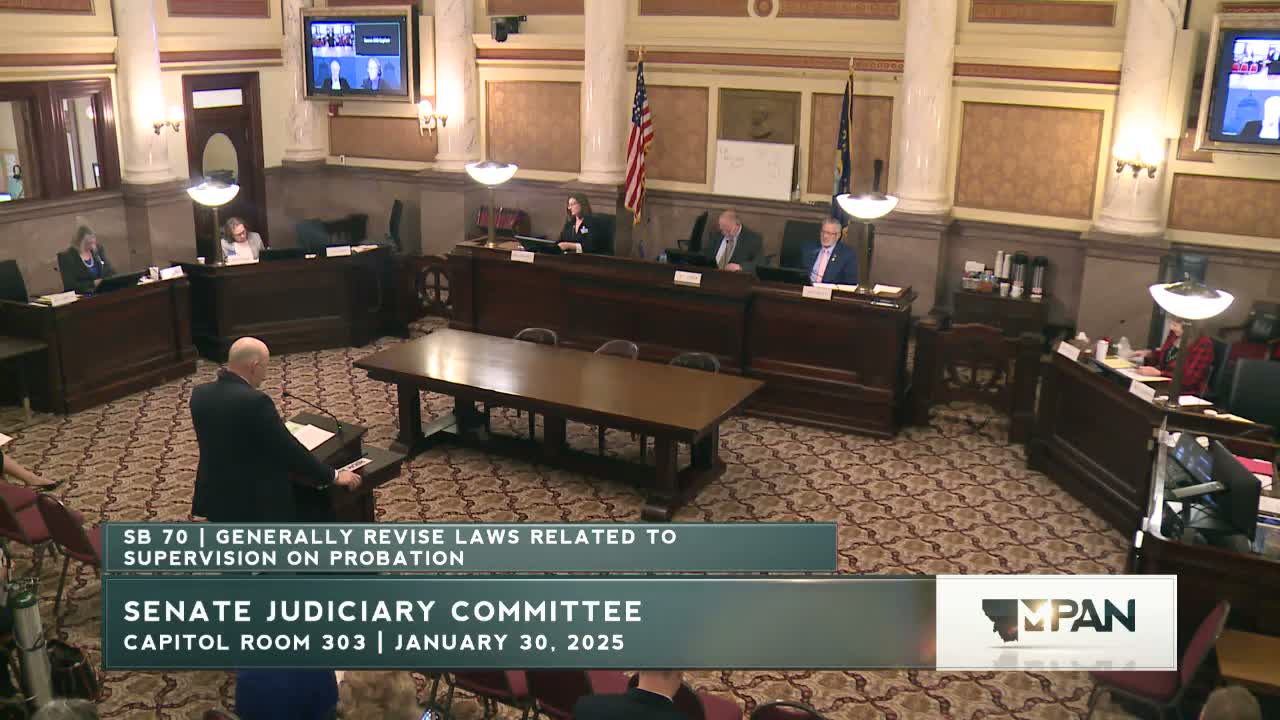
Senator Gail Lammers of Senate District 21 introduced Senate Bill 70, saying the bill creates a streamlined process for probation officers to seek removal of supervision conditions they consider no longer necessary. Under the bill, an officer may notify the sentencing court and county attorney of an intention to remove a condition; if the judge and county attorney do not object within 14 days, the condition is eliminated without a hearing. If any party objects within 14 days, the court must hold a hearing to decide whether the condition remains in place.
SB 70’s sponsor cited data she said show Montana supervisees face roughly 30 conditions on average compared with a national average of 17 and argued blanket conditions can divert officer attention from people who pose higher risks. She said some common conditions—such as a bank‑account restriction imposed without a connection to the underlying offense—can create barriers to housing, employment and stability.
Proponents included Rachel Wright, national policy director for Right on Crime, and John Schaffer, quality assurance for Montana Department of Corrections Probation and Parole. Wright told the committee that tailoring supervision reduces revocations and recidivism; Schaffer said the bill grew from a multidisciplinary work group that met monthly from November 2023 through June 2024 and included probation staff, judges, county attorneys, defense counsel and a citizens’ advisory council.
Committee members asked about victim notification. Schaffer and Caitlin Flood of the Crime and Justice Institute explained the bill requires notice to the sentencing court and county attorney and that victim‑witness advocates are notified of supervision changes; Flood said the work group and county attorneys agreed 14 days is a reasonable window for notice and any needed follow‑up.
Supporters said the bill would allow officers to focus resources on higher‑risk cases, reduce costly revocations, and remove obstacles to reentry. No formal motions or votes were recorded at the hearing; the bill’s sponsor reserved closing remarks and the committee closed the SB 70 hearing after questions.