Get Full Government Meeting Transcripts, Videos, & Alerts Forever!
Get email alerts on the Judicial Administration topic
No spam. Unsubscribe anytime.
Committee weighs requiring random selection for substitute judges
Summary
Senator Daniel Emmerich said SB 41 would require a random selection procedure for substituted or disqualified district judges and authorize the Office of Court Administrator to set the method. Proponents cited public perception of nonrandom picks; the State Bar urged seeking a court-rule fix, and the new court administrator offered data and a willingness to review the software used to assign substitutes.
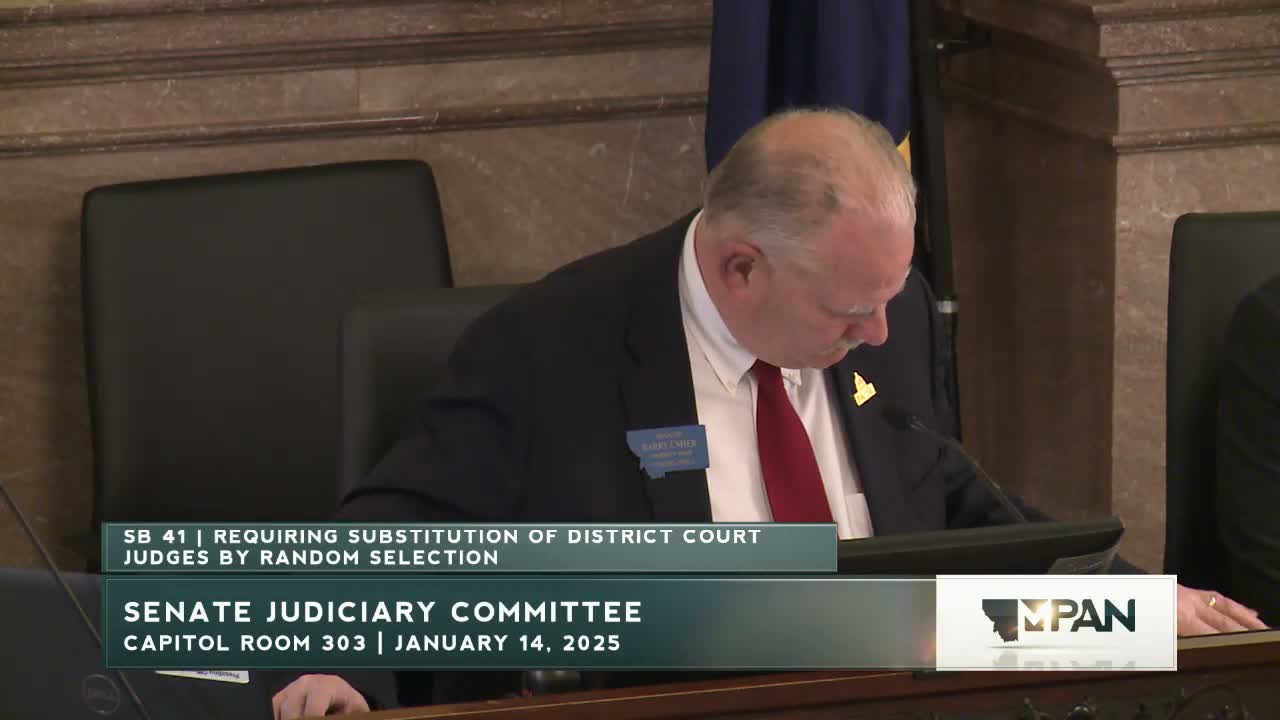
Senator Daniel Emmerich opened the hearing on Senate Bill 41, saying the bill would require the random selection of substituted or disqualified district-court judges and direct the Office of Court Administrator to establish the procedure.
Proponent testimony emphasized perception and fairness. James King, testifying as an individual, described a personal case he said demonstrated nonrandom selection practices and urged the committee to act to ensure impartial substitute assignments. The State Bar's Bruce Spencer said the bar did not oppose random selection in principle but warned the bill could conflict with Article 7, Section 2 of the Montana Constitution and suggested the legislature instead petition the Supreme Court to change court rules.
Dave McAlpin, the new court administrator, gave factual context and offered to work with the committee and sponsor. He told the committee that Montana's courts resolve roughly 250,000 cases a year and that district courts filed about 56,000 cases in 2024; that calendar year saw about 450 substitution motions nationwide ("less than 1% of the total caseload"). McAlpin said multi-judge districts accounted for around 75% of substitutions and committed to reviewing the assignment software with the committee and sponsor to improve transparency and randomness while noting practical limits to purely statewide random assignment.
Committee members pressed about the definition of "larger group" in the bill's random-selection language and about the practical implications for single-judge rural districts; the sponsor said those details were intentionally left to court rulemaking. No committee vote was taken; the court administrator and sponsor agreed to follow up on software capabilities and possible amendment language.