Get Full Government Meeting Transcripts, Videos, & Alerts Forever!
Get email alerts on the School Boundary Changes topic
No spam. Unsubscribe anytime.
Chippewa Falls school board tables K–3 boundary changes after parents object to timeline and transportation impacts
Summary
The Chippewa Falls Area Unified School District proposed phased elementary boundary changes to equalize K–3 class sizes but, after public comment and board debate, the board voted down the committee recommendation and tabled the proposal until September for further review.
At its Tuesday evening meeting the Chippewa Falls Area Unified School District board declined a committee recommendation for phased elementary boundary changes intended to equalize K–3 class sizes, then voted to table the proposal until September for further study.
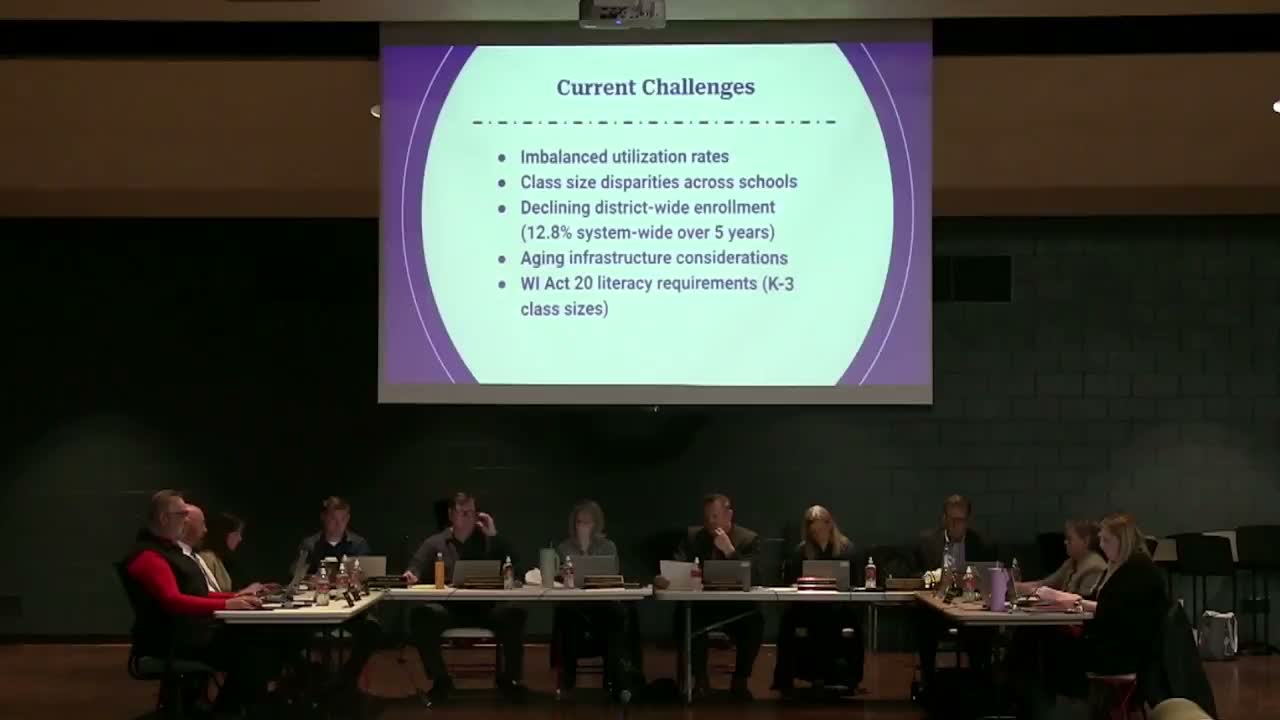
District presenters said enrollment has fallen about 12.8% districtwide over five years and recommended a three‑phase plan to achieve K–3 class sizes of roughly 18–22 students. "We've observed significant class size disparities across schools, particularly in the K–3 grades where consistency is crucial for literacy development," a district presenter said during the presentation. Phase 1, proposed for 2025–26, would affect an estimated 52–58 students and includes moving an expanded area north of Bridgewater Avenue from Hillcrest to Parkview and transferring another area from Homestead to Southview.
Presenters outlined projected school‑utilization changes: Homestead about 88% down to 77%, Hillcrest 85% to 67%, and several other schools shifting in the 70s to low 80s. Staff also said Phase 1 would directly affect roughly 106 students and require the addition of two bus routes to serve new routes.
Parents at the meeting urged the board to delay. "This information has come out in a very rushed manner," Katie Price, a parent who lives on Squire Street, told the board, urging the district to provide comparative statistics and to redraw lines so West Hill would not be split. Jeff Peck, another resident, raised transparency concerns about transportation for grandfathered students, saying that if students remain at their current school after reassignment, transportation would not necessarily be provided. District staff confirmed the reassignment policy generally does not guarantee district transportation except where special‑education bussing is required.
Board members pressed staff on staffing and program impacts. Staff said the staffing plan underpinning the proposal was built on a baseline that included two teacher positions the board had already approved; under that baseline the plan would be roughly staffing neutral for current classroom teachers, though removing the previously approved positions would produce a net reduction of two classroom staff relative to an earlier baseline.
After extended questioning and public comment, a motion to accept the committee (EDRC) recommendation failed on the floor. The board then moved and approved a motion to table the item until September so staff can provide additional information and the board can consider timing and transportation, enrollment and budget cycles before taking final action.
The school district cited Wisconsin Act 20 as part of the K–3 literacy and class‑size policy context discussed during the presentation. The next step is for staff to return with further analysis and materials before the board resumes consideration in September.