Get Full Government Meeting Transcripts, Videos, & Alerts Forever!
Get email alerts on the Chatham Park Sap topic
No spam. Unsubscribe anytime.
Board presses Chatham Park on transit, stormwater and fiscal assumptions in South Village small area plan
Summary
Town staff and Chatham Park representatives presented the South Village Small Area Plan; commissioners sought clearer traffic, transit, stormwater, parks and fiscal-impact details and asked for a written pros-and-cons memo and more complete financial and transportation analyses before making a recommendation.
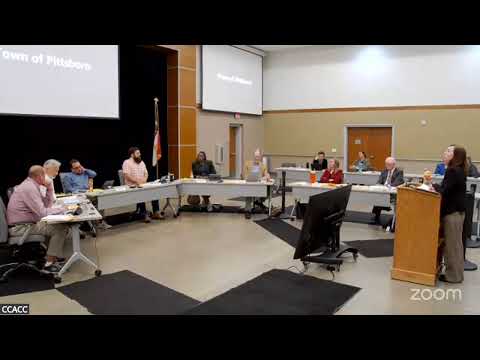
Town planning staff and Chatham Park representatives spent the bulk of the Oct. 13 meeting walking the Board of Commissioners through the South Village Small Area Plan, a 5,000‑acre component of the broader Chatham Park master plan that proposes land uses, development standards, park locations, greenways, transportation typologies and phasing through mid-century.
Assistant Planning Director Theresa Thompson and Chatham Park representatives described the plan as a conceptual guiding document that would inform later section-design plans and preliminary plats. The developer has proposed land-use quantities (including a cap on research-and-development sections allowing up to 50% residential in R&D areas unless otherwise limited), an estimated nonresidential square footage split across South and North sections, and infrastructure commitments such as multiuse trails (about 12 miles) and greenways (approximately 20 miles).
Commissioners focused on several technical areas they said need more detail before the board could recommend approval. Key questions included:
- Transportation and modeling: Commissioners asked whether the travel-demand model accounted for post‑COVID travel behavior, telecommuting and modal shifts, and whether RK&K (the town’s consultant reviewing the model) had been asked to incorporate the town’s vision and draft climate action plan. Staff said the model has been submitted and is under consultant review and that town staff will forward consultant recommendations to NCDOT.
- Stormwater: Several commissioners said stormwater is the single greatest infrastructure issue facing the town this year; they asked for stronger, quantifiable commitments (for example, whether the developer would design detention to a higher-than‑required standard or partner on off-site detention to mitigate downstream flooding) and clearer mechanisms for oversight and maintenance. Chatham Park representatives expressed willingness to partner with DOT and the town on detention and noted some previous discussion of detention alternatives (dry pond, wet pond, bioretention).
- Parks and greenways: Staff and the developer described multiple park sites and a third‑party review to confirm usable acreage (excluding wetlands and buffers). Commissioners asked how many acres of usable, active recreation would be provided and how quickly key parks and greenways would be delivered in relation to housing build‑out.
- Utilities and public facilities: Tri River Water representatives said current design work and planned force-main improvements are intended to provide sufficient sewer capacity in the near term, with an initial capability to move 2 million gallons per day and design capacity for more. Commissioners requested written documentation on water‑treatment improvements (including whether granular activated carbon filtration will be used) and confirmation of phased capacity assumptions.
- Fiscal impact analysis (FIA): Commissioners asked that the FIA be more comprehensive and transparent. They requested to see both revenue and expenditure projections (schools, police, fire, capital costs), assumptions behind phasing and unit counts (the plan’s entitlement numbers reach into tens of thousands of future units), and the treatment of developer-provided credits or fee-in-lieu arrangements (for example, previous references to $10 million in housing/development fee credits). Staff said they will request additional detail and can bring back updated analyses.
Board requests and next steps: Staff said they will (1) collect consultant feedback on the traffic model and ask the consultant to consider policy context (vision statement and draft climate action plan), (2) seek clearer documentation on stormwater commitments and park acreage usability from the applicant, (3) confirm utility infrastructure timelines and design commitments with Tri River Water, and (4) request a more complete FIA that includes both revenues and expenditures and that accounts for the range of entitlement scenarios. The plan will return to the board in November with further answers and supporting documentation.
Quote from the meeting: "Stormwater is a major issue," one commissioner said. "We have an extraordinary opportunity here because of the ownership of these two pieces of land to do something tremendous for that whole corridor."