Get Full Government Meeting Transcripts, Videos, & Alerts Forever!
Get email alerts on the Housing Board Representation topic
No spam. Unsubscribe anytime.
Senate committee hears bill to reserve Native American and veteran seats on Montana Board of Housing
Summary
Senators and witnesses discussed SB 219, which would reserve a seat for a Native American and a seat for a veteran on the Montana Board of Housing. Proponents and the Board's executive director described housing disparities, outreach efforts and logistical constraints such as membership expertise and quorum requirements.
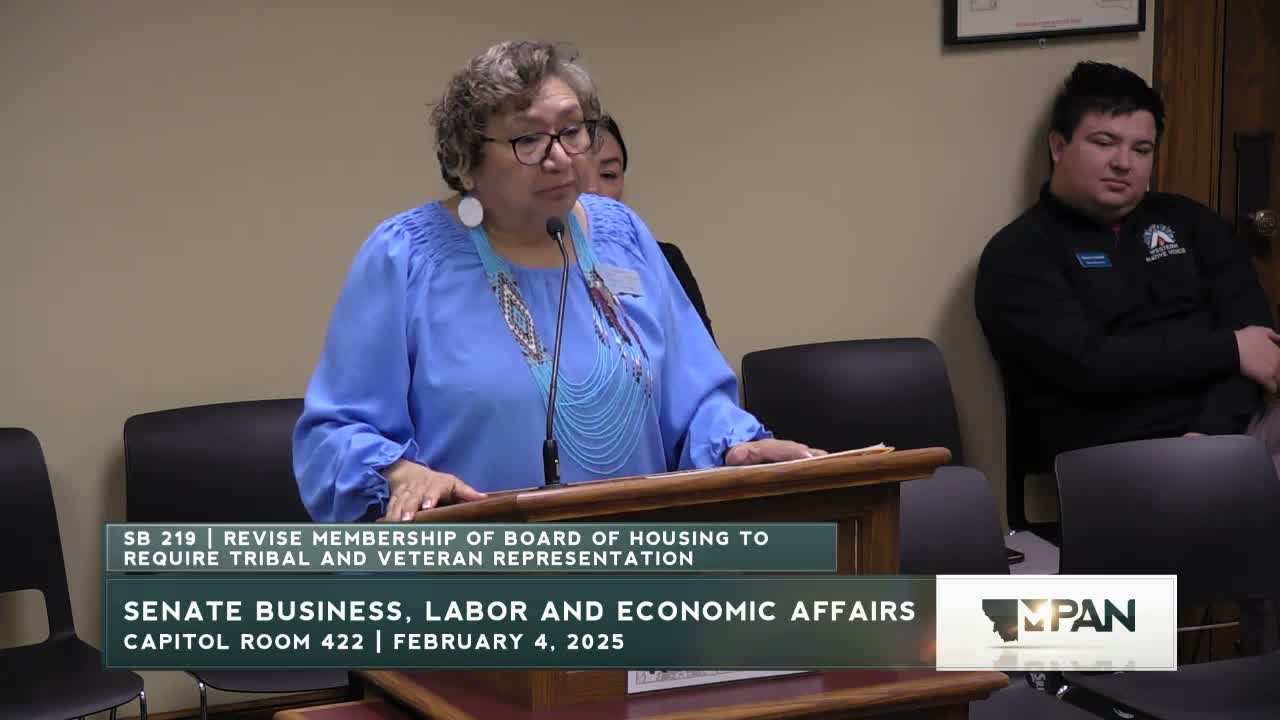
HelD in the Senate Business, Labor, and Economic Affairs Committee on Thursday, lawmakers heard testimony on Senate Bill 219, which would reserve one seat for a Native American and one seat for a veteran on the Montana Board of Housing.
Sen. Susan Webber, the bill sponsor, told the committee SB 219 is "requesting a seat at the table for a Native American and a veteran on the board of housing," arguing the change would give those groups a voice when the board sets housing policy and allocates resources. Webber cited homelessness among veterans and said existing programs are not reaching all communities.
The bill’s proponents told the committee those seats matter for both representation and policy design. Lats Forstar submitted a letter from the Montana American Caucus and described work with veterans on suicide-prevention programs. "We stand up for each and every one of you," Forstar said when urging the committee to give the bill a due pass. Alyssa Snow, representing the Chippewa Cree and Blackfeet tribes, cited data she said shows Native Montanans have lower homeownership rates and disproportionate representation among people experiencing homelessness: "45% of Native Americans in Montana own their own homes compared to 70% of white residents," Snow said, and Native people make up roughly 20% of the state’s homeless population despite being under 7% of residents.
Cheryl Cohen, executive director of the Montana Board of Housing, appeared as an informational witness and described programs the board administers and partners on, including HUD-VASH, the VHLP revolving loan fund drawing on coal trust tax receipts, and the HUD 184 mortgage product. Cohen cautioned the committee that the board currently requires members with specialized experience "in areas of housing, economics, or finance" and that state law also requires at least one member to be a practicing attorney. She warned that overly prescriptive composition requirements risk leaving the board short of members and jeopardizing quorum: "If you become too granular in your requirements, we may have challenges having enough board members there for every board meeting to be able to make timely decisions."
Committee members pressed on practical issues: whether the board should expand beyond seven members to accommodate guaranteed seats, whether a single individual could fill both the Native American and veteran role, and how the board reaches underserved communities. Webber said a single person could hold both identities if qualified, and argued outreach and targeted recruitment could find candidates who meet the board’s technical expectations. Cohen described an existing Native American Homeownership Coalition and partnerships with NeighborWorks Montana as outreach mechanisms and noted a prior legislative audit that recommended steps to serve Native communities better.
On program access, witnesses and the sponsor described hurdles that can leave people without assistance even when programs technically exist. Webber said the Bureau of Indian Affairs’ listed home-loan authority is often "so underfunded" in practice that it provides little help to would‑be borrowers. Cohen also described administrative and technical barriers on tribal lands that complicate some federal loan programs.
Webber closed by asking the committee for a due pass. The hearing concluded with scheduling remarks from Chair Noland about potential executive actions and other bills the committee might consider in the coming days.
The committee did not take a final vote on SB 219 during the hearing; the bill's next procedural step depends on committee action at a later meeting.