Get Full Government Meeting Transcripts, Videos, & Alerts Forever!
Get email alerts on the Agriculture Livestock Irrigation topic
No spam. Unsubscribe anytime.
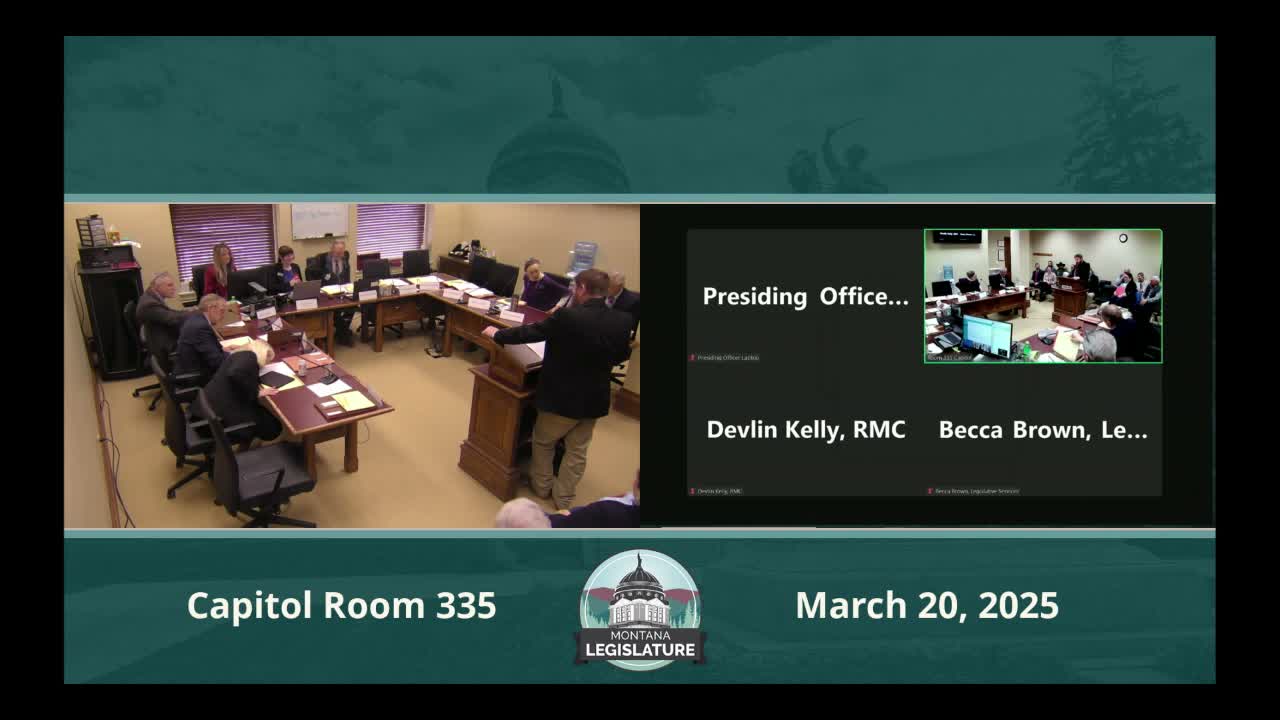
Senate committee hears hours of debate on HB 119 to create Montana Cattle Committee
Summary
The Senate Agriculture, Livestock and Irrigation Committee heard extensive pro and con testimony on House Bill 119, which would authorize a statewide Montana Cattle Committee and enable a producer referendum on a per-head assessment; committee members flagged governance, procurement and Native representation concerns and closed the hearing with no vote.
The Senate Agriculture, Livestock and Irrigation Committee heard hours of testimony on House Bill 119 on Tuesday as producers, tribal representatives and agency lawyers debated whether to authorize a Montana Cattle Committee and the process for a potential per-head assessment.
Speaker Lear, sponsor of House Bill 119, told the committee the bill establishes a framework for a statewide cattle committee but does not itself impose any assessment. "This bill is not imposing the tax," the sponsor said, adding that any assessment "would be left up to a referendum of the producers."
Proponents, including Karli Johnson of the Montana Farm Bureau Federation and Jane Curry, chair of the working group that drafted the bill, said the proposal mirrors existing commodity committees in Montana and other states and would allow producers to fund promotion, research and market development for Montana beef. Johnson said negotiated amendments would broaden who may nominate members, clarify language, remove certain exemptions and allow producers to request refunds twice a year. John Grande, a former Montana Stockgrowers Association president, urged support for an amendment package he said would improve the bill's chances.
Opponents ranged from producer groups to tribal representatives. Walter Schweitzer, president of the Montana Farmers Union, called it "creating a second bureaucracy" and urged rejection of the bill in its current form. Several tribal witnesses, including Patrick Kawaki, asked the committee to add explicit Native representation and suggested the Intertribal Agriculture Council as a nominating body. Ken Morris of the Montana Cattlemen's Association said the bill "allows [the Department of Livestock] to remove around a 190,000 from this tax revenue each year for the hiring of 1 full time employee," and raised concerns about transparency and the proposed referendum turnout rules.
Legal and administrative witnesses highlighted technical but consequential differences between HB 119 and existing law. Don Harris, chief legal counsel at the Department of Administration, identified problems with blanket exemptions in the bill from the state procurement act and from state human resources/pay-plan rules and said an amendment (HB119.002.010) would remove those categorical exemptions. Mike Honeycutt, executive officer for the Department of Livestock, said the bill would create a quasi‑government entity attached to the department and described the department's likely administrative role in running any referendum, collecting assessments and enforcing refunds.
Committee members pressed witnesses about whether removing particular sections would address procurement and HR concerns and whether the nomination and appointment structure could be made less partisan or more regionally representative. Several senators suggested a work session or subcommittee to negotiate line‑by‑line fixes and broader outreach to ensure producers understand the referendum mechanics.
The committee heard state and interstate examples: witnesses cited Idaho’s folded 50¢ checkoff and North Dakota’s $1 checkoff as alternative models and pointed to federal rules as the reason a state program would be required to focus specifically on Montana beef. No formal vote was taken; the sponsor said he would continue work on amendments and outreach. The hearing closed without action and the committee adjourned.
The committee did not take a procedural vote on HB 119; members signaled interest in further negotiations, and a work session or subcommittee was proposed as the next step.