Get Full Government Meeting Transcripts, Videos, & Alerts Forever!
Get email alerts on the Homelessness Response topic
No spam. Unsubscribe anytime.
Portland and Multnomah County present updated homelessness action plan and 12 KPIs; officials debate scale, costs and who sets targets
Summary
City and county staff presented a refreshed Homelessness Response Action Plan and a set of 12 proposed key performance indicators to guide FY27 budgets. Presenters warned current inflow outpaces outflow (net ~200 people/month); modeling shows a 50% increase in system effort would be needed to meaningfully bend the curve, and staff estimate a nearly 19,000-unit deficit for households under 30% AMI.
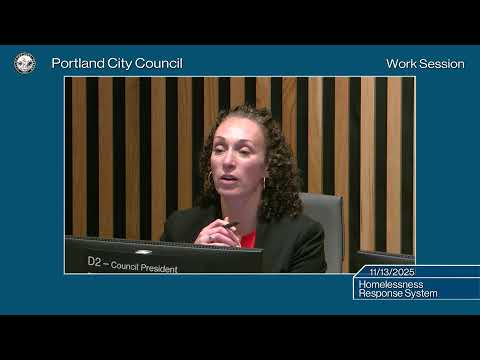
Portland City Council and the Multnomah County Commission met in joint session on Nov. 13 to review a refreshed Homelessness Response Action Plan (HRAP 2) and a proposed set of 12 key performance indicators (KPIs) that staff say will guide budget and policy decisions in the coming year.
"On average, 1,000 people are exiting homelessness each month," Commission Chair Vega Peterson said as she opened the meeting, "but each month, 1,300 additional people are becoming homeless," underscoring why staff framed the updated plan and KPIs as a tool to rebalance prevention, shelter, housing placement and supports.
Jillian Schoene, director of the homelessness response system, described the action-plan refresh as a reorganization of work into five goal areas— inflow, safety on and off the streets, outflow, care coordination and data and evaluation— and said the plan "is not an overarching investment strategy." Schoene highlighted new operational steps including a short-form "case conferencing light" pilot and a program to improve permanent supportive housing (PSH) retention among high-acuity behavioral-health cohorts.
Staff presented baseline data from the homeless services dashboard showing the system has sheltered or housed nearly 20,000 people over the last seven quarters while sustaining more than 8,500 people in housing with supports. Ryan Deibert, deputy director of the homelessness response system, said inflow currently exceeds outflow by roughly 200 people per month, leaving system capacity overwhelmed.
The proposed KPI package is intended as a system-level set of gauges rather than a program-by-program scorecard. Deibert said the team developed the 12 KPIs with steering and oversight and community committees and will carry detailed "sub-indicators" into later development to disaggregate results by population groups, race and program type.
To illustrate the policy trade-offs, staff shared modeling of several scenarios. "To get the needle bending downward by about 1% per month," Deibert said, staff estimate it would take roughly a 50% increase in overall system effort; more aggressive reductions would require near-doubling of effort and substantial new resources. That math, staff advised, will be central to budget deliberations next year.
Josh Roper of the Portland Housing Bureau walked through KPI 3, the affordable-housing production metric, which measures the number of rental units affordable to households at 0–30% of area median income (AMI) per 100 such households. Using older CHAS (2017–2021) data, staff estimated about 38 affordable rental units per 100 extremely low-income households in Portland and calculated a deficit of nearly 19,000 units to reach one unit per household; Roper said the team will refine benchmarks with updated microdata.
Elected officials pressed staff on several themes: whether the KPIs provide enough granularity to shape specific investments, how to tie dollars to results (cost per stable housing outcome), and which body should set numeric "green" goals. Multiple councilors and commissioners said they were willing to adopt the KPI definitions ("what" to measure) but want numeric targets set after the FY27 budget process rather than delegated to a smaller appointed oversight group. Schoene and staff said that is the SOC's recommendation: elected bodies would adopt definitions in December and the SOC would return in July 2026 to set specific numeric goals informed by final budget decisions.
Council and commission members also debated what interventions fall within local authority. "I don't understand why it's our interest... to increase secure residential facility beds," Commissioner Moyer said, arguing some beds and higher-level clinical services are controlled by state systems and that county and city leaders must press the state to allow access to Medicaid 1915 services for the highest-acuity individuals.
Several councilors emphasized cost trade-offs. Councilor Nick (last name in transcript referenced as Novick) outlined a rough sketch that suggested hundreds of millions of dollars annually might be required to stabilize inflow through rent assistance alone, and other members noted that deep, long-term investment in new units and alternative financing models would be required to close the 0–30% AMI unit gap.
Mayor Mike Wilson urged speed and process reform: "Our current outcomes are poor," he said, urging changes to reporting and a focus on removing system bottlenecks so that more shelter and housing placements move faster and at lower cost.
No vote was taken at the session. Staff requested additional briefings for elected officials before the December votes; the county plans a board vote on Dec. 4 on two resolutions (one to amend the IGA exhibit that defines the KPIs and another to replace the HRAP addendum), and the City Council is scheduled to consider its resolution later in December. Staff said a final report on the outgoing KPIs is due Feb. 2026, baseline quarterly reporting on the new KPIs will begin in May 2026, and the steering and oversight committee will return to set numeric goals in July 2026 after budget decisions are finalized.
Clarifying details discussed at the session included: average monthly inflow ~1,300 people, average monthly outflow ~1,100 people (net +~200), about 300 people newly housed per month on average, roughly 8,500 people sustained in housing via supports, an estimated 19,000-unit deficit for households at 0–30% AMI using CHAS data, and staff modeling that suggested a 50% system-effort increase to bend the overall homelessness curve modestly. Staff also noted HMIS data-system limitations and that a procurement for a new system is underway to improve provider interaction and analytic capability.
The joint session closed with plans for follow-up briefings and continued joint work as both bodies move the KPI definitions and the updated action plan toward separate votes next month.