Get Full Government Meeting Transcripts, Videos, & Alerts Forever!
Get email alerts on the Agricultural Land Valuation topic
No spam. Unsubscribe anytime.
Revenue Department explains agricultural land classes, valuation formula and how classification drives tax differences
Summary
The Department of Revenue presented Montana’s agricultural land classification rules, including automatic qualification at 160+ acres, the 20‑acre nonqualified threshold, a $1,500 gross‑income application test for smaller parcels, AUM calculations for grazing, and valuation inputs (NRCS productivity, commodity prices, 6.4% cap rate); parcel examples showed large tax differences for neighboring properties.
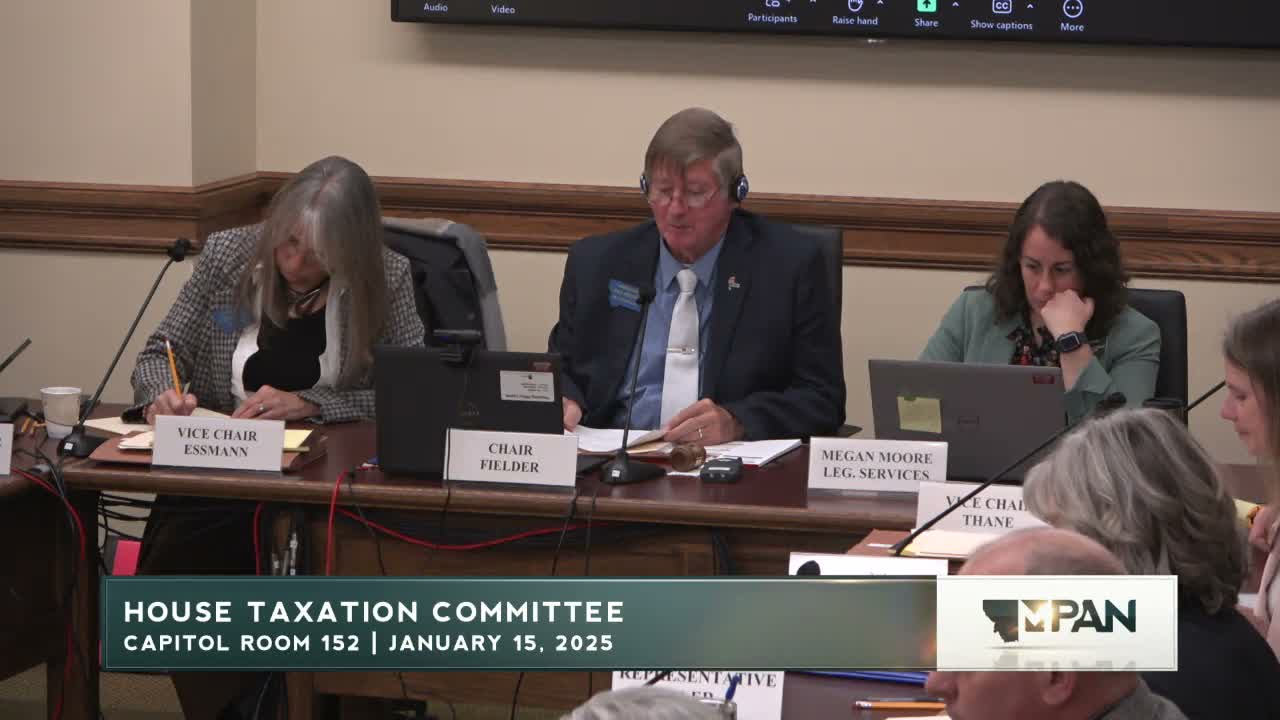
Bryce Kautz of the Department of Revenue presented a detailed overview of agricultural land classification (Class 3) and valuation methodology to the House Taxation Committee.
Kautz explained Montana is a classification state: the legislature sets classes and valuation standards, and the Department applies classification and values. He summarized automatic‑qualification rules (contiguous parcels of 160 acres or more automatically qualify as "qualified agricultural property" regardless of current use, except for industrial/commercial uses) and the nonqualified subclass (parcels of 20–160 acres automatically receive a "nonqual" designation that is valued using a statewide grazing average).
For parcels under 160 acres, owners must apply and show bona fide agricultural use and meet a minimum gross‑income threshold of $1,500 (or an MSU‑computed AUM threshold for grazing land). Kautz said Montana State University computes AUM (carrying capacity) values for grazing; the last cycle used 25 AUMs and the upcoming cycle will use 22 AUMs.
The Department described its income‑approach valuation: productivity (from NRCS soil surveys) × commodity price (10‑year Olympic average) × crop‑share percentage = net operating income; then net operating income is capitalized using the statutory floor capitalization rate of 6.4% to obtain a per‑acre productivity value. Sample inputs cited for the upcoming cycle included spring wheat at $6.11 per bushel, an alfalfa hay price worked at 80% to $124.20 per ton, and a private lease fee of $24.69 per AUM.
Kautz walked through examples showing how classification and the 1‑acre home‑site treatment create large differences in tax bills for similar neighboring parcels. Using three Lewis and Clark County parcels, a 20.15‑acre qualified parcel paid about $80.63 in 2024, a neighboring 22.93‑acre nonqual parcel (with the 1‑acre home site valued at market) paid about $486.97, and an 18.92‑acre tracked/market parcel paid about $1,583.64 — demonstrating the practical tax consequences of classification choices.
Committee members asked specifics about specialty crops, free‑range poultry (Kautz said poultry must be land‑supported rather than fed in barns to qualify), irrigation deductions (a flat $50/acre water expense deduction for irrigated land), and how improvements are valued and taxed (improvements on productive‑valued land are taxed at residential rate; improvements on market‑valued tracked parcels may use comparable sales models).
Vice Chair Thane flagged that the presentation is especially relevant to upcoming House Bill 27 and urged members to review the material closely. Kautz offered follow‑up meetings and dataset access for members who want to examine parcel‑level impacts.