Get Full Government Meeting Transcripts, Videos, & Alerts Forever!
Get email alerts on the Federal Funding Study topic
No spam. Unsubscribe anytime.
House panel approves resolution to study effects of federal funding cuts on Montana programs
Summary
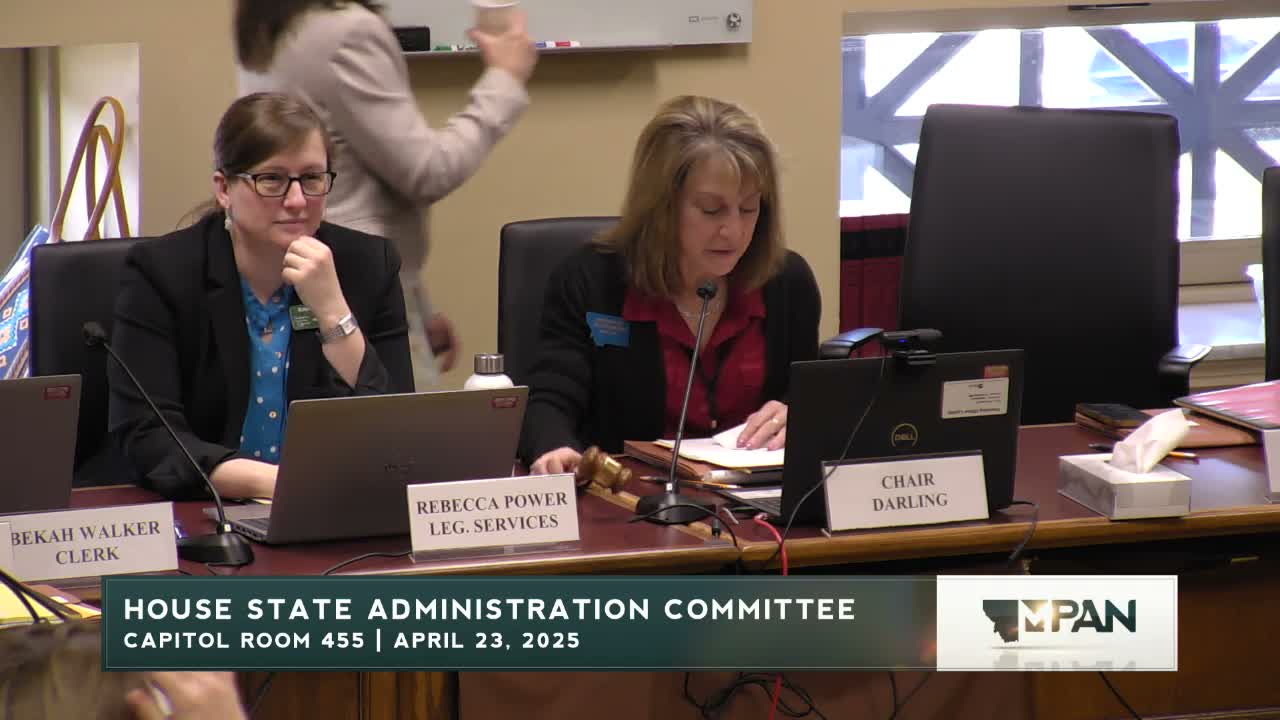
The House State Administration committee voted 19–0 to pass House Joint Resolution 69, a nonbinding resolution directing an interim study of how changes to federal funding could affect state programs including the Montana National Guard, DES, and education funding.
The House State Administration committee voted to pass House Joint Resolution 69, a nonbinding measure asking the Legislature to study how changes in federal funding would affect Montana state programs.
Representative Mark Lee, sponsor of the resolution, told the committee the study is meant to examine the ramifications of adjustments to federal funding across multiple agencies. "41% of Montana state budget is federal funding," Lee said, listing departments he said are heavily federally supported, including the Department of Military Affairs, Public Health and Human Services, Environmental Quality, Transportation and the Office of Public Instruction. Lee said the Department of Military Affairs budget is funded ‘‘20% by state dollars and 79% by federal dollars’’ and that more than 250 positions are fully or partially supported with federal funds.
The resolution would assign the study to the interim legislative finance committee, which Lee said would present findings to relevant interim policy and budget committees, including modernization and risk analysis and interim budget committees. Lee said the goal is to ensure the Legislature and the executive branch can respond quickly if federal support changes.
Representative Fern, speaking during questions, urged that the study account for recent large increases in some appropriations and raised concerns that specific programs might be cut at the federal level. Fern noted Starbase and the Youth Challenge program as examples, saying "the DOD's already talked about killing those," and asked whether the study would consider whether state entities such as the Office of Public Instruction or the Department of Justice would have to absorb those programs and costs if federal funding ends.
Lee responded that the draft study is intended to be "all inclusive" and to examine where replacement funding would come from and whether the state still wants to maintain programs if federal funding ceases.
After closing the hearing, the committee moved HJR 69 to a vote. A committee member moved that the resolution "do pass." The chair called for a voice vote; the clerk reported 19 ayes and 0 nos, with several members recorded voting by proxy (Representative Worth, Representatives Running Wolf and Smith were noted as voting aye by proxy). The chair announced the resolution passed.
The resolution is a directive for an interim study rather than a change in law or funding. The committee did not adopt any appropriations or binding policy changes at the meeting. The committee adjourned and the chair reminded members of a committee dinner that evening.