Get Full Government Meeting Transcripts, Videos, & Alerts Forever!
Get email alerts on the First Responders Property Tax topic
No spam. Unsubscribe anytime.
Committee hears bill to provide property‑tax relief for first responders injured or killed on duty
Summary
Representative Curtis Schomer introduced HB140 to provide property‑tax assistance to first responders injured in the line of duty and to surviving spouses; multiple law enforcement and firefighter organizations urged passage while some first responders and advocates warned the bill excludes volunteers and many EMS personnel.
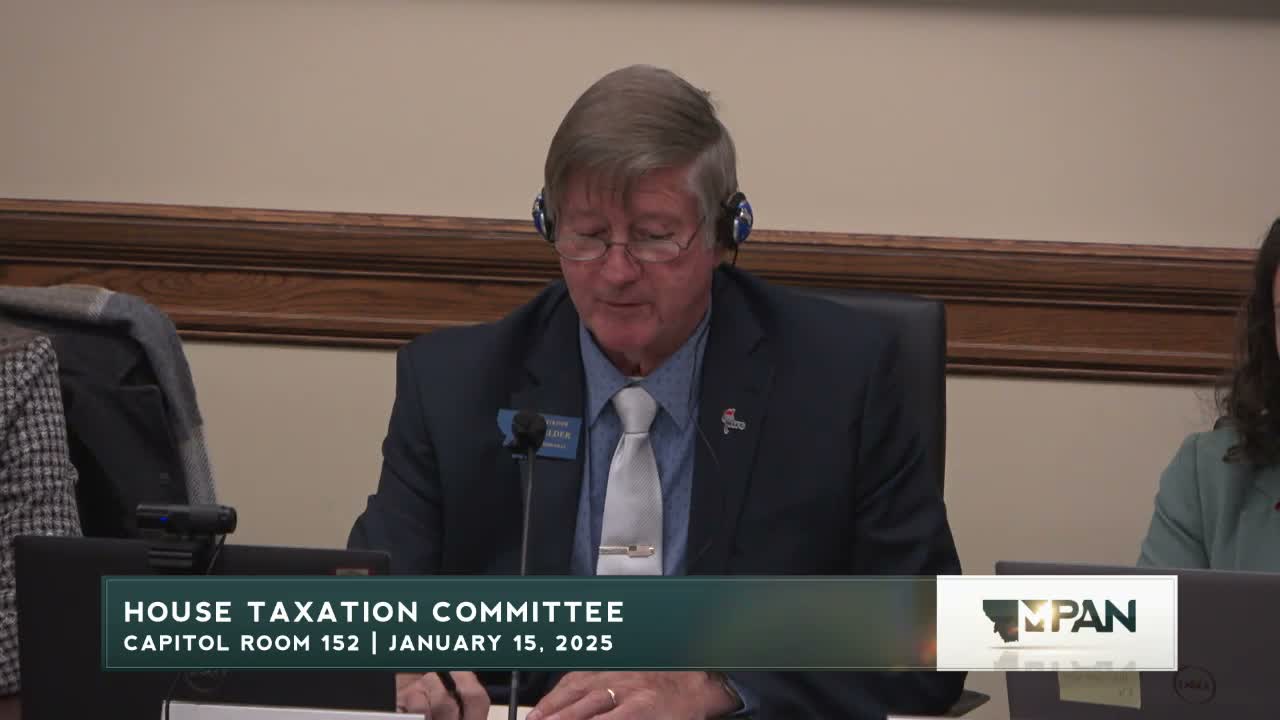
Representative Curtis Schomer opened the House Taxation Committee hearing on House Bill 140, saying the bill would provide property‑tax assistance for first responders injured or killed in the line of duty.
Heidi Paulson, whose husband was injured on duty, testified that line‑of‑duty injuries can cause sudden, severe income loss and that property‑tax relief would help families stay in their homes. "One thing that we can do to help lessen that burden is give them a bit of a break on their property taxes," Paulson said during her testimony.
Witnesses from law‑enforcement and fire organizations — including the Montana Police Protective Association, Montana State Firefighters Association, Montana Highway Patrol and the Montana Fire Alliance — emphasized the financial strain on families after injuries and asked for a do‑pass recommendation. Dan Smith of the MPPA said the association strongly supports the bill, and Chan Barry of the Montana Highway Patrol noted that troopers on disability may receive 50% of base pay, a partial retirement that can leave families with large financial gaps.
Several proponents and a retired officer described concrete impacts. Retired officer Clint Pullman said his household lost about $50,000 in annual income and reported his county property taxes rose from roughly $2,700 to more than $4,100 in recent years; he said the proposed relief would be "a really big help for our budget and my family."
Opponents acknowledged the bill’s intent but warned its definitions exclude many volunteers and EMS personnel. Audrey Martin, a 26‑year firefighter, said the bill’s language would exclude volunteer and wildland firefighters and the vast majority of EMTs and paramedics, and she cited statutory definitions that she said would leave more than 8,000 volunteer firefighters outside the measure’s coverage. Colt Barnard, who described a multigenerational family of first responders, similarly urged more inclusive language.
Paula Gilbert of the Department of Revenue — an informational witness — answered committee technical questions about application of the exemption. Gilbert said the exemption, as written, would apply regardless of market value, that a surviving spouse could retain the exemption so long as they meet the bill’s residency rule (7 months as the primary residence) and that a surviving spouse who purchases a different primary residence may still qualify if the residence timing meets the 7‑month rule.
Committee members pressed the sponsor on specific definitions (including park rangers and wildland firefighters employed by federal agencies). Representative Schomer acknowledged those concerns and said he would consider amendments to address coverage gaps and to align income thresholds with disabled‑veteran thresholds.
The hearing closed with the sponsor urging a do‑pass; the committee did not take executive action or a vote on HB140 at that session.