Get Full Government Meeting Transcripts, Videos, & Alerts Forever!
Get email alerts on the Pensions Overview topic
No spam. Unsubscribe anytime.
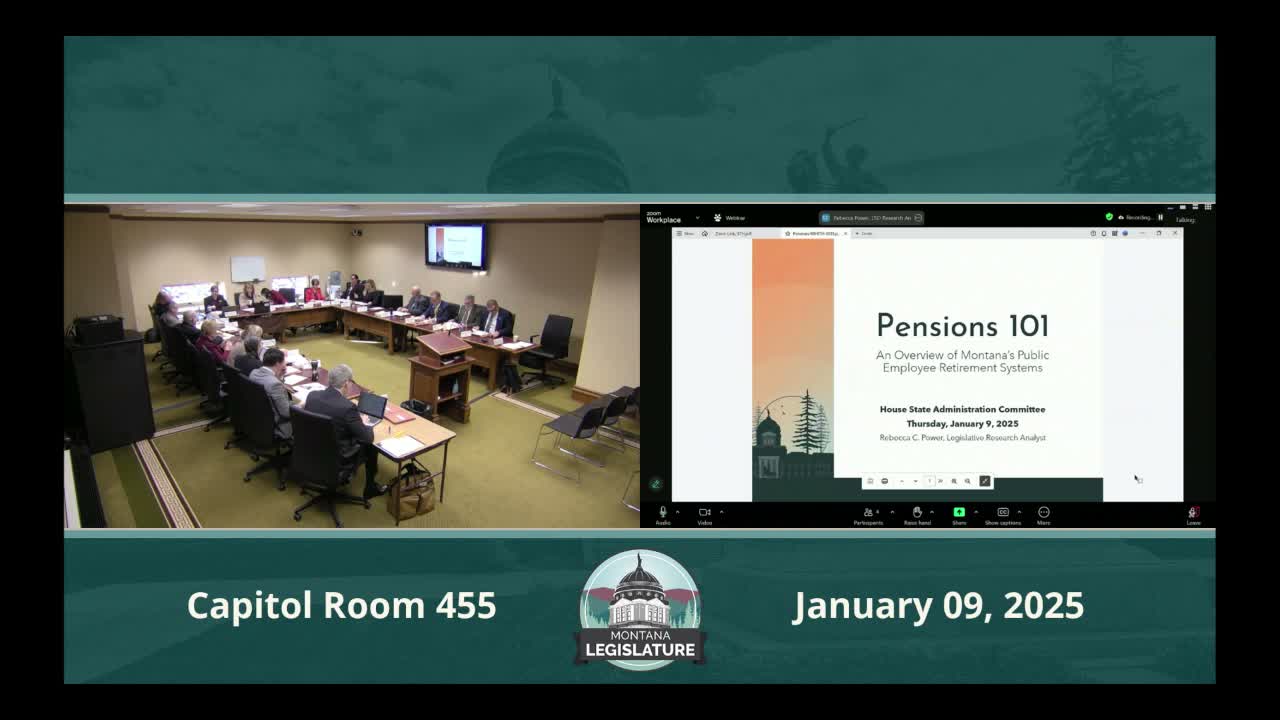
Montana House State Administration hears refresher on public pensions, funding and oversight
Summary
Committee received an overview of Montana's public pension systems: 11 statewide plans, FY24 assets of $17.1 billion, $4.6 billion in unfunded liabilities, and a 7.3% assumed return. Staff and agency directors outlined funding sources, performance metrics and the legislature's oversight role.
Madam Chair called the House State Administration committee to order and spent the morning reviewing the mechanics and fiscal posture of Montana's public employee retirement systems.
Rebecca Power, legislative staff, told members the state has 11 statewide public retirement systems (nine defined-benefit plans and two defined-contribution plans), with roughly one in 11 Montanans participating either as active members, retirees or beneficiaries. She said FY24 pension assets totaled $17,100,000,000 and that the systems carried about $4,600,000,000 in unfunded liabilities.
"These funds are protected by the constitution," Power said, citing Article 8, Sections 13 and 15, and she summarized the four primary funding sources: member contributions, employer contributions, statutory appropriations and investment earnings managed through the Board of Investments.
Power described the two basic plan types. Defined-benefit plans guarantee a formula-based monthly retirement payment funded by pooled trust assets and a mix of contributions and investment returns. Defined-contribution plans function more like private-sector 401(k)s, with individual accounts and investment risk borne by participants.
Directors from the leading pension administrators answered technical questions from legislators. Sean Graham, executive director of the Teachers' Retirement System (TRS), said TRS had about $5 billion in assets, was 74.2% funded as of July 1, 2024, and amortized in 21 years. William Hollahan, executive director at the Montana Public Employee Retirement Administration (PERS), said the PERS consolidated pension pool held roughly $7.3 billion for the PERS system, reported a funded ratio near 76% and amortized its liabilities in 27 years.
Both agency directors and Dan Villa of the Board of Investments emphasized the role of investment returns in the systems' health. Agency presentations noted FY24 market returns for pension pools above the assumed 7.3% rate (TRS market return reported at 8.89%; PERS consolidated pool at 8.94%), which improved funded ratios and shortened amortization periods in the most recent valuation.
Committee members asked how new hires choose between plan types and whether statutory constraints require legislative action when specific deadlines arrive. Hollahan described member education and a 12-month election window for PERS-covered employees deciding between DB and DC options. Graham said a statutory deadline tied to university-system supplemental payments (discussed separately during the TRS presentation) creates reporting and legislative decision points but does not automatically eliminate contributions absent legislative action.
The Chair closed the informational session by reminding the committee of upcoming bill hearings and that staff materials, green sheets and supplemental documents were available online for legislators.
The committee did not take formal votes during the session; presenters identified bills they expect to carry pension-related changes this session, and staff and agencies said they stand ready to provide detail to members as bill language is considered.