Get Full Government Meeting Transcripts, Videos, & Alerts Forever!
Get email alerts on the Transportation topic
No spam. Unsubscribe anytime.
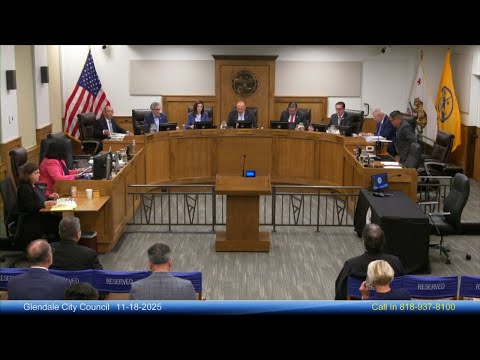
Council adopts 2025 Glendale Roadway Design Policy after extended safety and parking debate
Summary
Public Works presented and the council adopted a citywide Roadway Design Policy to standardize street design, prioritize safety and provide lane‑reduction feasibility criteria (16,000 ADT threshold); the item drew detailed Q&A about future traffic forecasting, neighborhood spillover and enforcement.
The Glendale City Council on Nov. 18 adopted the 2025 Glendale Roadway Design Policy, a consolidated framework Public Works said will standardize street‑design decisions, speed implementation of safety projects and guide lane‑repurposing feasibility analyses.
Public Works Senior Traffic Engineer Arik Harmandayan described the document as a living, context‑sensitive playbook for projects ranging from simple restriping to larger major‑reconstruction efforts. Among its elements, staff proposed a rule‑of‑thumb threshold: a four‑lane road carrying 16,000 average daily vehicles or fewer could be considered for lane reduction (a "road diet") and potential reallocation of lane space to protected bike lanes, parking, or pedestrian amenities. Harmandayan emphasized that the 16,000 figure is one criterion among many — collision history, peak flows and cut‑through traffic also factor into feasibility analyses.
Councilmembers probed how the policy accounts for planned development, future traffic forecasts and neighboring parallel streets. Staff said feasibility analyses will use current traffic counts tied to the time of design and will consider approved or pipeline projects where relevant; Public Works also noted it is preparing a longer‑range traffic model tied to the mobility element to inform future decisions. Pastor Casanova (principal traffic engineer) said the department will monitor spillover impacts and incorporate enforcement and education when projects are implemented.
Public commenters urged caution, saying community surveys ranked lane repurposing as a lower priority than pedestrian safety and that the document is long and technical; others asked for more benchmarking with other cities. Councilmembers asked for visual tools and simulations to accompany staff reports when projects come back for council consideration.
Vote: Council adopted the policy by roll call; staff said adoption requires no new funding and that the policy will be integrated into project development and permit processes.
Next steps: staff will incorporate the policy into project workflows, collaborate with fire and police on emergency access reviews, provide future benchmarking data on comparable cities on request, and use public engagement for significant corridor changes.