Get Full Government Meeting Transcripts, Videos, & Alerts Forever!
Get email alerts on the Land Use School topic
No spam. Unsubscribe anytime.
Santa Ana planning commission approves Cristo Rey high school campus at South Harbor Boulevard
Summary
The Planning Commission approved CUP 2025-22 to allow Cristo Rey Orange County High School to convert two office buildings at 3601 and 3611 South Harbor Boulevard into a professional high school campus; staff cited adaptive reuse, parking controls, and CEQA infill exemptions; commissioners pressed the applicant on safety, parking and the school model.
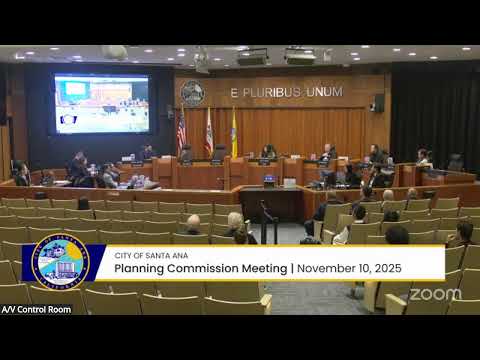
The Santa Ana Planning Commission voted to approve Conditional Use Permit (CUP) 2025-22 on a majority vote, allowing Cristo Rey Orange County High School to establish a professional-school campus in two existing office buildings at 3601 and 3611 South Harbor Boulevard.
The motion to approve was made by Vice Chair Benninger and seconded by Commissioner Wu. The roll-call recorded "aye" votes for Commissioners Escamilla, Wu, Vice Chair Benninger and Chair Ramos; the motion was announced as approved by majority vote with Commissioners Leo and Oliva noted as absent.
Staff and the applicant presented the project as an adaptive reuse of an underutilized office campus. Case planner Nancy Tran told the commission the site is approximately 9 acres, with roughly 1.4 acres proposed for school use. The project would repurpose second-floor space in two buildings to create classroom, counseling and common areas, add covered exterior stairways, a six-foot perimeter picket fence, outdoor recreation including basketball courts and shade structures, new trash enclosures and landscaping (46 new trees).
Tran also summarized operational controls included in the conditions of approval: a traffic and parking management plan, queue-stacking measures for drop-off and pick-up, and a limit on student parking permits. Staff concluded the project is consistent with the land-use element and is exempt from further environmental review under CEQA sections 15332 (Class 32, infill) and 15301 (Class 1, existing facilities/alterations).
The applicant, represented by founding president Steve Holti, said Cristo Rey has operated for three years at a temporary site and needs space to expand. "We're out of space to educate our students," Holti told the commission, describing a corporate work-study model that pairs students with more than 60 local employers and offsets tuition through paid internship work. Land-use consultant Patrick Strader framed the project as economic stabilization of a largely vacant office campus and said technical studies, including a health-risk assessment, were provided to support staff findings.
Operational details provided in the hearing: the campus would ultimately accommodate up to 500 students in grades 9–12 and employ as many as 90 staff at full build-out; staff projected an enrollment ramp to about 430 students by the 2029–30 school year. The site contains 489 shared parking spaces; staff said the school use requires 187 spaces and the conditions of approval limit student parking permits to a maximum of 115.
Commissioners pressed both staff and the applicant on compatibility and safety. Commissioner Pham asked whether the commission should treat the use as a trade school or as a traditional high school given the presence of minors; staff and the applicant said the project was reviewed as a professional school because of the corporate work-study component and noted schools typically adopt security plans and other operational safeguards. Commissioner Escamilla asked about the fence alignment and who would maintain landscaping; staff said the school would maintain the landscaping and property and that fence placement was revised to meet public-works sight-distance requirements.
Commissioner Wu challenged the applicant to explain its presence in Santa Ana and emphasized local dignity and investment. Holti responded that Cristo Rey is an independent school that receives little public money, that the model is designed to develop students' workforce skills, and that tuition is offset by student earnings through work-study placements. "Our students are a huge investment," Holti said.
Two Cristo Rey students addressed the commission during public comment. Freshman Frank Velasco described lab and hands-on experience gained through the work-study placements and urged support for a campus with adequate classrooms and science labs; junior Amalia Rodriguez said improved facilities would benefit the school's founding class and about 200 current students.
With the CUP approved, staff noted that recommendations on planning matters will be forwarded to City Council for final determination where applicable, and the project will proceed under the conditions the commission adopted.
Note: The commission record includes CEQA exemptions (sections 15332 and 15301), parking limits (489 sitewide spaces; 187 required for the school use; student parking permits capped at 115), and project build-out projections (up to 500 students; phased enrollment to about 430 by 2029–30).