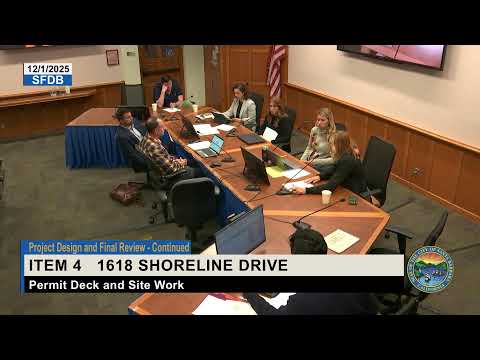
The Santa Barbara Single Family Design Board on Dec. 1 continued review of a proposal to add a private backyard pickleball court at 45 La Salterra Circle after neighbors testified that the plan could harm neighborhood quiet and hillside stability.
At a conceptual hearing, applicant representatives said the court would sit near the bottom of the property outside required setbacks, require about 100 cubic yards of grading and two small eucalyptus trees would be removed and replaced with evergreen screening (three olive trees plus three sycamores). Landscape architect Stacy Isaac told the board the design would use two 4‑foot retaining walls with a 6‑foot fence on top and no court lighting; she said the team would consider acoustic panels that the applicant said can reduce sound by about 32 dBA and would provide a formal acoustical study at a later review stage.
Neighbors packed the hearing to oppose the project. John Krueger, whose home at 1052 Los Alturas Road sits roughly 75 feet from the proposed court, asked the board to require “an acoustical study using modern standards and best practices by an acoustical engineer” and requested drone photos and a condition denying future pathway or court lighting. Janet Krueger and Helena Hill urged a geotechnical soils report because they said Rincon shale and observed runoff and past slides make the lower site unstable. Helena Hill said the house’s studio windows are about 70 feet from the corner of the court and that single‑pane windows provide limited protection from outdoor sound.
Neighbor Gary Hill submitted literature and told the board that pickleball is an impulse, high‑frequency noise that can be especially intrusive; he urged much larger setbacks and said secondary retrofit measures alone are insufficient when a court is near frequently used rooms. Other neighbors urged masonry walls or denser screening rather than chain‑link fence. Residents who supported the court noted that municipal courts exist nearby and urged the board to evaluate whether a single residential court would cause the same impacts as larger public courts.
Owner Drew Finley, calling in from New York, said the family intends to be respectful of neighbors and noted the owners had previously taken mitigation steps for pool equipment. The applicant reiterated that the court would be used during daytime hours only and that the intent was a private family court rather than a commercial or municipal facility.
Board members repeatedly noted their limited jurisdiction — design compatibility rather than land use — but said the packet lacked sufficient technical evidence to make the required public‑health, safety and welfare finding. Vice Chair Sherry said she would be able to support the project only if an acoustical report showed that, with mitigation, noise at the property lines would meet acceptable standards. Chair Lewis recommended staff research other nearby residential courts and their permitted setbacks for comparison.
Action: the board voted unanimously to continue the item to the full board and to require the applicant to submit an acoustical report addressing frequency and decibel levels at the property line, to propose acoustic panels or other sound screening plus dense screening planting, and to provide data about nearby permitted courts and their distances to neighboring residences. Staff also noted that final, appealable decisions would not be made at the conceptual stage.
Next steps: the applicant will provide the acoustical analysis and revised plans for the full board hearing. The board and staff flagged geotechnical concerns voiced by neighbors as items the applicant should address through required civil and site engineering reviews during later stages of the process.