Get Full Government Meeting Transcripts, Videos, & Alerts Forever!
Get email alerts on the Parks Pickleball Noise topic
No spam. Unsubscribe anytime.
Tucker council pauses Recreation Center bid after consultants say proposed pickleball plans could require massive noise barriers
Summary
After a detailed acoustic study, consultants told the City of Tucker that the Tucker Recreation Center layout would need tall, wide barriers or other extreme mitigation to meet a conservative 52 dBA target at nearby homes. Parks staff recommended pausing the construction bid; council voted to delay bidding and gather more public input.
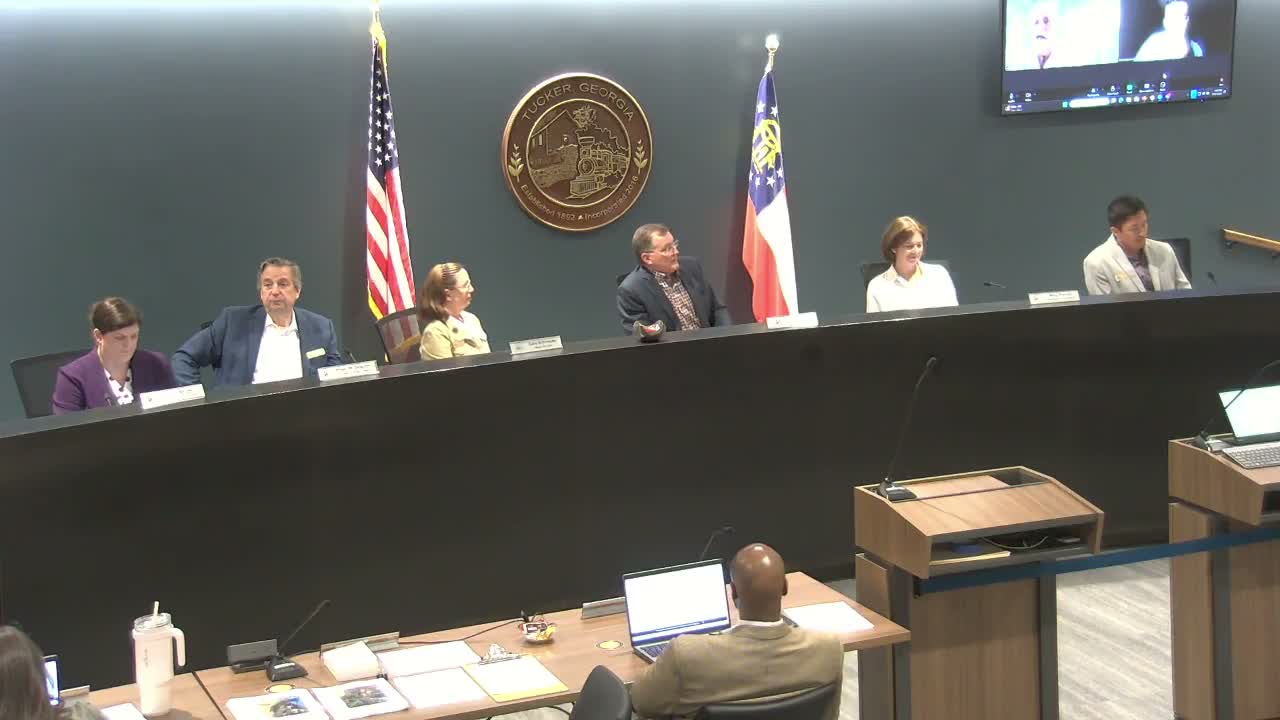
The City of Tucker on Sept. 22 paused plans to seek construction bids for sound mitigation tied to a proposed multi-sport expansion at the Tucker Recreation Center after hearing a technical study that warned the site could require very large barriers to limit pickleball noise for nearby homes.
Consultants from Pickleball Sound Mitigation (PSM) presented acoustic modeling for three proposed court zones at the recreation center and two alternate park sites, concluding that the 10-foot partial barriers in the May 2025 design would not meet the study's residential target. Braxton, a PSM consultant and professor, said the firm uses LAFmax (instantaneous peak levels) rather than long-term averages because pickleball creates short impulsive strikes that stand out against quiet backgrounds: "we're looking at the loudest pickleball hit of the loudest player" and recommended a conservative limit of ambient plus 3 dB (about 52 dBA) at residences to reduce community annoyance.
Why it matters: PSM found that at the Tucker Rec Center some receiver positions could predict levels well above that 52 dBA target unless barriers were substantially taller or extended around courts. The firm modeled reflective and absorptive panels at 12, 14 and even 16 feet and said some extreme cases still exceeded target levels; it also recommended reorienting or reducing courts in some zones and noted tradeoffs (rotating courts can reduce noise in one direction but increase it in another and can create sun-glare issues for players).
Parks staff told the council that, besides acoustic performance, fully enclosing courts with opaque mitigation materials would create safety and liability concerns because sight lines and sideline visibility would be impaired. Rep ( parks staff) told the council staff "recommend not moving forward with this project" as designed; Mayor (unnamed in the transcript) moved to instruct the city manager not to proceed with the current bid instructions and to hold a public information open house on Sept. 29 that would include concept-level alternatives for Henderson and Rosenfeld parks. The motion was seconded and passed (6 in favor, 1 opposed).
PSM also examined other park sites. Dale, a PSM consultant, described Henderson Park as acoustically favorable — greater setback, elevation differences and tree cover mean barriers are not required to achieve a 50 dBA target — while Rosenfeld Park is far more constrained, with homes as close as about 40 feet; at Rosenfeld PSM said even 16-foot absorptive barriers could fail to reach the more conservative 50 dBA target.
What the council directed next: Council agreed to pause soliciting construction bids tied to the May 2025 mitigation layout, proceed with the public open house next Monday for broader community input, and have parks staff prepare concept alternatives (including relocating or resizing courts, equipment choices and possible building/enclosure options) for follow-up council consideration.
A note on mitigation options: PSM said quieter paddles and different balls can reduce LAFmax by as much as about 9 dB in laboratory testing, and that design choices such as barrier height, continuous enclosure (roof + sides), court orientation, and limiting court count in particular zones can materially affect predicted noise at residences. The study drew on a previous long-term logger dataset by Arpeggio and the May 2025 court plans supplied by the city.
The council's action does not cancel pickleball projects citywide but pauses the current bid path for the Recreation Center component to allow more public engagement and alternative concepts to be evaluated.
Next steps: staff and PSM will present findings at the Sept. 29 public information meeting; the council will review concept-level alternatives and may reissue a bid only after further direction.