Get Full Government Meeting Transcripts, Videos, & Alerts Forever!
Get email alerts on the Comfort Dog Policy topic
No spam. Unsubscribe anytime.
Uxbridge School Committee: dog program to proceed after plan, policy work
Summary
After a long discussion about a school-based comfort dog called Cash, the Uxbridge School Committee asked the superintendent to write an annual implementation plan and referred the draft policy back to the policy subcommittee to address allergies, opt-outs and operational details.
The Uxbridge School Committee on April 15 took the first formal steps toward integrating a comfort/therapy dog into district schools, directing the superintendent to produce a written implementation plan and asking the policy subcommittee to rework the draft policy before a formal second reading.
Committee members spent the evening weighing potential benefits — including reading programs and crisis de-escalation — against practical concerns such as student allergies, inclusion and daily handler responsibility. The committee’s direction was procedural: keep a light-touch policy umbrella and require the superintendent to create an annual plan that sets day-to-day practices, vaccination and insurance proof, opt-out procedures and routines for when the handler is absent.
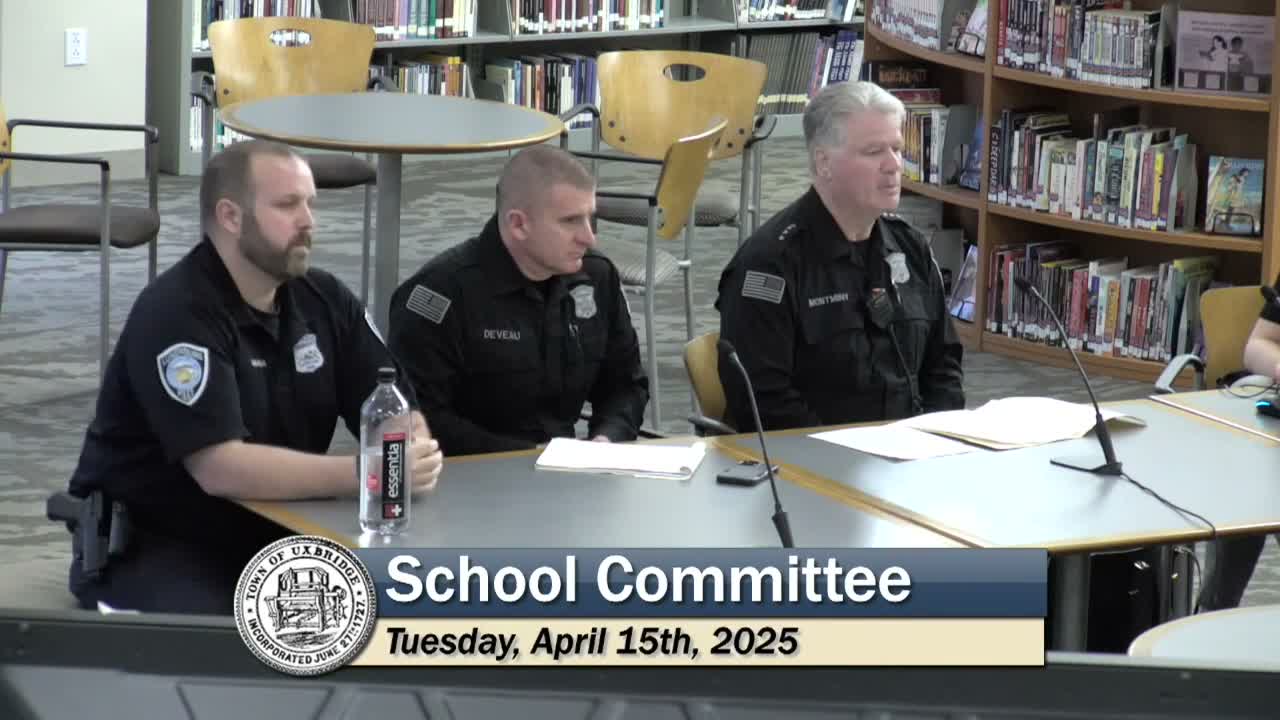
The discussion drew on examples from neighboring districts. Committee members and police partners described Lunenburg’s model and an existing memorandum of understanding that spells out roles between a police department and schools. A police representative told the committee the town had negotiated an MOU and had arranged insurance and veterinary checks for the dog; administrators said they would circulate the MOU and a sample policy for further review.
Administrators and police partners emphasized who would be responsible for the animal at any time. The committee requested clearer procedures for backup care and for situations in which the SRO or handler must leave the building. Members also required an opt-out process for families and explicit accommodations for students with severe allergies; staff agreed to include those items in the superintendent’s plan.
On operational points, the committee asked that the implementation plan address where a dog may be off-leash in controlled spaces (for example, a designated counseling room versus general-population areas), transportation and vehicle-kennel safeguards, and the mechanism by which principals may restrict the dog’s presence on specific days. Administrators and police partners said they would share the Lunenburg/Bloomberg model policy and their MOU for the committee’s review.
Next steps: the committee referred the draft policy back to its policy subcommittee with explicit direction to (1) remove unnecessarily prescriptive details from the policy handbook and (2) require the superintendent to provide a plan listing procedures, opt-out processes, vaccination and insurance verification, backup/trusted handlers, and a three-month post-launch review for the specific dog. The subcommittee will reconvene with police and administrative staff to produce the revised policy and the superintendent’s plan for committee review.