Get Full Government Meeting Transcripts, Videos, & Alerts Forever!
Get email alerts on the Bridges topic
No spam. Unsubscribe anytime.
Lawmakers hear MDOT briefing as agency warns aging bridges and limited funding risk closures
Summary
MDOT told the Appropriations Subcommittee that Michigan’s bridge inventory is aging, inspections and new federal data rules require substantial work, and limited state/local funding will leave hundreds of local bridges competing for roughly $50 million a year.
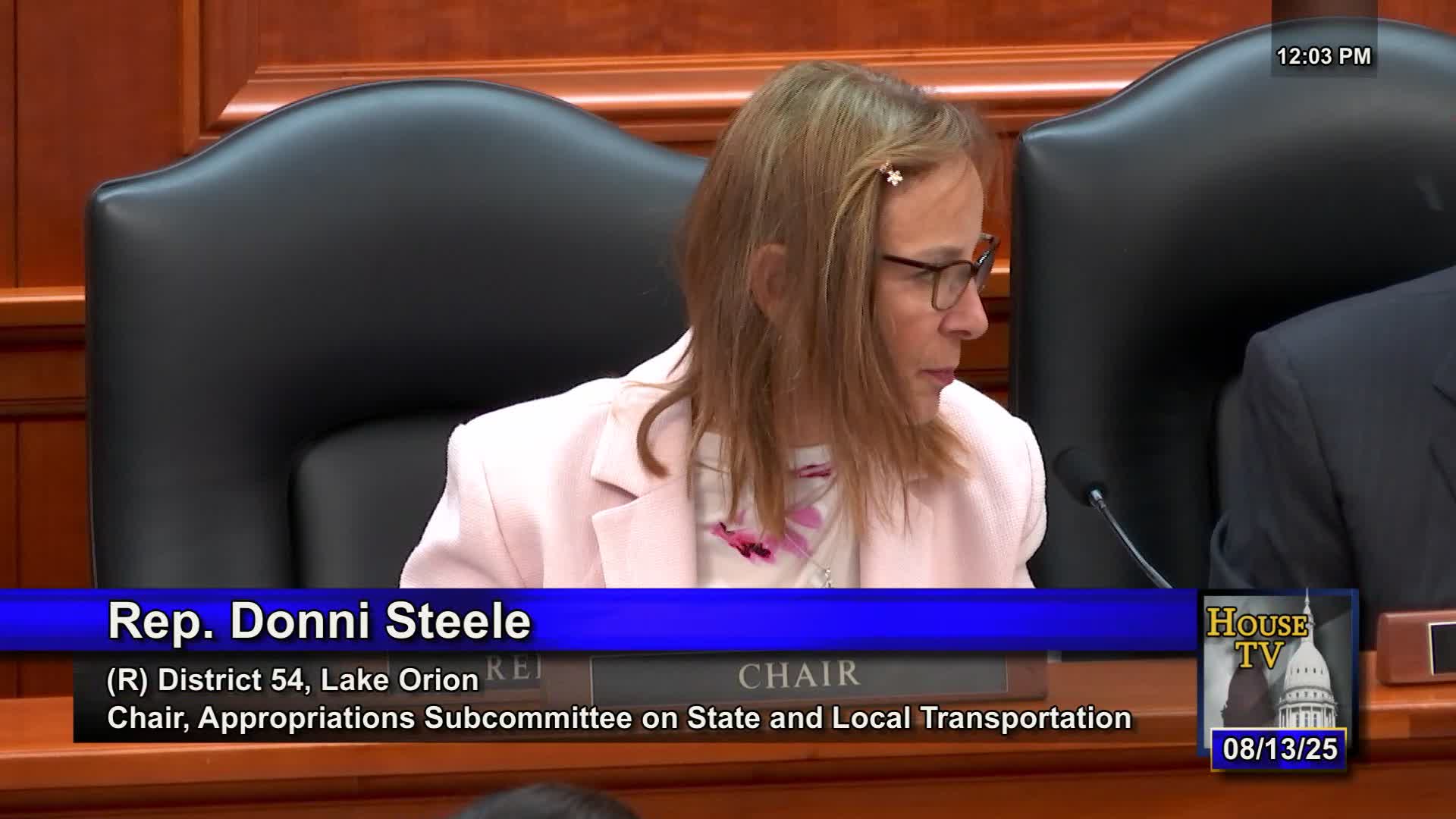
Members of the state Appropriations Subcommittee on State and Local Transportation heard a detailed briefing from the Michigan Department of Transportation on Dec. 5 about the condition, funding and delivery of bridge projects across the state.
Rebecca Curtis, director of the Bureau of Bridges and Structures at MDOT, told the committee the agency is balancing preservation and replacement across more than 11,000 bridges and that an aging trunk‑line inventory, inflation and limited local funds increase the risk of future closures. "We were successfully awarded a $34,000,000 grant," Curtis said, describing how MDOT used a bridge‑bundling approach to fund additional urban replacements. "The local bridge program is about $50,000,000 a year," she added, noting that annual applications typically total $400–$500 million.
Curtis outlined how bridges are scored and prioritized, saying components (deck, superstructure and substructure) are individually rated and the overall condition is the lowest component score. She described typical intervention costs, saying preventive work averages about $200 per square foot and major replacement roughly $725 per square foot, and warned that deferring work will drive higher costs and closures.
The presentation flagged a compliance challenge from new federal data requirements. Curtis described updates to the National Bridge Inventory and National Bridge Inspection Standards that add a routine‑permit‑load inventory item; many local owners lack recent load ratings and MDOT has proposed a five‑year assistance program with the County Road Association to reload‑rate local bridges and collect the required data.
Committee members asked how bridge costs are tracked inside larger highway projects; Curtis said MDOT tracks bridge‑specific work types and starts with an approximate $220,000,000 bridge budget that shifts as projects are selected. She also described innovations MDOT is using to lower costs and improve outcomes, including 3‑D digital delivery, self‑consolidating concrete and geosynthetic‑reinforced soil abutments, which the agency says can reduce costs by about 20% for some work.
Curtis urged action to avoid a wave of closures: MDOT’s analysis shows just over 100 trunk‑line bridges at risk of closure in roughly 10 years and about 1,200 at risk in 20 years unless investments increase. She summarized partial funding sources for inspection and NBIS compliance — unused CRRSAA funds, August redistributions and a proposed use of surplus in the movable‑bridge fund — but said some amounts remain uncertain and would require legislative or administrative action.
The committee recorded one formal, noncontroversial action during the meeting: Representative Robinson moved to adopt the July 30 minutes, and the motion "prevailed by unanimous consent." The session ended with members asking for follow‑up briefings on bundle selection, local collaboration and specific project accounting as the subcommittee reviews budget proposals.
Next steps: MDOT and the County Road Association plan further coordination on a procurement and assistance plan for NBIS compliance; the subcommittee resumes budget deliberations as the legislature considers allocations for bridge inspection and capital work.