Get Full Government Meeting Transcripts, Videos, & Alerts Forever!
Get email alerts on the Erosion Control topic
No spam. Unsubscribe anytime.
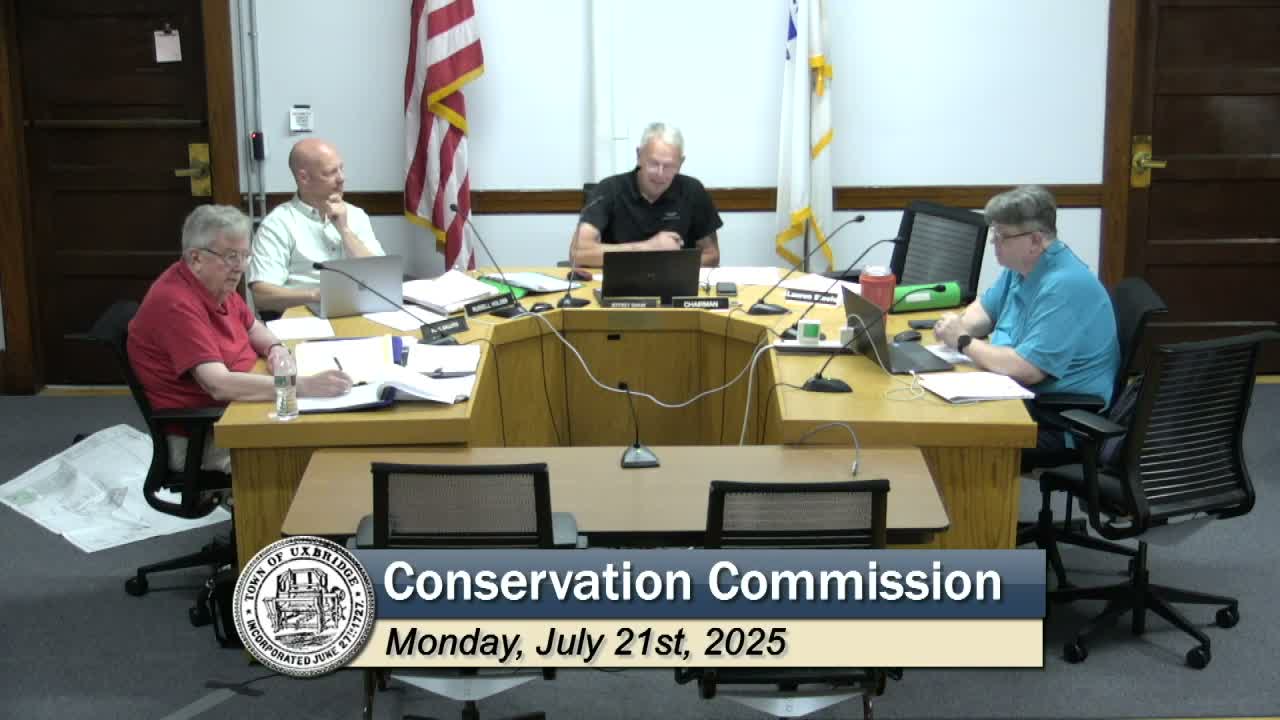
Conservation commission denies Certificate of Compliance for 295 Crown Shield over slope stabilization and marker concerns
Summary
The Uxbridge Conservation Commission voted to deny a Certificate of Compliance for DEP/ZEP 3121165 (295 Crown Shield, Lot 43A), citing an ungrassed slope, obscured phenospikes and lack of permanent stabilization; applicant may reapply after corrective work and visible growth.
The Uxbridge Conservation Commission voted to deny a Certificate of Compliance for DEP/ZEP file 3121165 for 295 Crown Shield Avenue, Lot 43A, after commissioners concluded the site does not match the permit-specified grassed slope and required buffer markers are not visible. The motion to deny carried on a voice vote with no recorded opposition.
The applicant's engineer, John Federico of Gerrier and Helmand, told the board that most work was within the approved disturbance zone and that three phenospikes had been installed along the 100-foot buffer. Federico said plantings were ‘low-growing shrubs’ and that the rip-rap slopes were intended to stabilize areas where proposed contours tied to existing steep grades. Federico also offered to notify the applicant to re-expose markers if they had become obscured.
Commissioners pressed for visible, long-term stabilization rather than temporary measures. “That is not a permanent stabilization,” said Speaker 1 (Unidentified commission member), referring to stump grindings and piles of mulch. Speaker 3 (Unidentified commission member) added that phenospikes must be clearly marked and visible before he would vote to approve: “we need to be marked with signs before I’ll vote for yes.”
Board members discussed acceptable remedies: regrading to a grassed slope or hydroseeding with straw and two growing seasons of coverage (the commission cited a 70–75% coverage metric used for acceptance), installing more substantive plantings (e.g., junipers), terracing, and permanent erosion-control features. Commissioners said stump grindings and loose mulch are not an adequate long-term solution and encouraged the applicant to return with a remedial plan and evidence of established vegetation growth.
The denial is procedural: staff confirmed an applicant may reapply for another COC after corrective actions. Speaker 6 (project engineer) was advised to coordinate with the applicant and submit amended plans and photos documenting growth and any additional signage or marking of buffer spikes prior to resubmission.
Next steps: the applicant may reapply with a corrected stabilization plan and visible markers; the commission asked that any corrective action demonstrate substantial growth or permanent measures before reconsideration.