Get Full Government Meeting Transcripts, Videos, & Alerts Forever!
Get email alerts on the Elections topic
No spam. Unsubscribe anytime.
House committee reports resolution pressing Michigan secretary of state to provide qualified voter file data
Summary
The House Committee on Election Integrity voted 6–3 to report House Resolution 196, which urges Michigan Secretary of State Jocelyn Benson to provide qualified voter file information to the U.S. Department of Justice amid a dispute over redaction and voter privacy.
Representative Fox brought House Resolution 196 to the committee, urging action after what he described as the secretary of state’s refusal to provide unredacted qualified voter file (QVF) information requested by the U.S. Department of Justice. The committee voted 6–3 to report the resolution with recommendation.
Fox told the committee that multiple entities, including the House Republican caucus, have sought access to QVF data to "ensure election integrity in 2026 and beyond by verifying that legal citizens of Michigan and only legal citizens of Michigan are eligible to vote." He named Secretary of State Jocelyn Benson and said her office had declined to supply unredacted data to DOJ. "Who does she think she is to defy federal law enforcement," Fox said during his testimony.
The committee’s debate focused on competing claims about voter privacy and legal authority. Representative Wooden questioned whether state law and the Federal Privacy Act bar the sharing of personally identifiable information such as Social Security numbers and driver’s license numbers and noted that Benson had redacted those fields when sharing data with DOJ. "The Federal Privacy Act also limits what the Department of Justice can request," Wooden said, adding that Michigan provided a statewide voter registration list "excluding personal information" on Sept. 2.
Fox and other supporters argued DOJ has long-used measures to protect identity and confidentiality and that those protections could be applied here. Supporters framed the resolution as a tool to compel cooperation and to press for accurate voter rolls; opponents emphasized statutory privacy limits and federal restrictions on the DOJ’s ability to obtain certain personal data without a warrant or individual authorization.
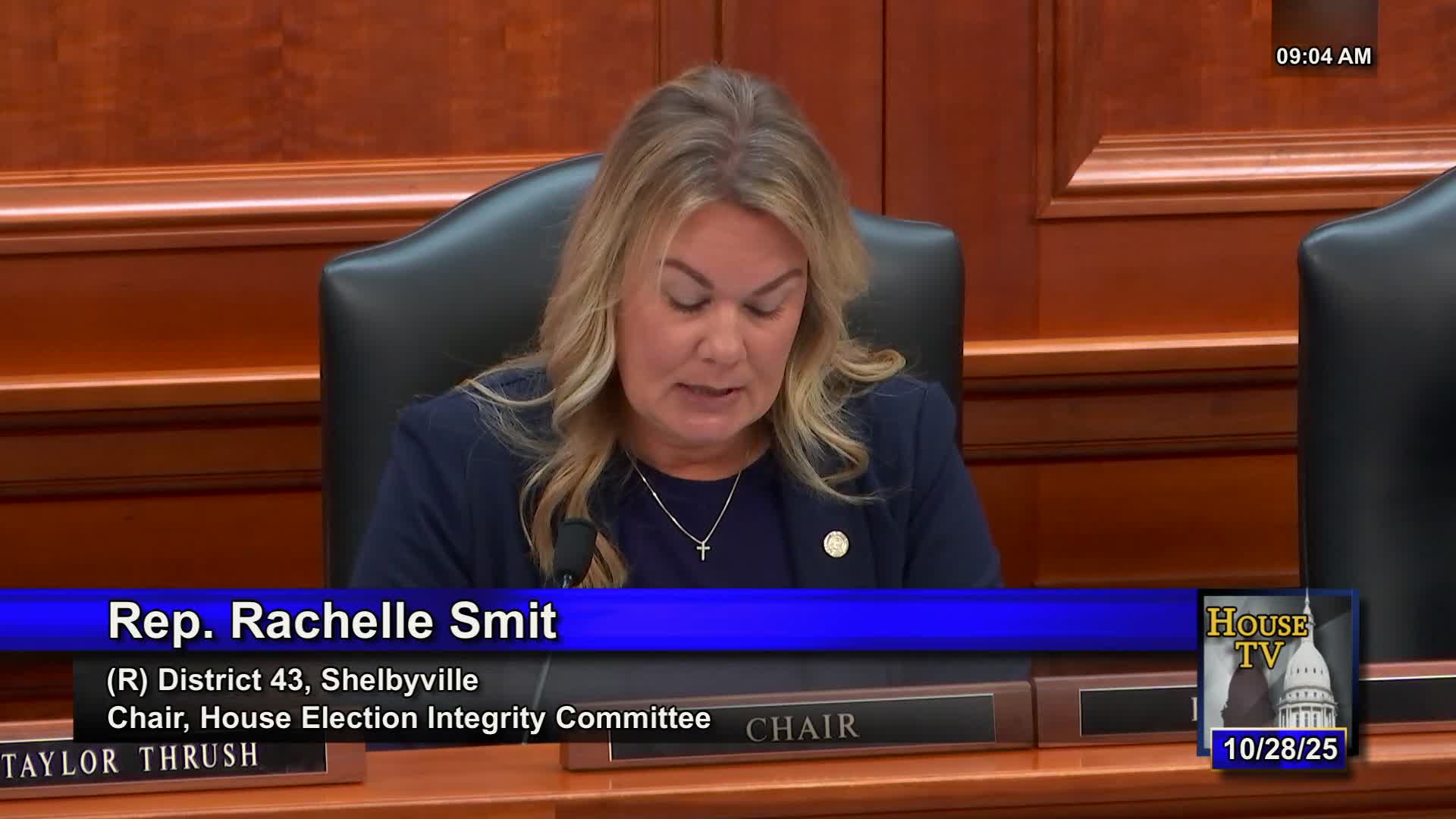
Representative Hoadley moved that the committee report House Resolution 196 with recommendation. The clerk recorded six yeas (Chair Smith; Representative Fox; Altman/Outman; Alexander; Hoadley; Pablo) and three nays (Wooden; Colzard; Song). The motion prevailed and House Resolution 196 was reported with recommendation.