Get Full Government Meeting Transcripts, Videos, & Alerts Forever!
Get email alerts on the Family Court Safety topic
No spam. Unsubscribe anytime.
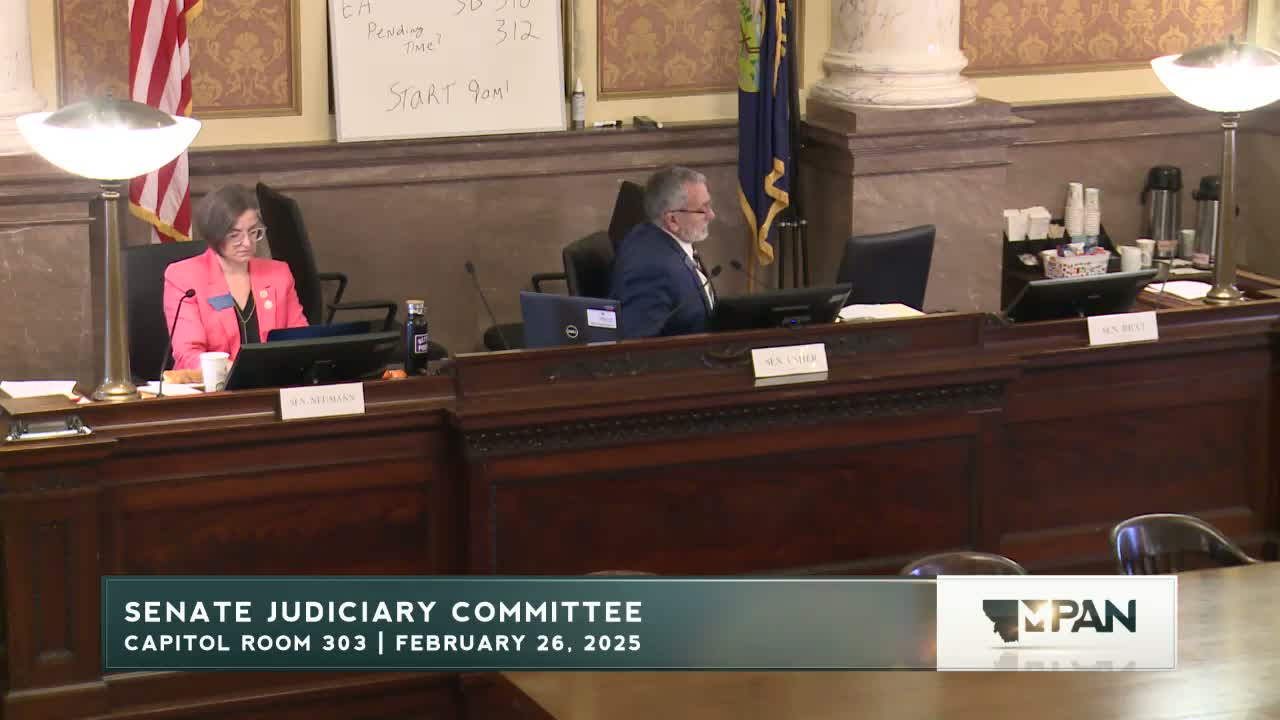
Montana Judiciary Committee hears emotional testimony on 'Brodie/Bridal' child‑safety bill
Summary
Proponents described patterns of post‑separation abuse and urged mandatory, trauma‑informed training for judges and other court professionals under SB 3‑18; opponents raised concerns about judicial authority and access to guardian ad litem services. The committee closed the hearing without an immediate vote.
Senate Bill 3‑18, described repeatedly by witnesses as “Brodie” or “Bridal’s Law,” drew hours of emotional testimony in the Senate Judiciary Committee hearing on its aim to strengthen protections for children in family‑court custody cases.
Sponsor Senator Lenz introduced the bill as a coalition effort by victims' advocates and family‑court reform groups to close “loopholes” in existing custody law that, he said, let abusive parents exploit parenting plans and place children at risk. “This bill…strengthens the ability of the courts to recognize and adjudicate domestic violence and child abuse allegations,” the sponsor said in opening remarks.
Why it matters: Proponents said the bill would make child safety the priority in custody disputes by requiring trauma‑informed, culturally appropriate training for judges, standing masters and other court professionals; tightening standards for expert testimony; and creating clearer avenues for courts to consider evidence of past abuse. Multiple witnesses described cases in which court processes led to prolonged litigation, lost custody or, in a handful of instances recounted here, child suicides. “We cannot afford to lose any more,” said Kyla Hailstone of the Montana Family Court Awareness Project, citing state filing statistics and adverse childhood‑experience data to argue for a systemic change.
Testimony and claims: Survivors and advocates gave first‑hand accounts of parents who said courts treated children as “property” or ignored evidence of abuse. Elizabeth Peterson warned against the use of the disputed concept “parental alienation,” calling it a “pseudo concept” that can obscure patterns of abuse. Several speakers referenced the loss of a young person named Brody (spoken of here as “Bridal” in testimony) to argue urgency for reform. Attorney Joseph Rafiani and other legal witnesses supported the need for judicial education on trauma dynamics, saying better‑informed judges are “essential for ensuring fair and just outcomes.”
Opposition and constitutional concerns: The Montana Judges Association and the State Bar, represented by Bruce Spencer, limited its objection to Section 2, which would prescribe training requirements. Spencer said Article 7, Section 2 of the Montana Constitution vests the Supreme Court with authority over court regulation and that a legislative mandate for training may exceed the legislature’s authority; he urged petitioning the Supreme Court instead. “Under Article 7 Section 2…the Supreme Court is the sole entity in charge of regulating the court system in Montana,” Spencer told the committee.
Access and capacity concerns: Several opponents — including social workers and local family‑law attorneys — argued the bill’s requirement that guardians ad litem be licensed attorneys could shrink the pool of available GALs, particularly in rural counties, increase costs for litigants, and slow access to representation. Emily Christ, a social worker who also serves as a GAL in some cases, said limiting GALs to attorneys could “negatively impact families who need access to these services” and would further burden an already strained system.
Committee questioning and potential changes: Committee members pressed proponents on specific lines — for example, one provision that could create a vacancy if a judge fails to complete required training — and asked whether the bill’s language would bar evidence now used in civil protection orders. Proponents said the bill focuses on establishing patterns (including repeated frivolous protection orders) rather than relying solely on convictions, and said it would not bar scientifically supported reunification therapy.
Where it stands: The hearing on SB 3‑18 closed after extended testimony and questioning; the committee did not take a final committee vote on the bill at this session. The sponsor said he would work with committee members on amendments and follow‑up, and the chair noted possible further scheduling and amendment deadlines.
What proponents said (representative quote): “SB 3‑18 is a pivotal step forward in recognizing the adverse traumatic experience Montana children suffer,” Kyla Hailstone testified.
What opponents said (representative quote): “It has to go through a petition to the Supreme Court — not a bill in front of the legislature,” Bruce Spencer said, summarizing his constitutional objection to the training mandate.
Next steps: The committee closed the hearing and proceeded to other agenda items; sponsors and opponents indicated a willingness to negotiate amendments on the GAL and training provisions.