Get Full Government Meeting Transcripts, Videos, & Alerts Forever!
Get email alerts on the Zoning Chickens topic
No spam. Unsubscribe anytime.
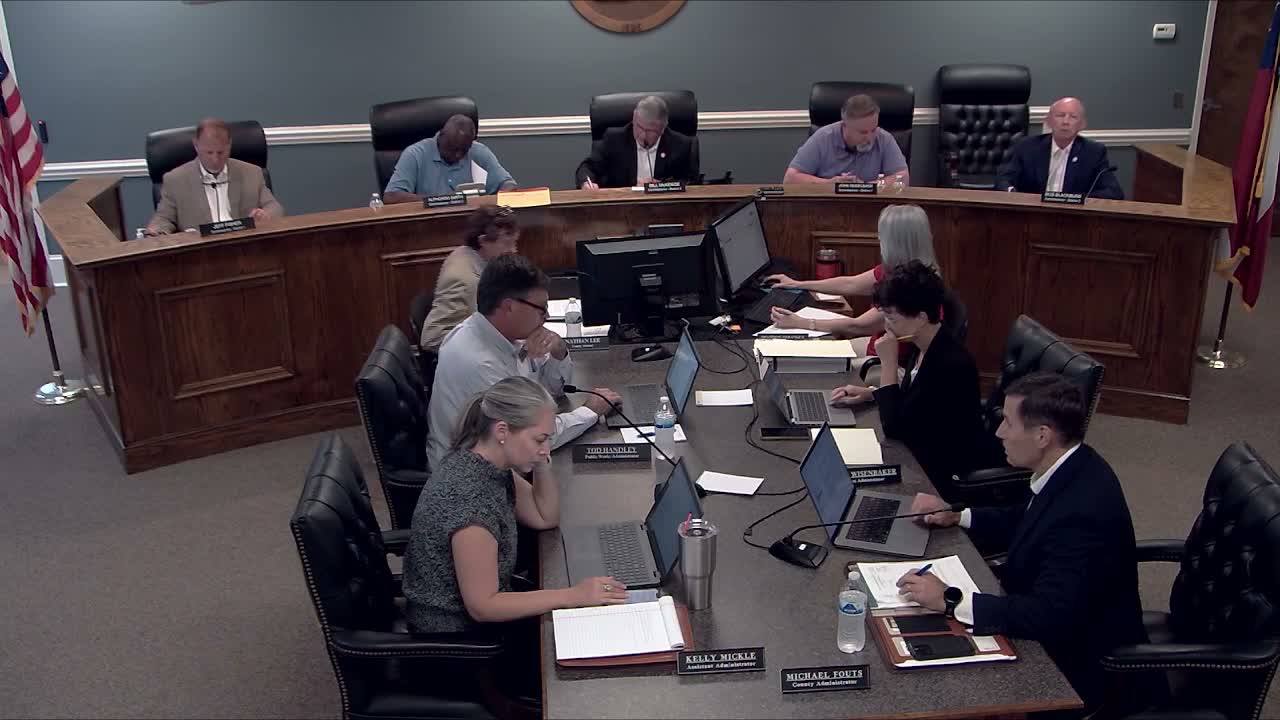
Coweta commissioners approve amendment allowing backyard chickens on half‑acre lots with limits
Summary
The Coweta County Board of Commissioners on July 1 approved an amendment to Appendix A of the county zoning code to allow noncommercial backyard chickens on lots of at least a half acre, with setbacks, sanitation rules and a limit of one rooster per premises; the change removes a conflicting setback sentence and defers to homeowners associations where applicable.
The Coweta County Board of Commissioners voted July 1 to amend Appendix A of the Coweta County Code of Ordinances to permit noncommercial backyard poultry on smaller, platted lots and to set new minimum setbacks and sanitary requirements.
County planner Mr. Amison presented the measure, saying the amendment is aimed at residents on smaller lots who want to raise eggs for household use. "We're proposing that the minimum lot size be a half acre," he told the board, adding that "no building permit will be required" for typical chicken coops and that structures "should be no closer than 30 feet from the property line or 50 feet from adjacent houses." The draft initially prohibited roosters; staff and several commissioners recommended revisions after public comment.
The proposal requires coops and runs to be located in rear yards, kept neat and sanitary, and requires feed to be stored in fully enclosed, rodent‑proof containers. Staff recommended removing the word "medication" from the rodent‑proofing language to avoid unintended implications for residents. The amendment also states that private covenants (HOAs) will govern where they apply.
Members of the public gave mixed input during the hearing. Nicole Deshue, a 4‑H alumna, asked why the draft mentions only chickens and not other small poultry such as ducks or quail and suggested graduated limits by acreage. Worth Smith, a resident who spoke in support, said roosters are important for reproduction and flock protection. Jennifer Webster, who also supported allowing chickens on small lots for 4‑H, urged graduated bird limits and nuisance‑control options rather than outright bans.
After discussion and a staff correction to remove conflicting setback language, Commissioner (speaker 5) moved to approve the amendment as revised, including a provision limiting roosters and other crowing fowl to one per premises in the applicable lots; the motion was seconded and approved by voice vote. The board recorded the action as an amendment to Appendix A, Article 7 (RC Rural Conservation District), as applied to half‑acre platted lots and similar subdivision parcels.
The ordinance change takes effect in accordance with county procedure. Staff directed residents with technical questions to the extension office; Miss Butcher, the extension representative, was present at the meeting and offered technical assistance information.
The board handled appeals and enforcement as complaint‑driven; Mr. Amison said code enforcement would act on validated complaints rather than conducting proactive coop inspections.