Get Full Government Meeting Transcripts, Videos, & Alerts Forever!
Get email alerts on the Education Funding topic
No spam. Unsubscribe anytime.
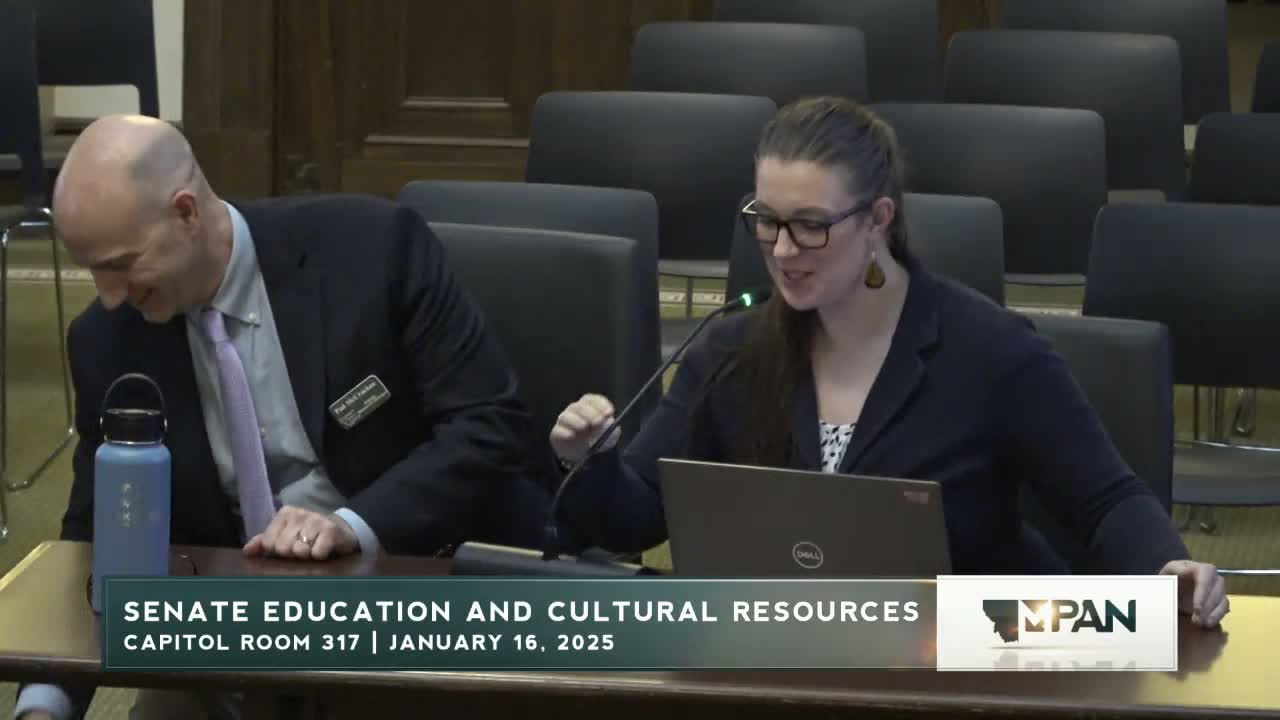
Legislative fiscal staff brief Senate Education Committee on school funding, demonstrate public dashboard
Summary
Legislative Fiscal Division staff (Pat McCracken and Julia Patton) gave an explanatory briefing on Montana's K‑12 funding formula, historical litigation shaping it, the guaranteed tax base (GTB), Impact Aid, district examples (Ennis, Browning, Lambert) and an interactive public dashboard for district-level analysis.
Legislative Fiscal Division staff told the Senate Education Committee that Montana's K‑12 funding system is complex and shaped by constitutional directives and decades of litigation. Pat McCracken, deputy research director, and Julia Patton, Legislative Fiscal Division staff, reviewed how the state's funding formula establishes minimum (base) and maximum budget limits for districts, the five state‑funded components that feed those limits and how differences in local property wealth and student counts create variation among districts.
Why it matters: The briefing outlined where state and local dollars flow in the school district general fund, identified large statewide funding components and demonstrated a publicly available interactive tool members can use to examine budget and enrollment data for individual districts. Committee members were shown examples (Ennis, Browning, Lambert and East Helena) to illustrate how property wealth, federal non‑taxable land and non‑levy revenues alter the mix of state aid and local taxation.
What staff presented: McCracken used a 'bucket' metaphor to describe base and max budget limits derived from formula components (student counts, teachers, special education, at‑risk funding and quality educator funding). He said direct state aid accounts for about 44.7% of the basic and per‑A/B entitlements in the handout example and that, on the statewide sample, guaranteed tax base (GTB) aid was shown at roughly $280 million with about $146 million of local property tax filling the comparable area on the chart. McCracken noted the 95‑mill mechanism brings in roughly $450 million in the current example but does not cover the state's full funding obligation.
Historical and legal context: Presenters reiterated that Article 10, Section 1 of the Montana Constitution frames the state's obligation to provide equality of educational opportunity and that litigation (equity lawsuits in the late 1980s–1990s and an adequacy lawsuit in 2004) required legislative responses and changes to the funding formula. The presenters referenced Montana Code Annotated provisions that govern the funding formula and emphasized that only the Legislature can modify it.
District examples and special funds: Using the dashboard, Patton displayed the Ennis district (Madison County) to show how very high property wealth (including portions taxed in Madison County from the Yellowstone Club area) produces a high per‑A/B value and results in little or no GTB aid for that district. They showed Browning as an example of a district receiving substantial GTB aid because of federal, non‑taxable trust land and high student counts. Lambert (Richland County) illustrated how non‑levy revenues tied to oil and gas can fill GTB and overbase areas. Staff emphasized that Impact Aid (federal payments for federally connected children) appears in separate funds and is visible in the tool but is not included in the district general fund.
Tool access and next steps: Julia Patton walked members through locating the interactive school‑funding tool on the legislative website (Fiscal tab → interactive tools/publications → School Funding). She said the tool includes the handout, historical materials, and filter/search functionality so members can pull up individual districts and review time series. Staff offered to provide district‑specific follow up and link the direct tool URL to the committee.
Committee questions: Senator Weber asked how the tool and the formula treat enrollment decreases and consolidations; staff described statutory three‑year averaging that can soften budget impacts after temporary declines and demonstrated longitudinal dashboards (East Helena, Chester‑Joplin‑Inverness) to show how consolidation and boundary changes affect historical data.
Closing: The chair thanked the presenters and encouraged members to use the dashboard for district conversations; staff said they would send the direct link to the committee. The meeting then adjourned.
Quotes from the transcript include: "School funding in any state and in Montana is incredibly complicated," (Pat McCracken) and "this tool... is on our legislative website" (Julia Patton). The staff presentation and district examples are drawn directly from committee testimony and the Legislative Fiscal Division demonstration, as recorded in the committee transcript.