Get Full Government Meeting Transcripts, Videos, & Alerts Forever!
Get email alerts on the Civil Litigation topic
No spam. Unsubscribe anytime.
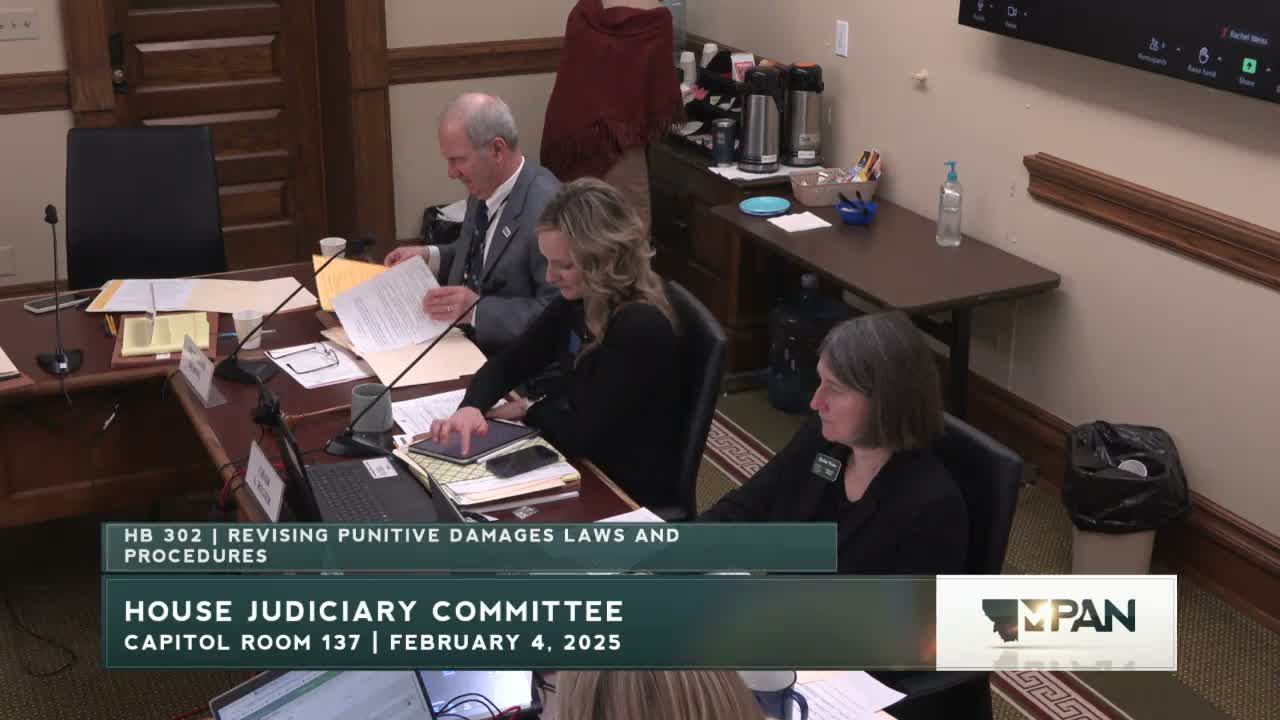
Panel weighs requiring early evidentiary hearings on punitive‑damages claims
Summary
House Bill 302 would let parties ask for live‑testimony evidentiary hearings to test punitive‑damages affidavits before plaintiffs amend complaints; sponsors said it exposes weak affidavit evidence and avoids later trial prejudice, while opponents warned it would create duplicative mini‑trials and delay justice.
Representative Anthony Nicastro opened for House Bill 302, describing punitive damages as ‘‘meant to be used, very sparingly’’ and proposing that courts be allowed to hold an evidentiary hearing, with live testimony and cross‑examination, before a plaintiff may add punitive damages to a complaint.
Supporters (including the Montana Chamber of Commerce) said the change addresses boilerplate affidavits and gives judges a tool to test evidence earlier. Brian Thompson told the committee the bill ‘‘makes it so that either side, plaintiff or defendant, can request an evidentiary hearing before the court on the actual evidence that is being submitted.’’
Opponents — several trial attorneys and victims’ advocates — said the 2023 amendments already impose a high bar for pleading punitive damages, and that HB302 would add delay and expense by requiring hearings that can resemble mini‑trials. Roger Sullivan and others used examples they said show punitive claims are rare but serious, and argued forcing victims and witnesses to testify multiple times would be harmful.
Committee discussion probed whether affidavits under oath are adequate now, whether hearings would be short or expand into multi‑day proceedings, and whether courts would be overloaded; sponsors stressed cross‑examination will expose unreliable declarations, while opponents said affidavits are subject to perjury penalties and often suffice for the limited task of amending pleadings.
What’s next: Hearing closed with sponsor requesting due pass; the committee will consider executive action on the bill as scheduled.