Get Full Government Meeting Transcripts, Videos, & Alerts Forever!
Get email alerts on the School Safety topic
No spam. Unsubscribe anytime.
Senate education committee backs bill to require cardiac response plans and fund AEDs in Montana schools
Summary
The Senate Education Committee concurred in HB 869, which requires schools to adopt cardiac emergency response plans, train staff in CPR/AED use and creates a modest grant program (one‑to‑one match up to $700/device) supported by a $240,000 biennial appropriation to help districts buy AEDs and training materials.
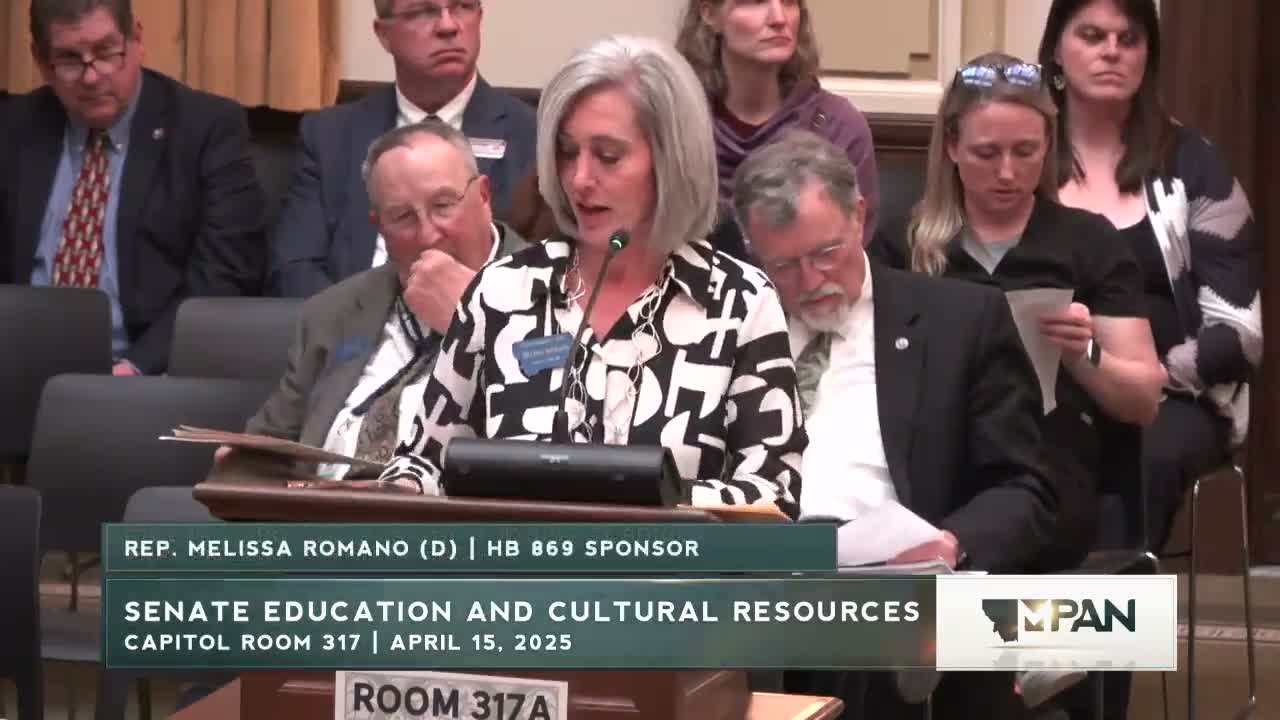
Representative Greg Romano urged the Senate Education and Cultural Resources Committee to approve House Bill 869, calling it “a proactive life‑saving measure” to protect student athletes from sudden cardiac arrest by requiring cardiac emergency response plans, training for coaches in CPR and AED use, and access to automated external defibrillators (AEDs) at athletic venues. Romano said the bill includes a $240,000 biennial appropriation to produce educational materials and fund a reimbursement grant program.
The bill’s proponents testified that minutes matter in a cardiac emergency. Jackie Semmens of the American Heart Association told the committee that schools with formal response plans and access to AEDs “see double the chances of survival” from sudden cardiac arrest; she said an AED used in the first minute can raise survival to about nine in ten. Student and school representatives, including Charles Snellman (Capital High School) and Rob Watson (school administrators), described local cases and urged passage. The Department of Public Health and Human Services’ cardiovascular program supervisor, Jessie Fernandez, answered questions about existing AED availability and grant opportunities and said DPHHS had 175 AEDs registered while the state has slightly over 500 school buildings.
Committee members asked about program scope and cost. Romano acknowledged the statewide incidence data are national and that only a portion of buildings currently have registered AEDs; the grant is designed to give districts “skin in the game” while helping fill gaps. Proponents described grants structured as 1:1 matches up to $700 per device and emphasized flexibility for districts to design response plans appropriate to local contexts.
At executive action the committee concurred in HB 869. The vote was recorded in committee roll call as 10 ayes and 4 nays. The bill will be carried to the Senate floor by Senator Vinton (committee carrier). The committee’s action sends the measure to the next stage of the legislative process; sponsors and proponents said districts could apply for grants to purchase AEDs and begin drafting plans once enacted.