Get Full Government Meeting Transcripts, Videos, & Alerts Forever!
Get email alerts on the Tax Increment Financing topic
No spam. Unsubscribe anytime.
Senate Bill 2 would prevent released TIF/TED increments from becoming 'newly taxable'; cities warn it would hobble redevelopment tools
Summary
Sen. Greg Hertz said SB 2 would exclude incremental taxable value released when TIF/TED districts sunset from being considered newly taxable; opponents — including the Montana League of Cities & Towns and economic development groups — argued the change would undermine tax-increment financing as a redevelopment and infrastructure tool.
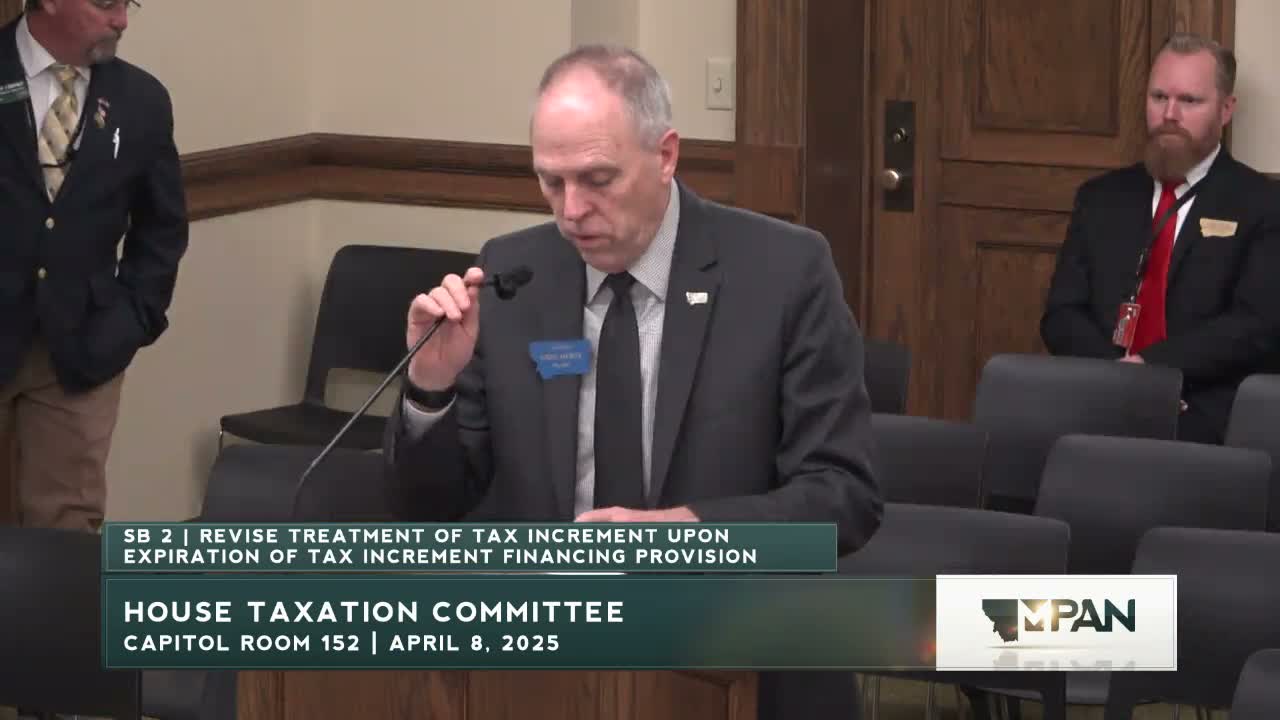
Sen. Greg Hertz (Senate District 7) told the House Taxation Committee that Senate Bill 2 aims to exclude release of incremental taxable value from being treated as "newly taxable" when a tax increment financing (TIF) or tax increment district (TED) sunsets. Hertz argued that the increment represents property that already receives normal local services and that taxing jurisdictions have been effectively subsidizing the TIF during its life; when the increment returns, he said it is reasonable to spread the benefit across taxpayers rather than letting the jurisdiction immediately expand budget authority.
Hertz said the revenue interim committee considered the issue and that SB 2 seeks to control growth while allowing some growth. He also said he would bring an amendment making SB 2 void if SB 117 passes, to avoid conflicting treatments. Hertz framed SB 2 as a common-sense fix to prevent a sudden budget spike when an increment is released.
Opponents included Jennifer Olson (Montana League of Cities and Towns), Adrianna Hines (Montana Infrastructure Coalition), Lisonbee Corbin (Montana Economic Developers Association), and Nicole Rush (Missoula Economic Partnership). They said TIF/TED is often used to eliminate blight and to make infrastructure projects feasible, and that treating the increment as newly taxable when a district sunsets is an established method for jurisdictions to capture revenue needed to maintain those improvements and support new services. Olson cited Whitefish’s experience remitting increment and using it to reduce mills, and argued that removing newly taxable status for increments could make TIFs infeasible and reduce local ability to fund redevelopment and infrastructure.
Eric Dale (Department of Revenue) served as informational witness; he and the sponsor discussed an amendment tying SB 2’s applicability to SB 117 outcomes. No formal votes were taken during the hearing.