Get Full Government Meeting Transcripts, Videos, & Alerts Forever!
Get email alerts on the Taxation topic
No spam. Unsubscribe anytime.
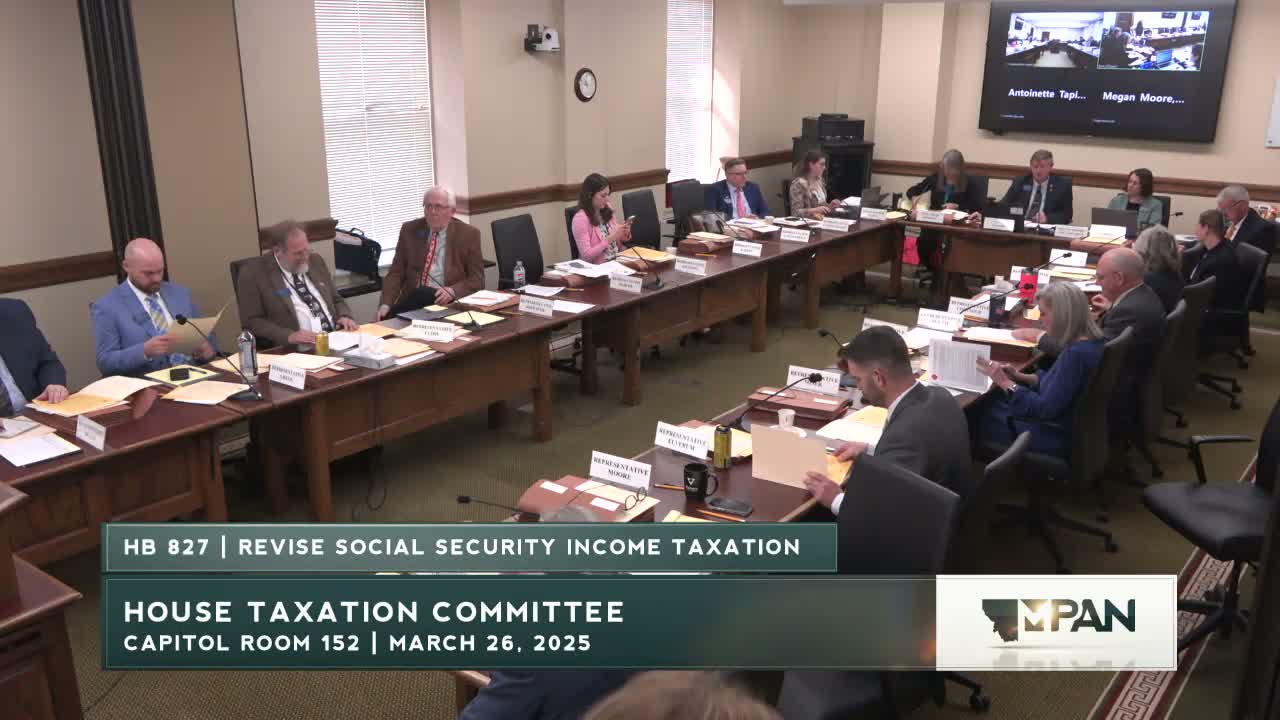
Committee hears measured proposal to raise thresholds for taxing Social Security income
Summary
Representative Melody Cunningham’s HB 827 would revise Montana income-tax treatment of Social Security by raising thresholds that determine how much Social Security is included in taxable income; senior groups and AARP supported targeted relief while budget analysts urged caution about cumulative revenue impacts.
Representative Melody Cunningham opened HB 827 by describing a targeted change to Montana’s taxation of Social Security benefits that adjusts the thresholds at which portions of Social Security become included in taxable income. "Montana is one of only 9 states that still have this tax on Social Security," Cunningham said, framing the bill as a narrower alternative to full repeal that balances retiree relief with fiscal responsibility.
Proponents included Big Sky 55 Plus, the Association of Montana Retired Public Employees and AARP Montana, which called HB 827 a pragmatic way to help retirees keep more of their income while avoiding the large fiscal note of full repeal. Tim Summers of AARP said the bill helps older Montanans "keep more of their hard earned income" and called the approach appropriate given budget constraints.
Department of Revenue income-tax specialist Brian Olsen explained the mechanics: federal rules currently include portions of Social Security in taxable income (commonly applying 50% or 85% inclusion at different thresholds), and the bill would shift the trigger points where the 50% and 85% inclusion rules apply for state tax purposes. Committee members asked for worked examples showing how the new thresholds interact with filing status and with property-tax assistance programs; the Department of Revenue said it would provide illustrative charts.
Rose Bender of the Montana Budget and Policy Center offered guarded opposition, praising the targeted relief but warning that cumulative revenue loss from multiple tax-cut bills could strain future budgets. The sponsor closed by reiterating the equity rationale for reducing Social Security taxation for retirees and urged a favorable committee report.
The hearing produced technical questions about thresholds, filing status and long-term fiscal effects; Department of Revenue staff committed to providing worked examples to the committee.