Get Full Government Meeting Transcripts, Videos, & Alerts Forever!
Get email alerts on the Property Tax Reform topic
No spam. Unsubscribe anytime.
Senate Bill 117 would cap how much newly taxable value feeds local budgets and create reserve accounts, sponsors say
Summary
Sen. Daniel Zola Cobb told the committee SB 117 smooths inflation, caps newly taxable revenue (75% for residential class 4; 40% or 50% for other classes), and requires a 10% deposit into a large taxpayer reserve account to mitigate losses if major taxpayers leave; counties largely supported it while cities raised concerns about funding new housing and infrastructure.
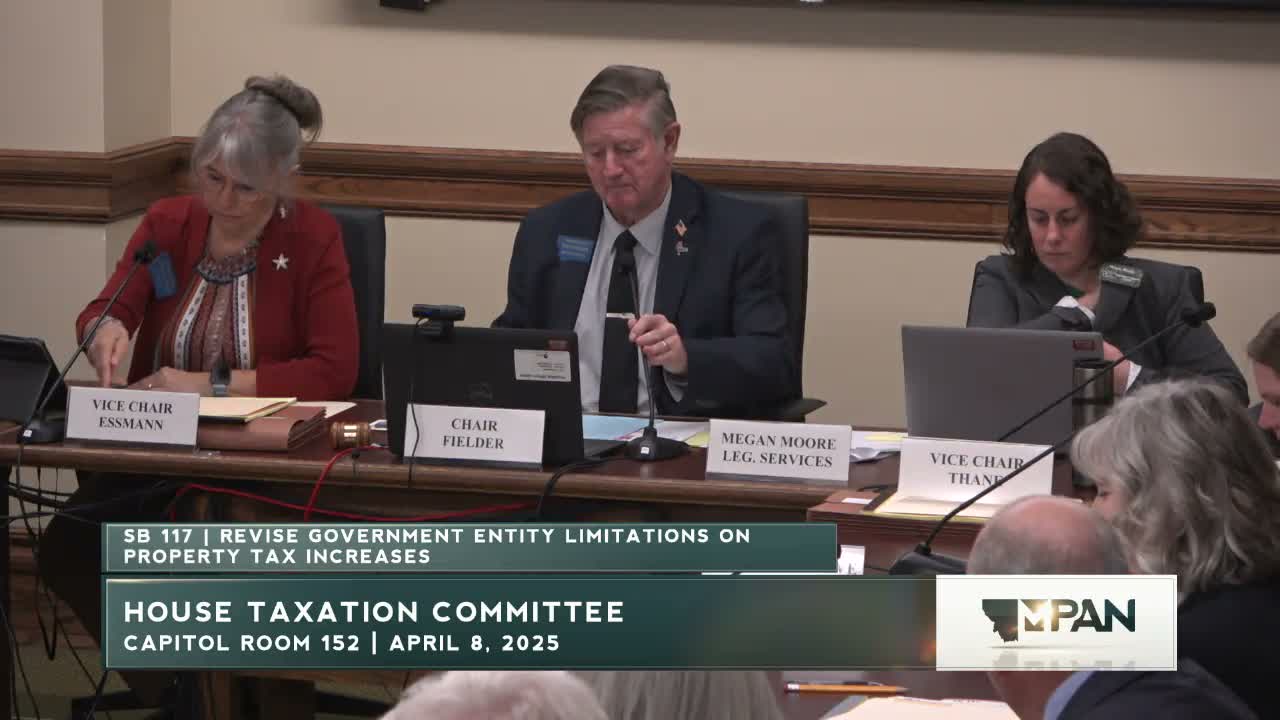
Sen. Daniel Zola Cobb (Senate District 22) presented Senate Bill 117 on April 14 as a long-term rewrite of parts of Montana’s property-tax system aimed at slowing compounding growth in local budgets and returning more benefit to existing taxpayers. The bill would use a multi-year average of inflation (the prior three years, capped at 4%) for budget growth and would limit how much newly taxable value may increase local budgets: class 4 residential newly taxable would be capped at 75% while other property classes would be capped at either 40% or 50% depending on whether a jurisdiction creates a "large taxpayer reserve account" and meets deposit requirements.
Under the proposal, a jurisdiction that creates the reserve account must deposit 10% of newly taxable revenue from affected classes into that account; deposits may be used to offset Department of Revenue technology payments but otherwise must remain restricted until a large taxpayer permanently ceases operations or experiences a 25% or greater drop in taxable value. The sponsor said the reserve would let counties and cities backfill revenue losses when a large taxpayer leaves rather than shifting costs to other taxpayers.
County groups, including the Montana Association of Counties and MAKO, supported SB 117 at the hearing, emphasizing capital needs in jurisdictions that have been operating at reduced growth (half the rate of inflation) and rely on large new taxpayers for one-time capital expenditures. Jason Bridal (Montana Association of Counties) and several county commissioners said the 50%/75% model with a reserve account is a fair compromise.
Cities and rapidly growing communities objected. Kelly Lynch, executive director of the Montana League of Cities and Towns, urged the committee to preserve 100% newly taxable for class 4 residential because fast-growing cities rely on full newly taxable residential value to fund infrastructure and services for new households. Danny Hess (Belgrade/Bozeman) and other municipal witnesses said reducing residential newly taxable to 75% would strain their ability to build roads, public safety capacity and other infrastructure.
Committee members pressed the sponsor on whether the bill would meaningfully change outcomes, whether it creates uneven rules for cities and counties, and whether preserving 100% for residential would nullify the effect. Sponsor Cobb said the bill is designed to produce modest but compounding relief over years and to avoid political misuse of technical revenue-neutral numbers; he asked for committee support and offered to work with members on specifics.
No vote was taken on SB 117 at the hearing; the committee concluded the testimony and moved to the next item.