Get Full Government Meeting Transcripts, Videos, & Alerts Forever!
Get email alerts on the Taxation topic
No spam. Unsubscribe anytime.
Lawmakers hear paired proposals to limit a future sales tax to buying down education property taxes
Summary
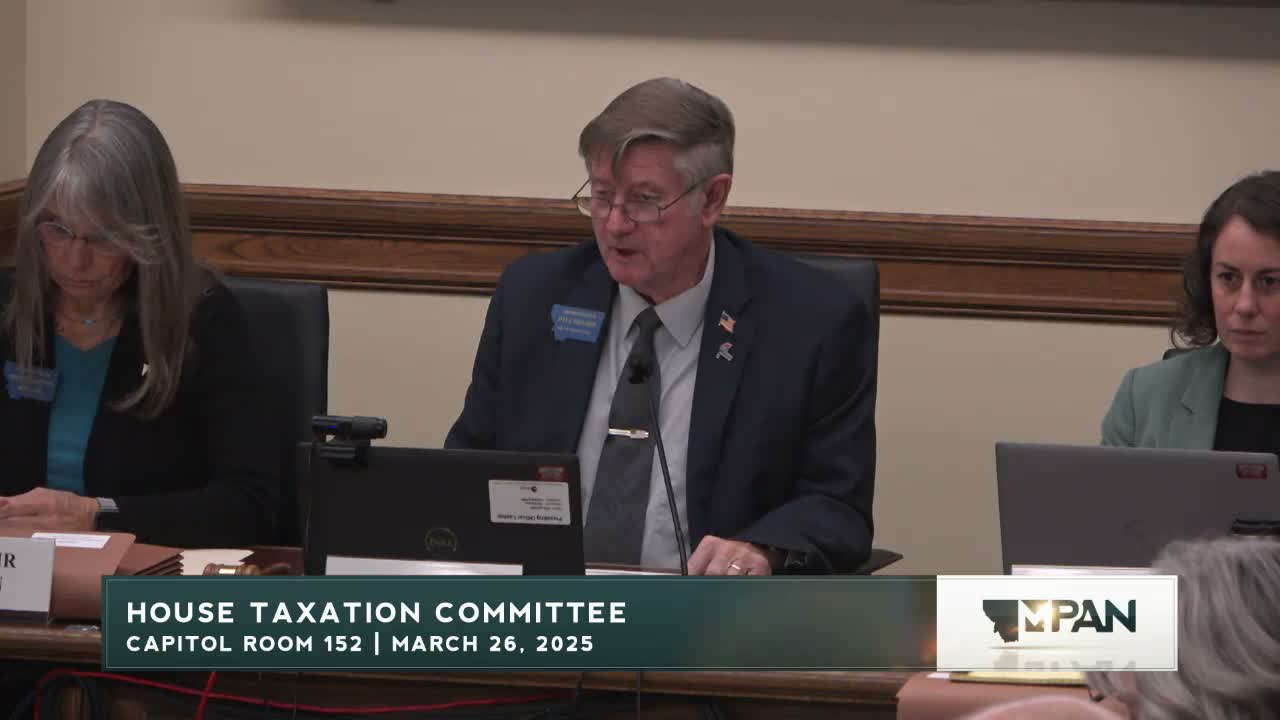
The House Taxation Committee heard HB 841 (a constitutional restriction) and HB 842 (a statutory referendum) from Rep. Brad Barker proposing that any future general statewide sales tax be used only to reduce property-tax mills for public schools and the Montana University System; supporters argued it protects taxpayers and equalizes school funding while opponents warned it would make any sales tax regressive and tie legislators' hands.
Representative Brad Barker opened HB 841 on behalf of his proposal to add a constitutional restriction that would require any future general statewide sales tax revenue to be used only to buy down the property-tax mills dedicated to K–12 education and the Montana University System. "8 41 is not a sales tax," Barker told the committee, adding that the bill would "add further protection on any use of sales tax" and that a 4% general sales tax could generate about $1.3 billion in 2025 and ‘‘could potentially reduce the property tax burden that is dedicated to education by over 78%." Barker also handed out a technical amendment inserting the words "general statewide" to clarify which sales taxes the restriction would cover.
Supporters told the committee that narrowly tying new sales-tax revenue to education would reassure voters and spread relief statewide. Bob Story of the Montana Taxpayers Association said limiting revenue to education helps spread property-tax relief across counties, and Ross Butcher of the Montana Association of Counties said the restriction would allay fears that a new sales tax would simply add another tax without meaningful offsets for homeowners. Lance Melton, representing school boards and affiliated education groups, described how modest sales-tax rates could replace specific education levies and simplify school funding formulas.
Opponents urged caution. Rose Bender of the Montana Budget and Policy Center told the committee that swapping property taxes for sales taxes is regressive and that sales-tax revenue is more volatile than the property-tax base. Amanda Curtis of the Montana Federation of Public Employees warned that sending a constitutional change to voters to address tax policy risks handing away the legislature's responsibility for long-run tax design. Several unions and consumer-advocacy witnesses echoed concerns that exempting basic necessities may not offset the regressive effect on low- and middle-income households.
Committee members questioned both the policy design and the sequencing of the two measures. Representative Thain asked why the proponents did not run the restriction and a parallel sales-tax referendum together; Barker explained that ballot rules limit initiative language to one issue and said HB 842 would separately poll voters on whether the legislature may establish a sales tax capped at 4% with enumerated exemptions.
The hearing record shows competing priorities: supporters framing the package as a voter-protected path to property-tax relief dedicated to schools, opponents highlighting equity and volatility risks, and business groups urging precise drafting to avoid sweeping in existing targeted taxes. The committee closed the HB 841 and HB 842 hearings after extended Q&A and remarks from the sponsor about the need to let voters weigh a carefully designed option.