Get Full Government Meeting Transcripts, Videos, & Alerts Forever!
Get email alerts on the Workforce Housing topic
No spam. Unsubscribe anytime.
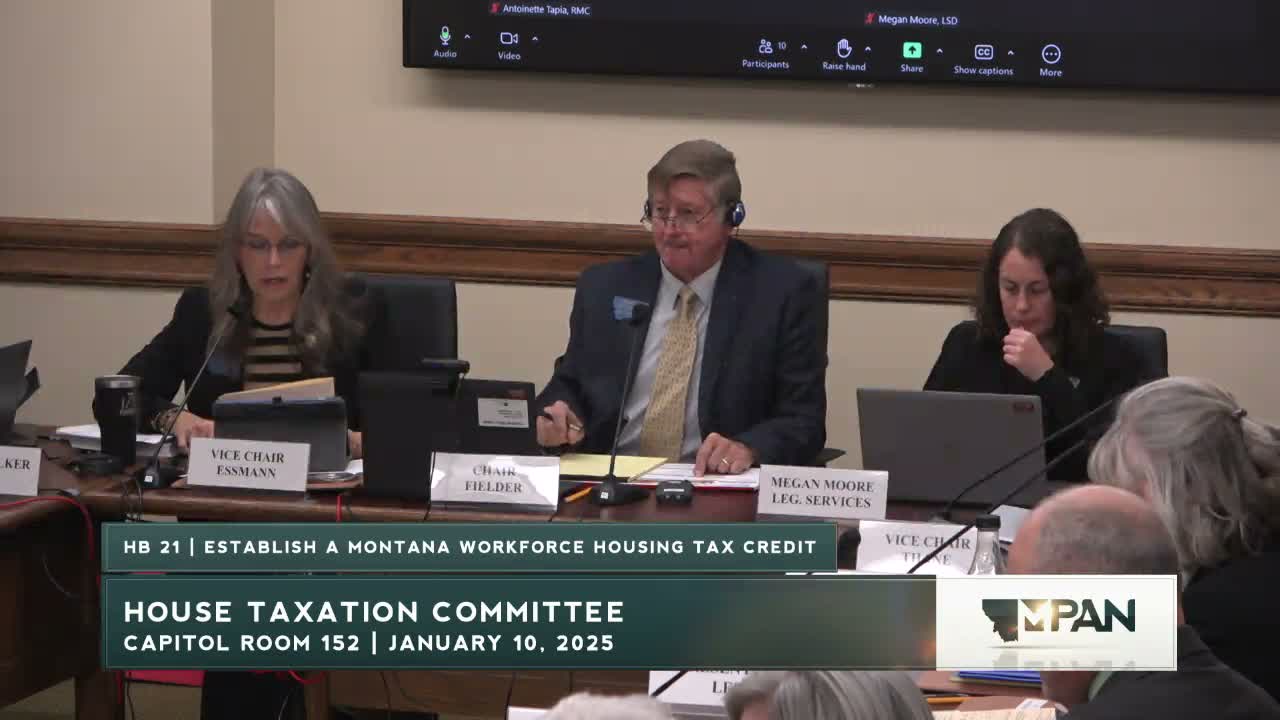
House panel hears bill to create state workforce housing tax credit to fill funding gaps
Summary
Supporters told the House Taxation Committee HB 21 would create a state workforce housing tax credit to bridge financing gaps on affordable rental projects, leveraging federal credits and private investment; opponents warned tax-code complexity and urged direct funding instead.
The House Taxation Committee on Tuesday heard testimony on House Bill 21, a proposal to establish a state workforce housing tax credit intended to help developers fill “gap” financing on affordable rental projects.
Representative Larry Brewster, sponsor of the bill, said the proposal is a committee bill that would allocate limited state tax credits over time and include periodic review by the revenue interim committee. “It basically allocates money over time so that people can gain a tax credit to supplement their projects for low income housing,” Brewster said.
Don Sturhan, president of Scribe Builders LLC, explained how tax-credit equity is used to raise capital for developments. “These tax credits are designed to be sold so that we can raise capital, which in turn is put into the project,” Sturhan said. Using a hypothetical $10 million project, he described how federal credits often provide roughly 70% of the capital stack and a state credit can help fill the remaining 30 percent.
Kia Peterson, executive director of NeighborWorks Montana, and Karissa Trujillo of Homeward said the state credit would make small and rural projects more feasible. “This state workforce housing tax credit would make more housing development possible,” Peterson said. Trujillo added that such credits “leverage private capital and allow us as developers to raise equity through investors who buy those credits.”
Supporters included a cross-section of business and civic groups — the Montana Chamber of Commerce, Montana Bankers Association, Montana Contractors Association, Montana Building Industry Association, Montana Housing Coalition and local governments — who said housing shortages are hampering workforce recruitment and that state credits are a proven tool in other states.
John Iverson of the Montana Society of CPAs testified in reluctant opposition, arguing that adding tax credits re‑complicates the tax code. “When we start rolling back that achievement and adding new tax credits back to the tax code, we begin to once again overly complicate our tax code,” Iverson said, and he recommended direct appropriations to the Board of Housing instead of tax credits.
Informational witnesses from state agencies — Cheryl Cohen of the Montana Board of Housing and Brian Olson of the Department of Revenue — were present to answer administrative questions about allocation, compliance and whether credits would be used primarily for rental production.
Committee members asked technical questions about the typical period of affordability for projects, whether credits can be used for mixed-market developments, and how a six-year state credit would pair with the ten-year federal credit. Cohen said federal-administered tax-credit projects are predominantly rental and noted Montana’s Board of Housing currently sets long affordability periods for many projects.
Representative Brewster closed by saying the bill had been refined since prior sessions and urged committee approval. The committee closed the hearing on HB 21 without taking executive action that day.