Get Full Government Meeting Transcripts, Videos, & Alerts Forever!
Get email alerts on the Education Policy topic
No spam. Unsubscribe anytime.
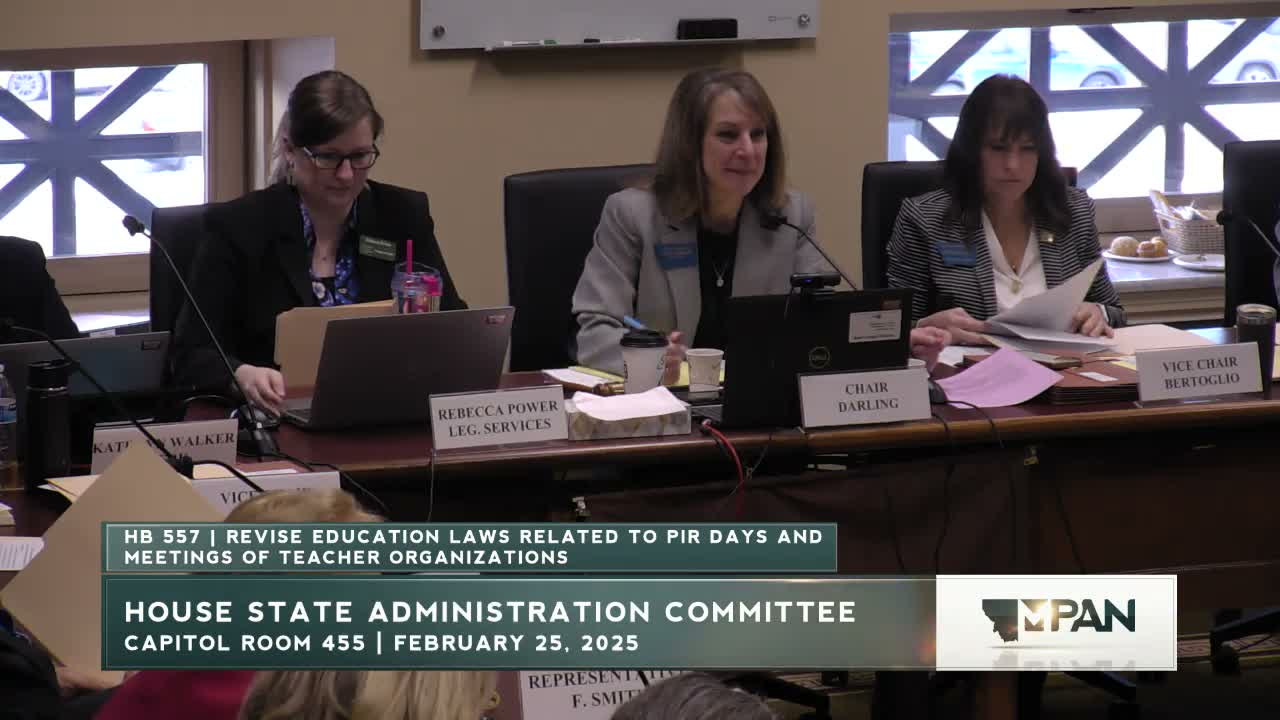
Heated hearing on HB 557 over state‑mandated PIR days and educator conferences
Summary
HB557 would remove statutory language allowing pupil‑instruction‑related (PIR) days to be used for state teacher-organization meetings and strike the requirement that districts close for those meetings; proponents argued taxpayer protection and local control, while educators and school groups said the change would harm rural teachers and disrupt calendars and student activities.
Representative Jodie Etchart opened the hearing on House Bill 557, describing it as a "pro teacher, pro taxpayer, and pro local control" measure that would let local districts tailor PIR days and would remove statutory authorization for teachers to use PIR days to attend state meetings of teacher organizations.
Proponents including Maxford Nelson of the Freedom Foundation and Finley Warden (who described undercover observations) argued the MFPE educator conference includes sessions they characterized as political or ideological and said the statute in its current form improperly directs taxpayer-funded release time to those events. "There's no justification for the state to compel taxpayers to pay for teachers to attend the convention of a private membership organization," Nelson said.
A large group of opponents testified that the annual educator conference (held in October) provides required renewal units, wide subject-area professional development, mentoring and networking, and crucial supports for rural teachers who otherwise lack access. Kim Popham, director of public policy for the Montana Federation of Public Employees, said the conference dates and curriculum groups supply the sessions teachers need to meet licensure renewal and to implement revised standards. "This conference offers teachers the opportunity to improve their practice by connecting face to face with others who understand the uniqueness of teaching in Montana," she said, and she said teachers generally pay their own registration fees.
Additional opponents—representing music educators, rural education associations, the Montana AFL-CIO and other coalitions—warned HB557 would create a "patchwork" of district calendars that could impede statewide events such as music festivals and youth-only hunts, and would disproportionately harm remote districts that rely on state conferences for subject-specific training. Several speakers noted the effective date in the bill could complicate already‑set school calendars for 2025–26 and urged a delayed or negative recommendation.
Christy Mockstutz of the Office of Public Instruction explained that MFPE and curriculum groups finalize conference agendas and that OPI is invited to present and awards renewal units; she told the committee OPI delivered roughly 55,000 renewal units via its online teacher-learning hub in the prior year but that in‑person sessions at the educator conference remain important for many subject areas.
Committee members asked whether agenda review, OPI oversight, or a compromise amendment would address concerns; Representative Etchart said she would consider OPI involvement in agenda-setting as an amendment. The hearing closed after extended questioning and a sponsor closing that emphasized local control and maintaining music festivals and youth hunts.