Get Full Government Meeting Transcripts, Videos, & Alerts Forever!
Get email alerts on the Water Well Contractors topic
No spam. Unsubscribe anytime.
Committee hears bill to raise water‑well contractor bonds and change disciplinary rules
Summary
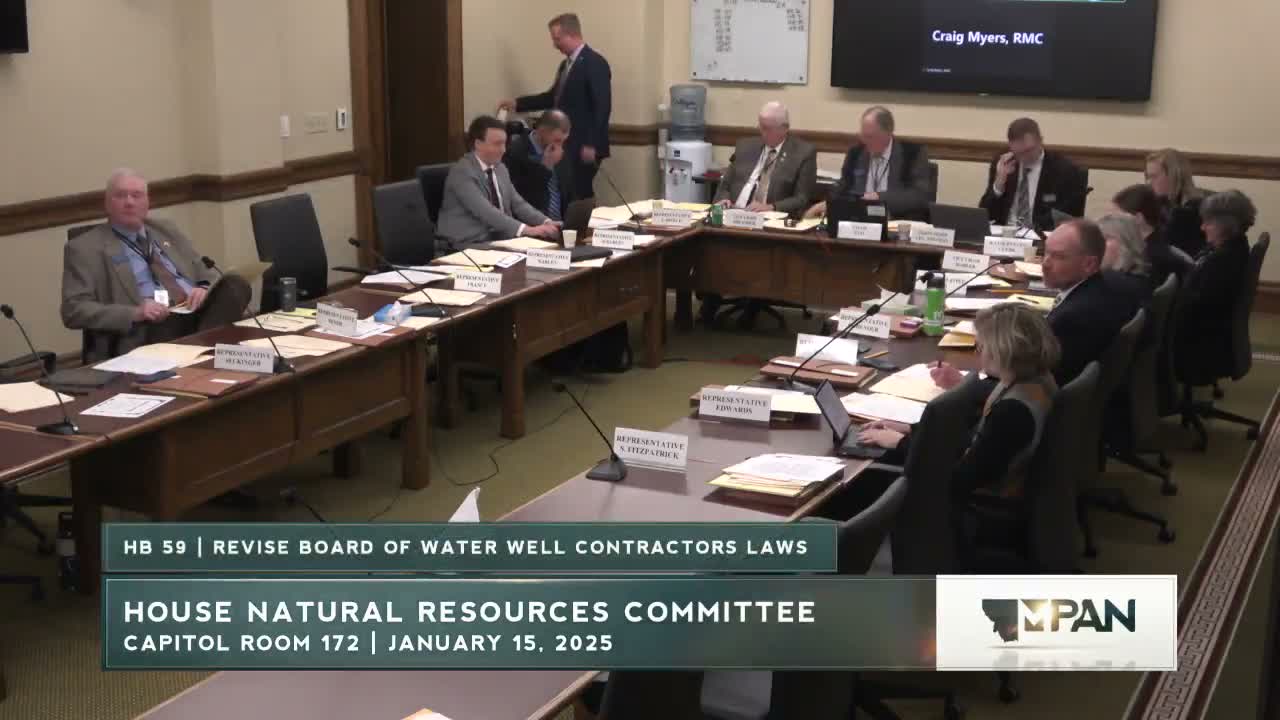
Lawmakers considered HB 59, which would clarify who may contract on behalf of water‑well companies, raise required bonds to $25,000, and remove language that can block disciplinary action when a licensee is denied property access. Proponents from DNRC and the drilling industry supported the changes; some drillers warned the discipline language could be abused without due process.
Representative Mike Vinton opened House Bill 59 as a technical and consumer‑protection measure to update the Board of Water Well Contractors statute and to align bond requirements with current drilling costs.
Todd Netto, bureau chief at DNRC's Adjudication, Enforcement and Distribution Bureau, testified the measure seeks four primary changes: remove a requirement that the licensed water well contractor must personally sign contracts on behalf of firms, clarify license coverage for different types of well work, raise contractor bond amounts to $25,000 for both individuals and businesses, and remove language that can prevent the board from initiating disciplinary action when a landowner denies access.
Art Robinson, program manager for the board, explained the $4,000 individual/$10,000 business bonds were set decades ago and no longer represent realistic costs to replace or repair wells. "In today's market, dollars 4,000 will not repair or replace that well," Robinson said, adding the board expects premiums to be modest and the $25,000 bond to better align with current costs.
Industry witnesses including Rhonda Wiggers of the Montana Water Well Drillers Association and several small drillers supported the bond increase as reasonable; Wiggers said the premium impact would be modest. Some industry members urged retained procedural safeguards to protect small businesses.
Matthew McKenzie, a practicing driller who testified in opposition to the discipline language, warned the removal of a sentence that requires licensees to be given an opportunity to remedy complaints could allow the board to discipline contractors without giving them a fair chance to respond. He told the committee the board is largely composed of other contractors and said the proposed change could be used unfairly against smaller competitors.
Committee members and witnesses discussed possible fixes: keep the board's ability to require complainants and licensees to appear, preserve due‑process protections contained elsewhere in statute (disciplinary procedures cited in 37‑43‑3‑10), or modify the struck language to retain an "opportunity to respond" while removing a provision that allegedly allowed bad actors to evade discipline by denying access.
Sponsor Representative Vinton said he and DNRC would work with committee staff and stakeholders on language refinements. The committee closed the hearing on HB 59 after extended Q&A and indicated staff follow‑up on precise statutory cross‑references would be appropriate before moving the bill forward.
Status: hearing closed; sponsor and committee members said they expect to negotiate clarifying amendments on the disciplinary and due‑process language before executive action.