Get Full Government Meeting Transcripts, Videos, & Alerts Forever!
Get email alerts on the Wildfire Response topic
No spam. Unsubscribe anytime.
Committee advances bills to keep DNRC's rapid‑response firefighting assets and clarify state authority near boundaries
Summary
Lawmakers heard testimony supporting two bills to make state wildfire preparedness funding permanent and to clarify when the Department of Natural Resources and Conservation can conduct aggressive initial attack near state boundaries; DNRC officials said the programs reduced large‑fire risk in 2023–24 and added reporting and coordination requirements.
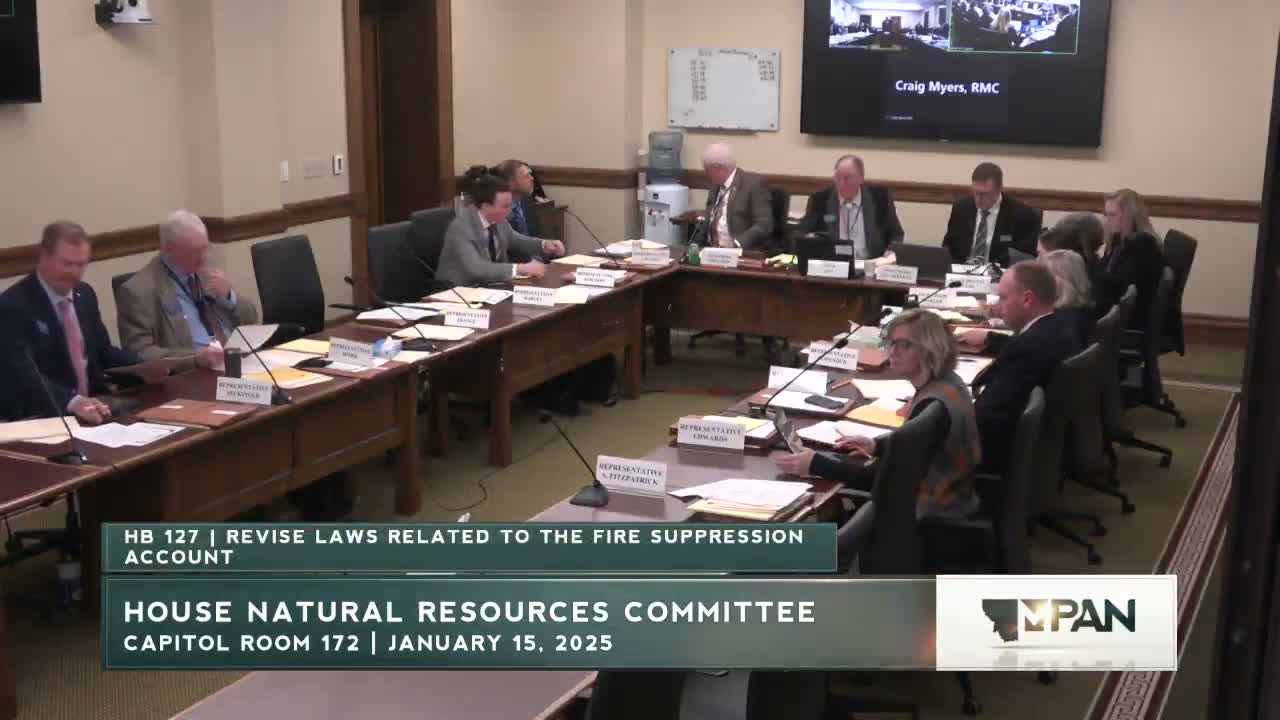
Representative Lou Jones, sponsor of House Bill 127, told the House Natural Resources Committee the bill would make permanent a program created last year to fund fast‑attack firefighting assets for the Department of Natural Resources and Conservation (DNRC).
"This program put on 1,300,000 gallons of water and did a ton to protect private property and stop fires from getting out of hand," Jones said, describing the aircraft, helicopters and rapid‑deployment crews the program funded during 2024.
Wyatt Frampton, deputy division administrator for DNRC's Forestry and Trust Lands Division, said HB 127 builds on a pilot from the 68th Legislature and adds a reporting requirement to ensure transparency and accountability. "House bill 127 not only enhances our firefighting capabilities, but it also represents a smart investment," Frampton said, arguing that effective early attack can prevent larger fires and save millions in suppression and property losses.
Frampton described specific assets DNRC contracted in 2024, saying the department secured a "type 1 helicopter" on a 90‑day exclusive contract, contracted a large air tanker shared across western states, and added a night‑capable aircraft with a thermal imaging camera to detect heat anomalies before visible smoke appeared.
Separately, Representative Jones introduced House Bill 130 to give DNRC clearer authority to act on incidents near state boundaries when private property, communities or state lands are at risk. Amanda Kaster, DNRC director, told the committee the state is responsible for wildland fire protection across roughly 60,000,000 acres and that "in fact, this last year we kept 95% of our fires under our jurisdiction under 10 acres or less. I repeat, 95%." She said HB 130 would direct the agency to pursue safe, aggressive initial attack and, when appropriate, seek cost recovery from federal partners.
Committee members pressed DNRC witnesses on liability, the master cooperative agreements with federal agencies and whether the state would be left holding costs if federal partners declined to reimburse. Frampton said DNRC and federal partners routinely exchange bills and that the bill would clarify the department's intent and negotiating posture in upcoming master‑agreement renegotiations; he also said the department is already working to update those agreements.
Members raised concerns about tribal lands and liability exposure; DNRC said it would consult with tribal entities and seek clearer implementation language in forthcoming amendments. Several lawmakers asked whether pursuit of reimbursement would be practical; DNRC staff said the department expects to pursue cost recovery where appropriate but acknowledged there are no absolute guarantees.
The committee closed the hearings on both bills after testimony and extended questions. No formal vote on HB 127 or HB 130 was recorded during this hearing; both bills were taken under advisement and the sponsor indicated he would bring amended language to address liability and implementation details.