Get Full Government Meeting Transcripts, Videos, & Alerts Forever!
Get email alerts on the Middle Housing topic
No spam. Unsubscribe anytime.
Lawmakers debate bill to require cities to permit triplexes and fourplexes
Summary
Sen. Jeremy Trebas' SB 266 would require many Montana cities to allow triplex and fourplex housing where single-family homes are permitted; supporters said it expands options and supply, while municipal planners warned of financing, infrastructure, and local-planning conflicts.
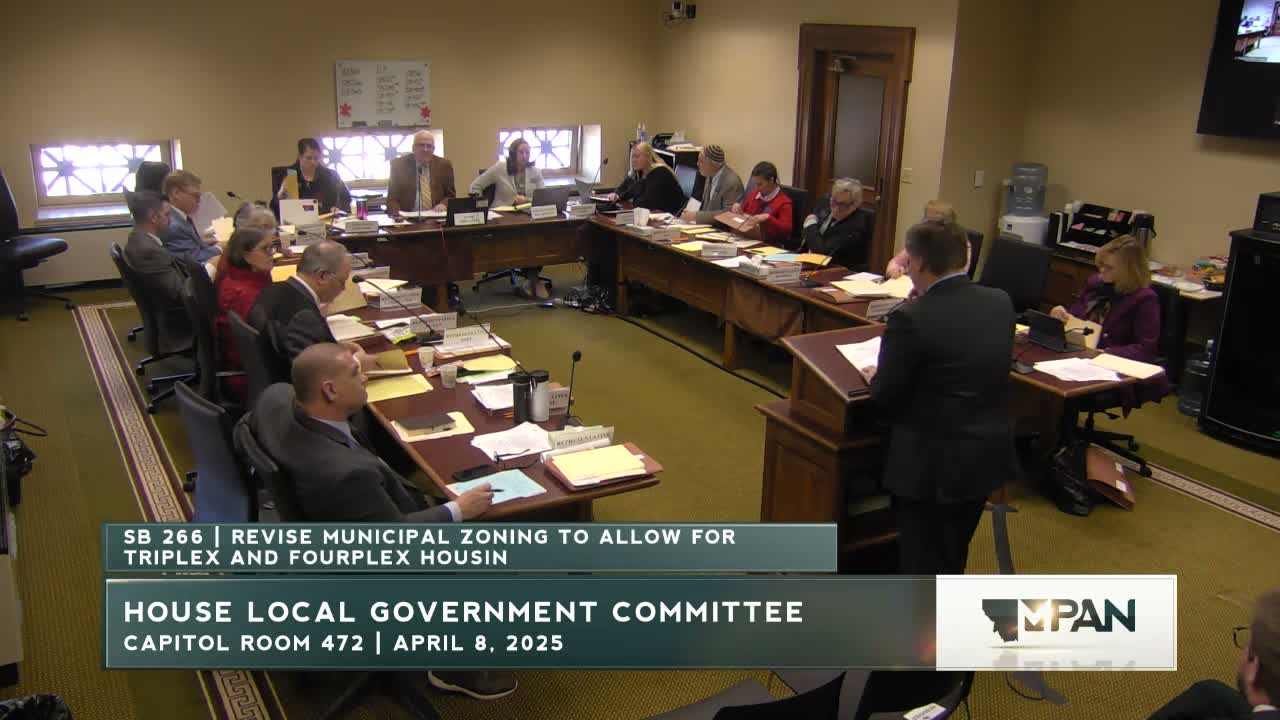
Senate Bill 266 — sponsored by Sen. Jeremy Trebas — returned to the House Local Government Committee as a proposed expansion of last session's duplex law. Trebas said the bill would require some municipalities (generally those with populations above 5,000) to permit triplexes and fourplexes on lots where single-family dwellings are allowed and would prevent zoning rules for those units from being more restrictive than for single-family homes. A delayed effective date of Oct. 1, 2026, was included to let cities align the change with Montana Land Use Planning Act (MLUPA) work.
Supporters, including affordable-housing advocates, AARP Montana and local officials, testified that "middle housing" could diversify housing choices for older adults and working families and help address the state's housing shortage. Proponents argued that modestly denser housing can be an attainable and walkable option that integrates with existing neighborhoods.
City planners, the Montana League of Cities and Towns and several municipal witnesses opposed or urged caution, saying the bill removes local discretion and could conflict with capital improvement plans, impact-fee structures and MLUPA implementation. Kelly Lynch of the Montana League warned that the bill would require redoing analyses already underway under MLUPA, and Billings planning director Wyeth Bridal said the statutory definitions are ambiguous (for example, whether a "fourplex" must be attached units) and that local codes manage neighborhood transitions, street capacity, water and sewer capacity, fire response and schools.
Committee members questioned whether the market, lending practices and developer economics would produce affordable units without affordability requirements. Sen. Trebas and proponents said the bill is a supply-side, light-touch approach that preserves building codes and local enforcement of construction standards.
The committee recorded extended debate and later tabled SB 266 during executive action; proponents urged an interim study or collaboration on implementation details for municipalities that raised capacity and financing concerns.