Get Full Government Meeting Transcripts, Videos, & Alerts Forever!
Get email alerts on the Opportunity Public Charter Framework topic
No spam. Unsubscribe anytime.
Charter commission reviews draft performance framework for Opportunity Public Charter Schools
Summary
Deputy director Maggie Lund presented draft Commission policy 3.71 to implement the adjusted performance framework required by state law for Opportunity Public Charter Schools, explaining at‑risk definitions, proposed metric weights and safeguards; commissioners requested clearer public-facing explanations and raised concerns about a hard 75% enrollment threshold.
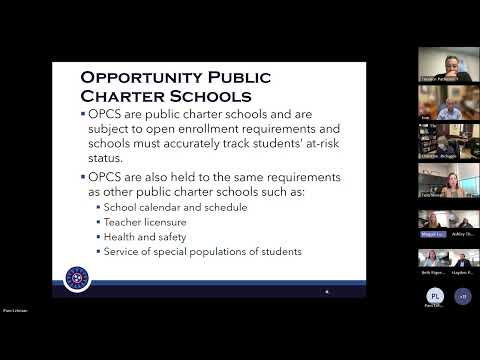
NASHVILLE — The Tennessee Public Charter School Commission’s School Performance and Accountability Committee on Oct. 7 reviewed a draft performance framework (Commission policy 3.71) for Opportunity Public Charter Schools, the new school type created by state law to serve students defined as “at risk.”
Deputy Director of Authorizing Maggie Lund told commissioners the legislation (Tennessee Code Annotated 49-13-133) requires an adjusted framework and that the commission built its draft around four academic indicators — student outcomes (the state’s adjusted letter grade), mission-specific goals, comparative performance and a TBOS growth composite — while adding an organizational measure to ensure compliance with enrollment rules. “These schools are required to serve at least 75% at‑risk students as defined in statute,” Lund said, describing the at‑risk definition as a household income test (400% of the federal poverty level) plus one or more statutory risk criteria such as previous dropout, adjudication, chronic absenteeism or documented substance abuse.
The draft incorporates state-level adjustments to the letter‑grade calculation, including a year‑one hold harmless, shifting weight from achievement to growth and providing an option to calculate the ‘‘growth 25’’ indicator by either the lowest 25% or continuously enrolled students. Lund said the commission increased the weight for mission‑specific goals from 10% to 20% to recognize model‑specific metrics that are typically school‑reported. “We wanted to ensure the data we’re capturing is valid and publicly available while still honoring innovation,” she said.
Commissioners asked staff to make the framework and its public presentation clear for outside audiences. Commissioner Tom Griscom said he wants external readers — legislators or other stakeholders — to be able to understand why Opportunity schools’ results may appear different from results for traditional charter schools and urged staff to prepare plain‑language explanations and contextual materials. “I hope...they do not see this school and its performance as an outlier” without context, Griscom said.
Commissioner Chris Richards raised concerns about the statutory 75% at‑risk enrollment threshold and potential impacts on small programs if a handful of students changed status. “It seems very harsh with a hard 75%,” Richards said, noting that changes in one or two students could affect a small school’s charter classification. Lund responded that at‑risk status is determined at the time of enrollment and that the requirement would trigger an amendment only after three consecutive years below 75%, reducing the likelihood that a single year or a small number of students would force an immediate charter change.
Staff also proposed a comparative measure based on a time‑and‑model analysis that compares students who remain enrolled year‑to‑year, and offered an optional college‑and‑career‑readiness (CCR) comparison for high‑school operators once data are available (typically by year four). Lund said the commission will continue stakeholder engagement, pressure‑test the draft with newly available data and return the framework for final reading at the commission’s January 2026 meeting.
The committee did not take a formal vote on policy 3.71 at the Oct. 7 meeting; staff said the Rules, Policy and Governance Committee will take action to move the policy forward to the full commission. Next steps include continued stakeholder outreach, further data pressure‑testing and a planned final read in January.