Get Full Government Meeting Transcripts, Videos, & Alerts Forever!
Get email alerts on the Water Rights topic
No spam. Unsubscribe anytime.
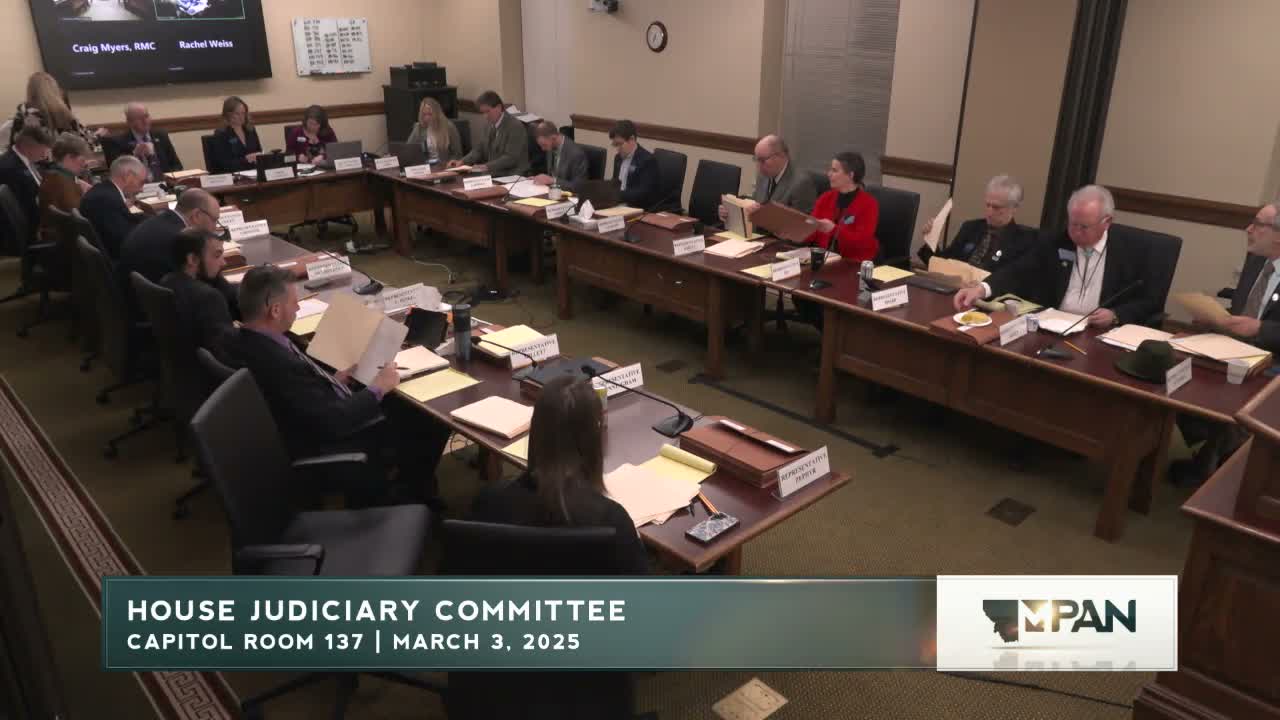
House committee advances bill to keep judicial review option for water-rights decisions
Summary
The House Judiciary Committee heard unanimous proponent testimony and moved HB 775 forward; the bill would repeal a temporary sunset and keep judicial-review options for DNRC permit and change decisions in place. Supporters said it offers choice and court expertise; opponents urged caution about entrenched bureaucracy.
Representative Ken Walsh, the bill sponsor, told the House Judiciary Committee he introduced House Bill 775 to repeal the sunset on the statutory option allowing aggrieved parties to seek judicial review of Department of Natural Resources and Conservation (DNRC) permit and change decisions.
"All we're doing is repealing that sunset date," Walsh said, describing the measure as a narrow technical fix that preserves a party’s ability to bring a petition for judicial review in either district court or the water court. Walsh said the change preserves choice for litigants and helps when district courts are backlogged.
Clayton Elliott of Trout Unlimited and Mike Murphy of the Montana Water Resources Association joined as proponents, saying the provision—derived from a 2017 Legislature bill—has worked well and provides a useful, limited alternative for review. "This is a very narrow situation that just allows for judicial review of permit or change decisions," Elliott said. Supporters told the committee parties across the water‑use spectrum have used the option since it was enacted.
Jasmine Krotkov of the Montana Farmers Union opposed repeal of the sunset, arguing that the water court was intended as a temporary litigation tool tied to final decrees in adjudication and that leaving the water‑court authority open “forever” was not the original plan.
Chief Water Court Judge Steve Brown answered committee questions that the bill addresses petitions for judicial review rather than the ongoing adjudication workload; he said the water court routinely handles petitions arising out of DNRC proceedings and that assigning a firm terminal date for the water court is difficult because litigation pace and interagency workflows are outside the court’s control.
The bill was moved forward in committee for further action. No policy change to DNRC permitting thresholds was proposed; proponents emphasized the bill’s narrow scope and the practical choice it preserves for litigants who want a forum with water‑specialized expertise.
The committee’s record shows the item later moved through executive action; the committee discussion focused on preserving access to both forums while alerting members to ongoing broader water‑court and adjudication debates.