Get Full Government Meeting Transcripts, Videos, & Alerts Forever!
Get email alerts on the HB 300 (education Discrimination) topic
No spam. Unsubscribe anytime.
House Judiciary hears hours of testimony on HB 300 to clarify sex‑based discrimination in education
Summary
House Bill 300 would amend Montana’s discrimination‑in‑education law to bar biological males from competing on girls’ teams and require access to single‑sex private spaces; proponents said it restores Title IX protections and gives complaint pathways, opponents said it discriminates against transgender students and raises NCAA and constitutional risks.
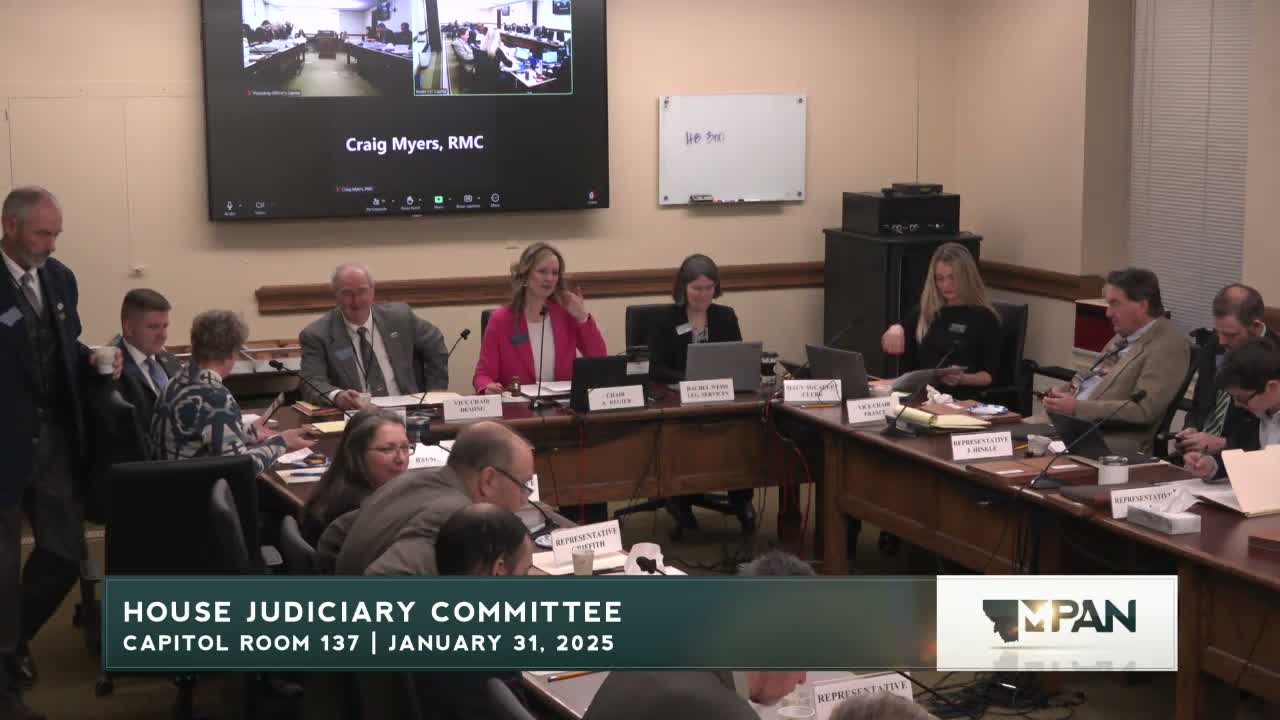
At a House Judiciary Committee hearing on House Bill 300, lawmakers heard hours of testimony from supporters and opponents about a proposal to clarify the state’s discrimination‑in‑education law to protect women’s athletic opportunities and single‑sex private spaces.
Representative Carrie Seekins Crowe, the bill sponsor, told the committee the legislation would "provide additional clarity to our discrimination in education laws" so that "no student, educator, or staff member faces discrimination" and urged members to give the measure a do‑pass recommendation. She said the bill is intended to carry out the promise of Title IX and protect women’s competitive and private spaces.
Dylan Klapmeier, education policy adviser to Governor Greg Gianforte, told the committee the governor supports HB 300 and described it as strengthening the 2021 Save Women’s Sports Act by creating a state legal pathway for complaints under the human‑rights code. "The governor supports House Bill 300," Klapmeier said, adding the measure would provide "even more legal protections" for Montana girls and women.
Proponents including the Montana Family Foundation and Alliance Defending Freedom framed the bill as restoring sex‑based distinctions that they said federal policy changes had blurred. Susie Hedalen, the superintendent of public instruction, testified that "allowing biological males to compete in women's sports threatens" Title IX’s aims and could discourage female participation; she recommended the committee consider HB 300 as a protection for female athletes.
Opponents—including BridgerCare, the ACLU of Montana, Planned Parenthood Advocates Montana, Legal Voice, Trans Visible Montana and Catalyst Montana—urged a no vote. Shawn Reagor of BridgerCare said the bill would stigmatize transgender students and "create additional barriers to the healthy development and full participation in school," and Khadija Davis of the ACLU said exclusion from sports and school life would deprive trans students of educational and social benefits.
Galen Hollenbaugh, deputy commissioner for the Office of the Commissioner of Higher Education, warned that a provision in the bill (Section 3) "would place the Montana University System out of compliance with NCAA policy regarding transgender athletes," exposing campuses to potential fines or the loss of postseason hosting; he also said Section 4's language about access to sleeping quarters is overly broad and could invite litigation involving residence halls.
Witnesses and committee members spent substantial time on legal and factual questions: how the bill would be enforced at K‑12 and collegiate levels, how many transgender athletes currently compete in Montana, the fiscal and litigation costs of defending similar laws, and whether Board of Regents authority or recent court decisions constrain the legislature’s action. Counsel for proponents referenced Hecox v. Little—the Idaho case now pending further review—and proponents cited a recent U.S. Department of Education letter they said restores Title IX’s original sex‑based interpretation.
Committee members asked staff and agency witnesses to provide follow‑up materials. The committee requested that Legislative Services and OPI (Office of Public Instruction) collect data and, where possible, cost estimates related to recent litigation defenses and the number of transgender athletes in state programs.
No formal vote occurred during the hearing. The chair closed the hearing on HB 300 and placed the bill on the committee’s list; members were told to submit proposed amendments to committee staff and that executive action was planned for the coming week pending receipt of requested follow‑up information.
What’s next: The committee left HB 300 on the agenda and asked staff to collect additional legal, fiscal and participation data before scheduling executive action. If the committee advances the bill it may be subject to further amendment and legal review given the litigation history in other states.