Get Full Government Meeting Transcripts, Videos, & Alerts Forever!
Get email alerts on the Water Feasibility Study topic
No spam. Unsubscribe anytime.
Porterville signs on to state-funded water study to evaluate hooking about 280 wells to city system
Summary
The council authorized a nonbinding letter of interest to join a State Water Board-funded feasibility study examining consolidation of roughly 280 domestic wells with Porterville’s water system; council asked for clarity on wastewater and long-term costs before any required commitments.
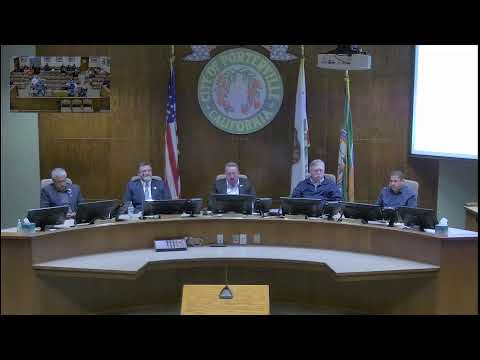
Porterville’s City Council voted Nov. 20 to provide a nonbinding letter of interest to the Community Water Center for a State Water Board-funded feasibility study that will evaluate long-term drinking-water solutions for roughly 280 domestic-well households within the city’s urban boundary.
Director Alvarez said the 12- to 18-month study, funded by the State Water Resources Control Board, will evaluate technical and financial options — including potential consolidation with the city system — for households north of Castle (between the Friant Canal and Highway 65) and along Orange Belt Drive and Avenue 181, plus an area near Indiana and Teapot Dome tied to the Hope School alignment.
Council members supported studying the options but repeatedly raised two concerns: first, the study focuses on drinking water while some residents’ wells show groundwater contamination (high nitrates) likely linked to failing septic systems; second, the city should avoid becoming financially or operationally obligated to extend service without clear limits. Vice Mayor McCurvey cautioned that state offers can later be modified and cities can be left covering costs.
Councilman Beltran moved to approve staff’s recommendation to participate in the feasibility study and provide the nonbinding letter of interest; the motion passed with three yes votes, one no and one abstention. The staff report said participation preserves local control over future decisions while allowing the city to access data and state-funded analysis.
Next steps: staff will sign the nonbinding letter and participate in the study; council directed staff to track wastewater and groundwater contamination issues and to return with further analysis before any commitment to extend city water service.