Get Full Government Meeting Transcripts, Videos, & Alerts Forever!
Get email alerts on the Pout Pond BMP topic
No spam. Unsubscribe anytime.
Pout Pond demonstration BMP draws support, triggers Natural Heritage review over dragonfly habitat
Summary
Town engineers proposed reconstruction of Pout Pond parking and new bioretention basins as an MS4 demonstration BMP to reduce phosphorus loading; commissioners welcomed the design but asked Natural Heritage to confirm whether priority habitat or an endangered dragonfly would be affected before the commission votes.
Engineers for the Town of Uxbridge presented a Notice of Intent for a demonstration BMP at Pout Pond to satisfy the Massachusetts MS4 General Permit and reduce total phosphorus loading to the Blackstone River.
Jean Christie (Tyler & Bond) said the project includes parking lot reconstruction, a sewer connection for the beach house (removing septic), and two biofiltration basins sized to infiltrate the 100‑year storm. The basins include sediment forebays, heavily planted bioretention media, and are designed to maximize TSS and phosphorus removal; signage for the educational component is also planned.
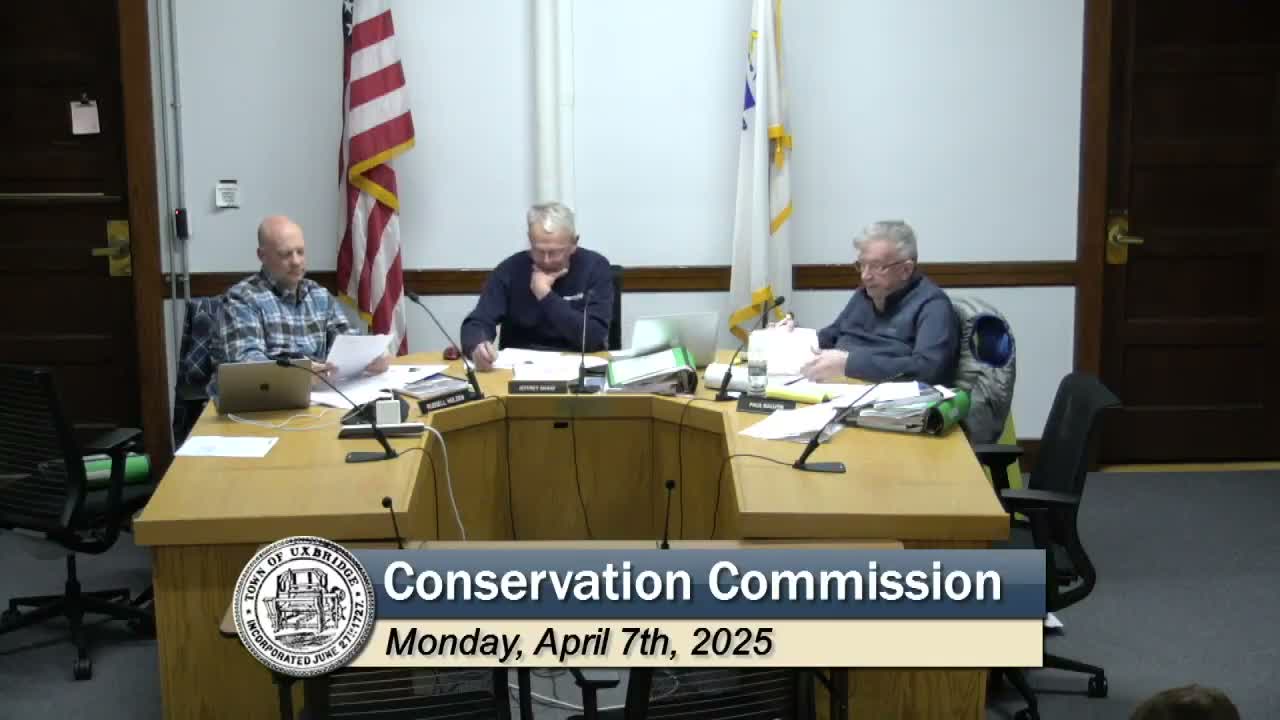
Commissioner concerns centered on the proximity to potential priority habitat and an endangered dragonfly. Speaker 2 asked whether Natural Heritage had been consulted; staff confirmed the NOI was submitted to Natural Heritage and their biologist was reviewing the materials. The commission agreed to wait for Natural Heritage comments (they have up to 30 days) and to evaluate any required mitigation or alternative locations if priority habitat constraints are confirmed.
The commission also raised site‑selection transparency questions (which town parcels were evaluated during the MS4 selection process) and whether porous pavement might be a preferable alternative; staff noted the site was selected through the town’s MS4 prioritization and capital planning processes because of public exposure and educational value.
Next steps: await Natural Heritage response, incorporate any required mitigation, and place the project on the next agenda for decision once the biologist’s comments are received.