Get Full Government Meeting Transcripts, Videos, & Alerts Forever!
Get email alerts on the Old Elmdale Subdivision topic
No spam. Unsubscribe anytime.
Commission presses Old Elmdale developer for dust control, tighter phasing plan amid vernal‑pool concerns
Summary
At a public hearing on Old Elmdale Estates (DEP 3121168), commissioners pressed the developer’s engineers for clearer phasing, dust‑control measures near a sensitive vernal pool and realistic timelines after engineers estimated phase‑one export of about 171,000–172,000 cubic yards.
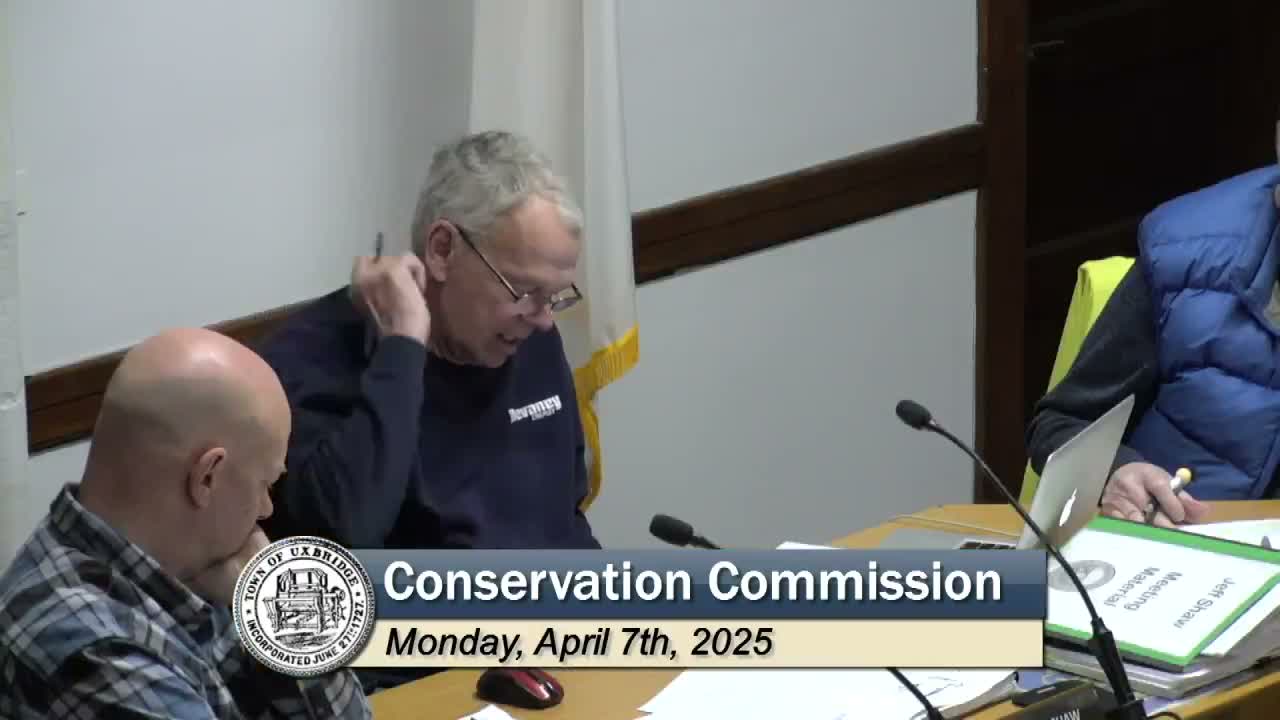
At its April meeting the Town of Uxbridge Conservation Commission continued the hearing on Old Elmdale Estates (DEP 3121168) after a lengthy technical discussion focused on dust control, project phasing and risks to vernal pools.
Chris Shea of Dupre Engineering described the subdivision and planning‑board approvals but told commissioners the widening plans were separated from the subdivision filings. Commissioners identified the most pressing issues as dust migration onto a nearby vernal pool and the need for a more detailed phasing plan to limit clearing and stabilize slopes. A commissioner asked, "How are we going to keep that pool from having any dust settle in it at all?" and recommended stronger onsite watering, longer water‑truck reach or dust‑fence installations near pool areas.
Commissioners also raised construction sequencing concerns tied to estimated material export. Speaker 2 noted phase 1 calls for roughly "171, basically 172,000 cubic yards" of soil export; based on truck counts, that could take 14–24 months and intersect vernal‑pool activity seasons, potentially triggering seasonal work restrictions. The commission asked the applicant to return within two weeks with phasing diagrams covering all four phases and a timetable that minimizes clearing and the duration of exposed soils.
The applicant agreed to revise plans to show reduced clearing where feasible and interim erosion controls within phases. The commission voted to continue the public hearing to April 22 so staff can review updated phasing diagrams, a more detailed narrative of sequencing, and any inspection schedules Graves Engineering will provide.
Next steps: applicant to provide revised phasing diagrams and estimated duration for each phase, dust‑control specifications (hose lengths, water‑truck reach, temporary dust fencing), and an inspection frequency proposal for the period of highest risk.