Get Full Government Meeting Transcripts, Videos, & Alerts Forever!
Get email alerts on the Personhood Amendment topic
No spam. Unsubscribe anytime.
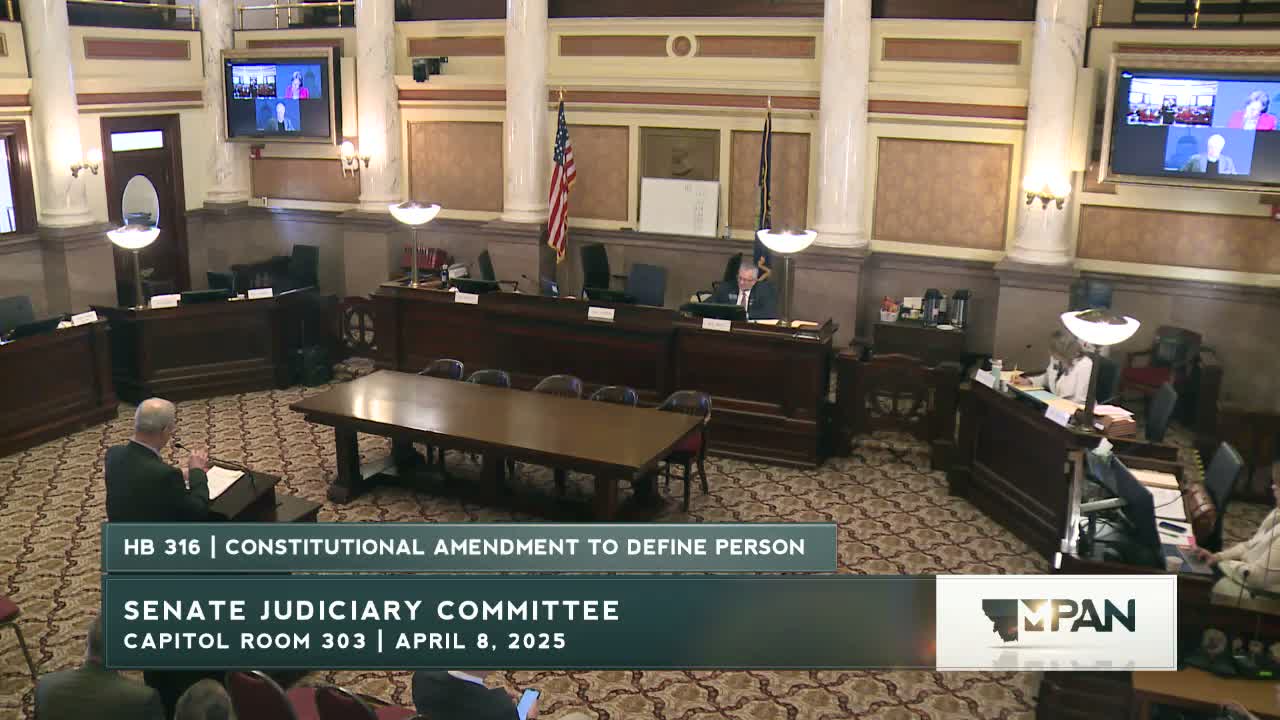
Senate Judiciary hears hours of testimony on proposed personhood constitutional amendment
Summary
Representative Lee Deming’s HB316 would define 'person' to include all human life 'beginning at fertilization'; proponents framed it as a moral and constitutional correction, opponents warned it would conflict with last year’s CI‑128, threaten IVF and miscarriage care and invite legal uncertainty. The committee voted to concur and send the measure to the floor.
Representative Lee Deming opened House Bill 316 as a proposal to amend the Montana Constitution to define "person" to include "all members of mankind at any stage of development, beginning at the stage of fertilization or conception." He framed the measure as an effort to extend constitutional protections he says the framers intended.
Proponents argued repeatedly that personhood begins at fertilization and that the constitution should reflect that view. Bill Lisonbee, a Ravalli County official, told the committee that scripture and conscience compel the change (testimony began SEG 1550). Medical and religious witnesses including Dr. Annie Bukacek and others described the amendment as a moral necessity and urged the committee to pass the bill to place it before voters (SEG 1611, SEG 1696). Several witnesses recounted personal stories to underline their position.
Opponents ranged from reproductive‑health providers to people who said the amendment would create real‑world harms for pregnant people and medical providers. Tess Fields of Blue Mountain Clinic warned that comparable laws in other states have led to prosecutions and restricted care, citing arrests and civil litigation tied to pregnancy outcomes (SEG 2048). Planned Parenthood Advocates of Montana’s Martha Fuller and multiple medical professionals emphasized that the text could jeopardize in vitro fertilization, emergency contraception and routine pregnancy care and conflict with CI‑128, the voter‑approved amendment protecting reproductive decisions (SEG 2696, SEG 2700).
Committee members pressed the sponsor on scope and unintended consequences. Questions focused on IVF protocols, whether fertilization versus implantation should be the defining line, and how the amendment would interact with existing criminal statutes that already reference unborn life (deliberate‑homicide code discussion, SEG 3343–3356). Several senators noted the political and legal friction between HB316’s text and CI‑128 and asked whether the amendment would override or create contradictions across Montana law.
Representative Deming closed by saying he believed the measure would return constitutional protections to unborn human life and that voters should decide the issue at the ballot box. After executive action later in the meeting the committee voted to concur on HB316 and reported it to the floor for further consideration (executive action recorded later in the transcript).