Get Full Government Meeting Transcripts, Videos, & Alerts Forever!
Get email alerts on the Wildlife Management topic
No spam. Unsubscribe anytime.
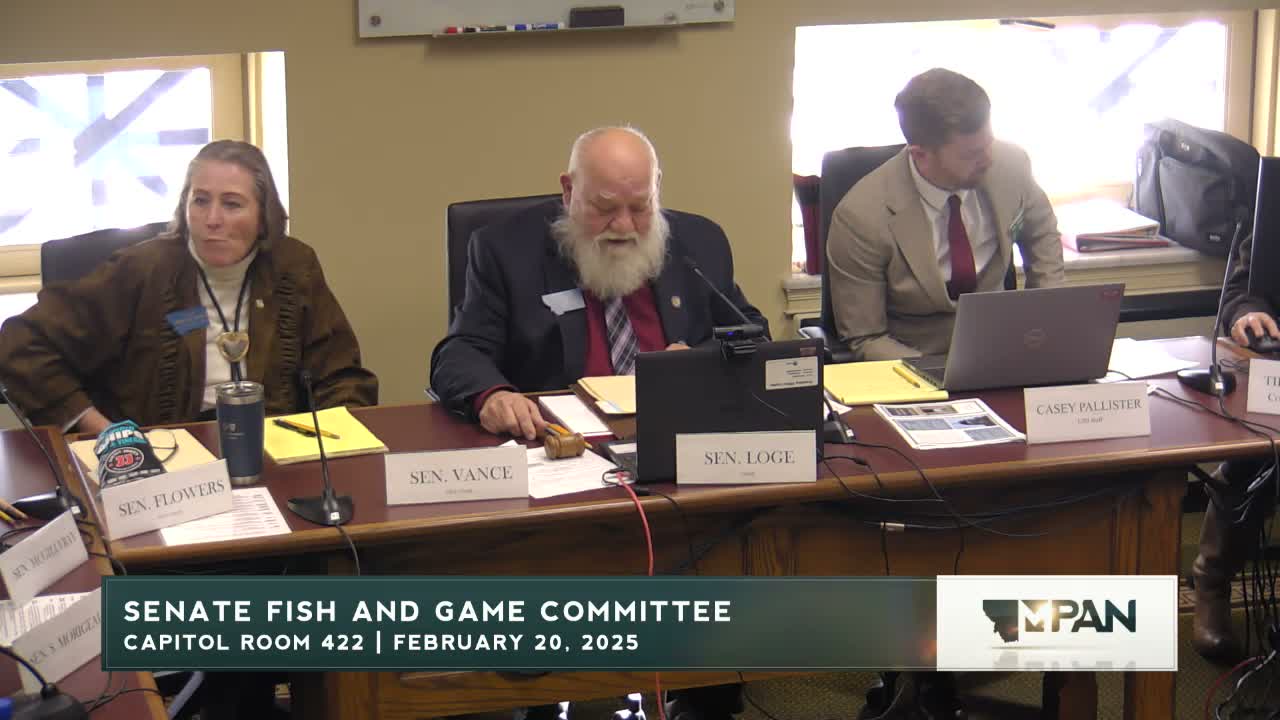
Senate Fish and Game hears wide opposition and support for HB 176 to allow statewide wolf quota
Summary
A packed Senate Fish and Game hearing on House Bill 176 drew competing testimony: ranchers and sportsmen urged a statewide quota to reduce wolf numbers for livestock and elk recovery, while tribes, conservation groups, scientists and tourism businesses warned the measure relies on uncertain counts, risks Yellowstone-area packs and could harm tourism and tribal rights. The committee held a hearing and took no vote.
Representative Shannon Maness opened the Senate Fish and Game hearing on House Bill 176, telling the committee the bill would allow Montana Fish, Wildlife & Parks (FWP) to adopt a statewide wolf quota — rather than region-by-region quotas — until the state’s wolf estimate reaches 550 animals and to aim for a management level of 450 thereafter. "This bill is allowing FWP to institute a statewide wolf quota instead of our regional ones," Maness said in her presentation, framing the proposal as a tool to reduce livestock depredation and local elk declines.
The hearing drew intense, divided testimony across roughly 40 in-person and online speakers. Proponents — including sportsmen’s groups, trappers and ranchers — said regional quotas have failed to address local problems. Jeff Darrrah of Stevensville said the commission and department "have worked with the commission and tried ... to get some of these wolf numbers down. It's been very difficult at best to get that done," and asked the committee to pass the bill to add an option for FWP. Rancher Dean Peterson described repeated livestock losses, saying his neighbors and family documented confirmed kills and maimed animals and estimated monetary losses for confirmed deaths, urging support for the measure.
Opponents included conservation organizations, wildlife biologists, tourism businesses, and tribal representatives. They raised three recurring objections: the state’s population estimates rely on an estimation method called IPALM (integrated patch occupancy modeling) that some witnesses say is not a population-counting tool; the bill replaces localized management with a "one-size-fits-all" approach that could concentrate harvest near high-success areas and Yellowstone boundaries; and the legislature did not adequately consult tribes whose treaty hunting rights and cultural connections intersect with wolf management. Patrick Yawake, representing several tribes, told the committee tribes "were never properly consulted in the creation of this piece of legislation."
Quentin Kujala, chief of conservation policy for FWP, appeared as an informational witness to answer technical questions. Kujala described IPALM as an estimation process that combines hunter and public sampling responses with specialist ground truthing and produces a central estimate and credible intervals. "That 1,100 you hear talk about ... is a product of IPALM," he said, explaining the method is intended to capture uncertainty. He also traced the history of wolf management from unit-based quotas to the current regional structure and said FWP still documents breeding pairs and pack locations to inform estimates.
Opponents warned of economic and reputational risks, especially in gateway communities that rely on wildlife tourism. Several business witnesses and tourism operators said wolf viewing generates significant local revenue and that removing regional quotas could reduce sightings and visitor spending. Conservation groups and scientists warned that aggressive, statewide removal could harm genetic connectivity and that some proposed harvest methods would be inhumane or non-targeting.
Committee members pressed both technical and practical points: senators asked about real-time measurement challenges, the Livestock Loss Board’s compensation rules (which reimburse confirmed dead animals at market value, not lost genetics), and whether regional quota changes could cause localized overharvest. Ranchers recounted confirmed kills and maiming that in some cases were compensated, while FWP and other witnesses emphasized the difficulty of confirming some depredations and the statistical uncertainty in counts.
Representative Maness closed by saying the bill does not change hunting seasons (those remain FWP's authority), reiterated the bill’s population buffer (unlimited quota to 550, then aiming for 450) and noted ongoing discussions with FWP about possible amendments to protect Yellowstone-adjacent areas. The committee did not vote; the hearing concluded and the committee was adjourned.
The next procedural step, as stated in the hearing, is internal consideration by the committee and potential redrafting or amendments; no final legislative action was taken at the hearing.