Get Full Government Meeting Transcripts, Videos, & Alerts Forever!
Get email alerts on the Executive Session topic
No spam. Unsubscribe anytime.
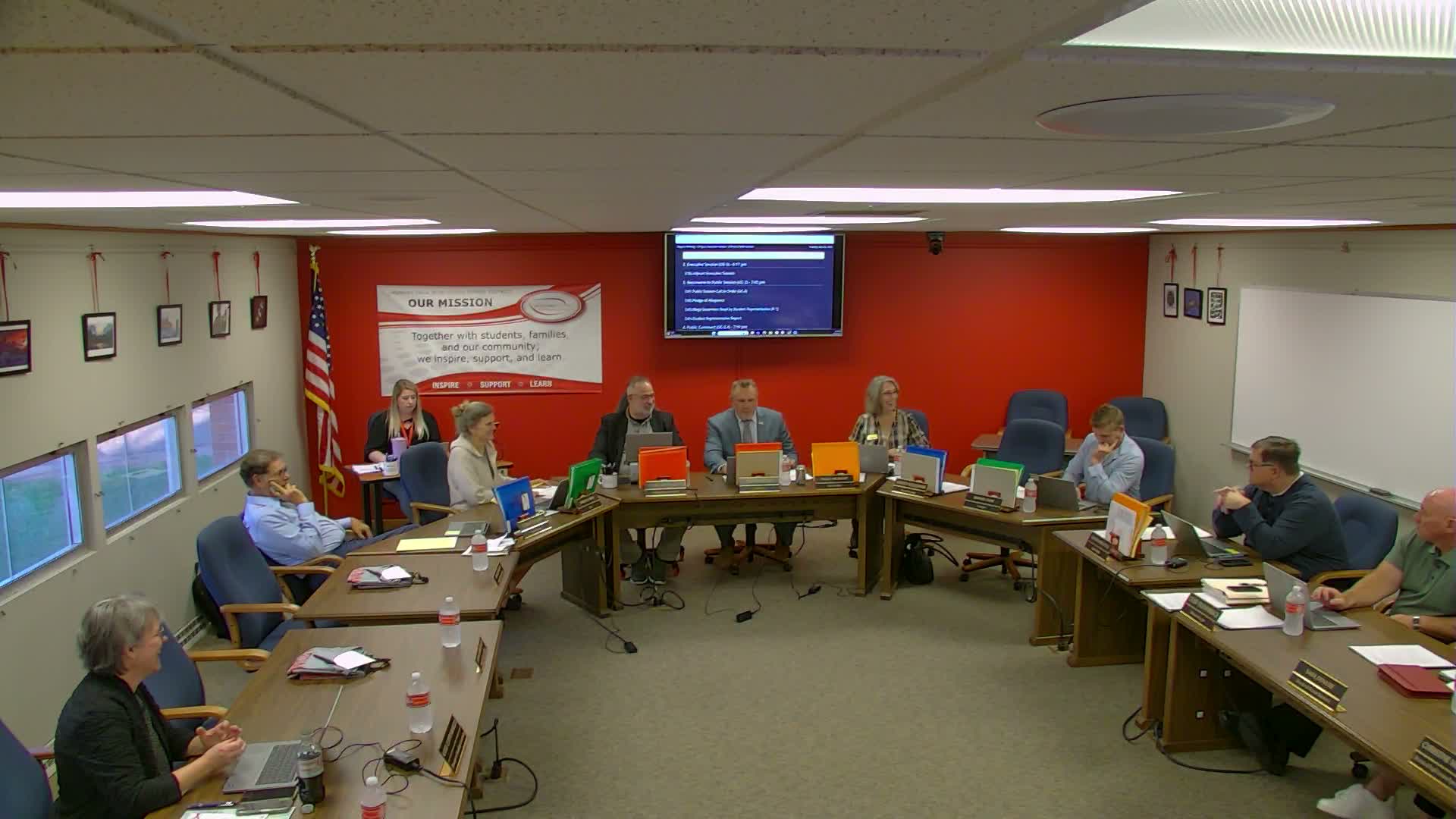
Chippewa Falls Area Unified School District board approves agenda and votes to enter executive session citing state statute
Summary
Board members approved the meeting agenda and, after a motion by Dennis Fear and a second by Peggy McKillop, voted to move into an executive session citing Wisconsin statute to discuss prior closed-session minutes, personnel matters, safety reports, property negotiations and pending litigation.
The Chippewa Falls Area Unified School District board approved its meeting agenda and voted to go into an executive session after a motion citing Wisconsin statute.
Meeting chair (unnamed) confirmed a quorum and asked for approval of the agenda under item 1.03. A member moved to approve the agenda, another seconded, members answered 'Aye,' and the chair declared the motion carried.
Later under item 1.04, the chair asked for approval of the executive session agenda and then called for a separate motion to move into executive session. "We do have a quorum," the chair said when opening the discussion. Dennis Fear, a board member, moved to enter executive session pursuant to "Wisconsin statute 19.851 C, D, E, F and G" to consider prior closed-session minutes, specific employment actions concerning individual employees, employee matters, safety drill evaluations and the safety report, deliberate and negotiate property purchase, and discuss legal litigation matters and advice of legal counsel regarding a pending notice of claim. Peggy McKillop seconded the motion.
The chair called for a vote; multiple members responded 'Aye' and the chair then requested a roll call. During roll call several members identified themselves and answered affirmatively; the chair then announced that the board was in executive session.
The motion to enter executive session was approved and the board moved into closed session to address the cited items. The transcript records the motion, the statutory citation, the second, and affirmative responses from members; it does not record a complete, unambiguous roll-call tally for every member in sequence. No substantive discussion of the executive-session topics appears in the public portion of the transcript.
The board did not return to public session within the provided transcript segment and no further public actions or votes on the cited matters are recorded here.