Get Full Government Meeting Transcripts, Videos, & Alerts Forever!
Get email alerts on the Education Technology topic
No spam. Unsubscribe anytime.
Rochester Community School District outlines generative AI guidance, shows classroom uses
Summary
Instructional staff presented a yearlong effort to create generative AI guidance and described classroom uses — from sandboxed tools for teachers to rubric‑driven chatbots for students — while trustees pressed for clarity on detection, rollout by grade, and ongoing professional development.
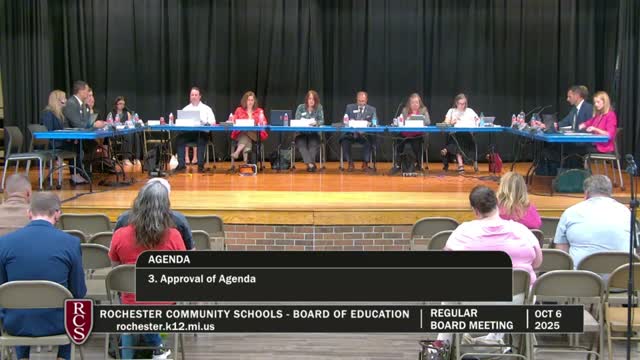
Rachel Monero, the district’s instructional technology specialist, told the Rochester Community School District Board on Oct. 6 that the district has completed and begun rolling out guidance for generative artificial intelligence after a year of work by a 26‑member K–12 steering committee.
"Artificial intelligence itself is a general term that is applied to functions carried out by machines that are commonly associated with human intelligence," Monero said, and she emphasized the specific subset the board was discussing: "generative AI" — models that "are able to create text, images, codes, videos, and more." She said the district’s guidance stresses AI literacy, transparency when AI is used and protections for academic integrity.
The board heard classroom examples from teachers who have used district‑approved tools. "NotebookLM...it's only taking a look at the documents that you enter," said Brian Lindstrom, an economics teacher at Rochester Adams High School, describing why the district whitelisted that tool for teacher use. Lindstrom said he used it to generate differentiated guided notes and to translate materials for a newly arrived student.
Micaela Youngs, an English teacher and newspaper adviser at Rochester High School, described using Gemini to adjust reading levels and create assessment activities: "In my ELA classes, I have been using Gemini a ton to help me differentiate my instruction, whether that is adjusting reading level for texts...or adjusting worksheets." District staff also showed student examples in which teachers upload a rubric and use a school‑specific chatbot as a thought partner rather than a replacement for student work.
Trustees focused on oversight, asking when guidance is introduced at elementary grades and how teachers can tell when a student relied on AI. Monero said teachers and information‑literacy specialists are embedding AI practices into digital citizenship curriculum and that the guidance will be revised over time. She warned there is no commercially available product that can definitively prove a piece of writing was produced by AI, so teacher familiarity with students’ writing remains central.
The district published a generative AI acceptable‑use document on its website and rolled initial professional development out Aug. 20; Monero said further asynchronous and embedded PD offerings are scheduled through the fall. Board members asked for ongoing updates and said they want to see student voice included in future presentations.
What happens next: the district will continue monthly communications, expand PD offerings and adapt acceptable‑use language for younger students. Monero and the steering committee said they will return with further updates as classroom practice and vendor capabilities evolve.