Get Full Government Meeting Transcripts, Videos, & Alerts Forever!
Get email alerts on the Renewable Resource Grants topic
No spam. Unsubscribe anytime.
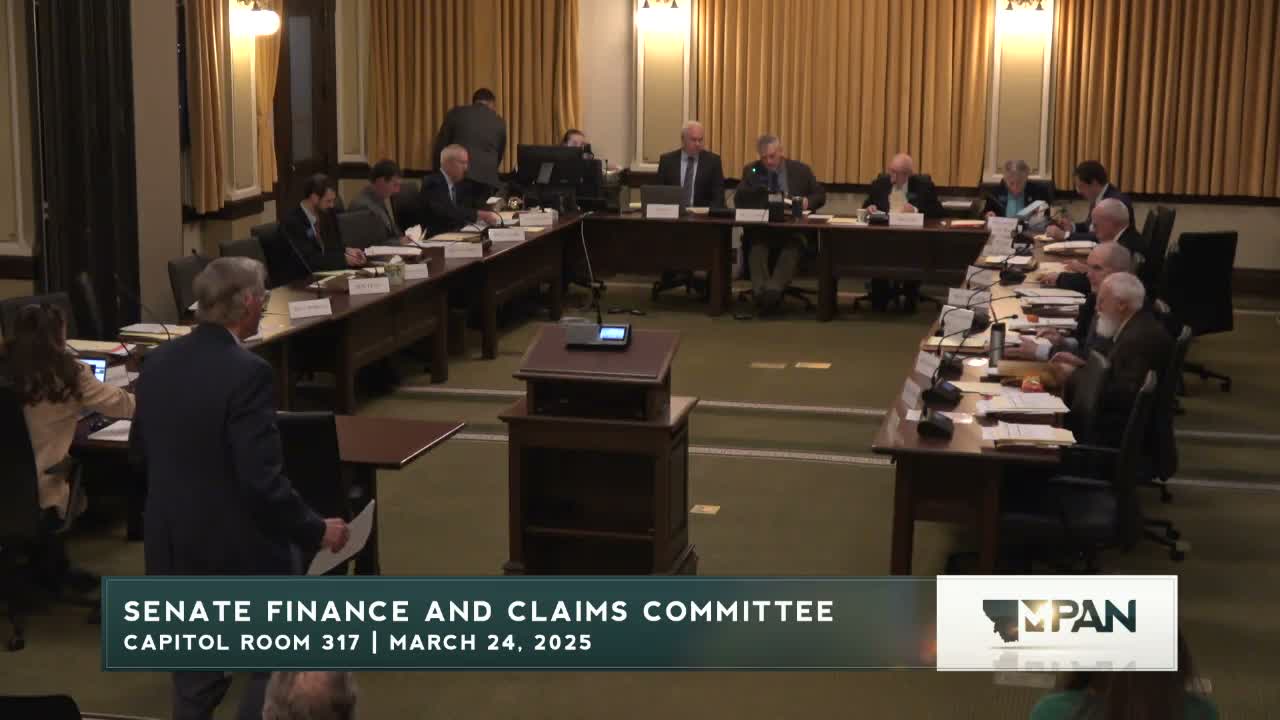
Committee hears HB6 to fund water, wastewater and irrigation grants after revenue estimate cut
Summary
Lawmakers on the Senate Finance and Claims Committee heard testimony on House Bill 6, a DNRC-funded package of renewable resource grants for water, wastewater and irrigation projects; sponsors said a revenue-estimate error forced a roughly 50% reduction in scope and removed two Granite County projects that offered no local match.
Representative John Fitzpatrick, the bill sponsor, told the Senate Finance and Claims Committee that House Bill 6 is part of the executive budget package to provide grants to local governments and districts for water, wastewater and irrigation repairs funded by interest from the Resource Indemnity Trust. "After the bill was introduced, it was discovered that there had been a significant error in the revenue estimate, and it was necessary to reduce the scope of the bill and limit the number of projects that could be funded by, roughly 50% of the revenue anticipated in the original bill," Fitzpatrick said.
The bill before the committee contains funds sufficient to support projects down through the town of Ennis and to fund 21 irrigation projects, according to Fitzpatrick. He said two projects — both in Granite County — were struck from the bill because they provided no form of local match: "If it's not important enough for them to find money or put their own money in, it's not important enough for the state of Montana to fund it," Fitzpatrick said.
Autumn Coleman, deputy administrator at the Department of Natural Resources and Conservation (DNRC), described the Renewable Resource Grant programs in HB6 and the criteria DNRC uses to rank applications, including public benefits, technical feasibility and the availability of matching funds. Coleman said DNRC received 71 grant applications for the current biennium and that the bill’s project grants (the largest category) are awarded by the legislature via HB6.
Supporters from local and statewide organizations— including Jennifer Olson of the Montana League of Cities and Towns, Clayton Elliott of Trout Unlimited, Mike Murphy of the Montana Water Resources Association and Ben Rigby of Montana Rural Water Systems — described the bills’ planning and nonpoint-source programs as critical for rural communities and irrigation families. DNRC said the first list of 21 water and wastewater projects contains about $48,000,000 in project funds and that the observed local match on those projects amounted to roughly $1 million.
Committee members asked whether the cuts were uniform and whether additional funding could be found. Fitzpatrick said the reductions were applied across the list after the revenue error and that he expects some additional revenues in the coming days that could permit amending the bills to restore projects; he also said any transfers to fill the gap would likely be handled in another bill. Senators questioned specific removals, including a Missoula public library green-roof stormwater project, and committee members pressed DNRC on multiple applications from the same irrigator and on how ranking and matches are verified.
The committee closed the hearing on HB6 after the sponsor said he would watch for additional revenues and moved on to the next bill.
The committee did not take a vote on HB6 during the hearing; no formal action was recorded.