Get Full Government Meeting Transcripts, Videos, & Alerts Forever!
Get email alerts on the Committee Votes topic
No spam. Unsubscribe anytime.
Senate committee concurs in a batch of House education bills; roll calls recorded
Summary
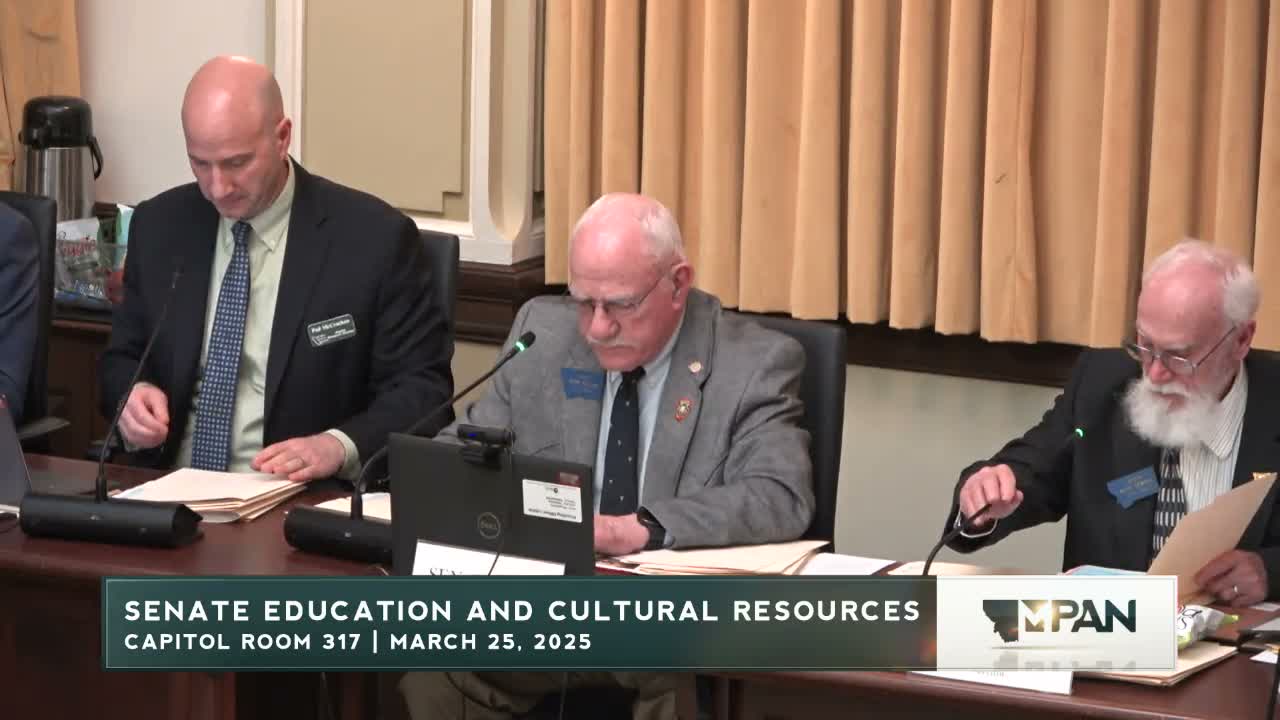
The Senate Education and Cultural Affairs Committee concurred in several House bills on education — including HB266, HB338, HB357, HB628 and HB745 — after brief committee discussion and amendments; recorded roll‑call results and amendment text are summarized.
The Senate Education and Cultural Affairs Committee on [date] took up and concurred in multiple House bills covering school funding, early literacy, career and technical education and background checks.
House Bill 266: The committee adopted a coordination amendment that instructs that, if Senate Bill 258 ultimately passes, SB258 would be void where it conflicts with HB266; the amendment carried on voice vote and the committee concurred in the bill by roll call (recorded: 8 aye, 6 nay). Mr. McCracken summarized HB266 as requiring a comparison of consumer price index inflation over the most recent six years with legislative school funding as part of the budgeting process.
House Bill 338: This bill, which adds a numeracy focus to the early literacy statutes and adds an initial reporting section, was explained by Mr. McCracken. The committee concurred by roll call (recorded: 8 aye, 6 nay). A committee member noted support for recognizing math as part of foundational school learning.
House Bill 357: The measure would provide an appropriation of $240,000 in the second year of the biennium to fund middle‑school career and technical education. Senator Vinton spoke in favor, calling for early exposure and industry partnerships. The committee concurred (recorded: 13 aye, 1 nay).
House Bill 628: Sponsors broadened the definition of early literacy to "early scholastic literacy," explicitly including math and permitting the inclusion of students who are on‑trajectory in some places. Committee staff explained a coordination amendment to avoid conflicts with HB338; the amendment passed and the bill was concurred in (recorded: 8 aye, 6 nay).
House Bill 745: The committee advanced a bill requiring fingerprint‑based background checks for school employees and volunteers who have unsupervised access to children. Members asked whether fingerprinting already applies to licensed educators; panelists and committee members said the bill codifies and extends that practice to cover gaps and to put it in statute. The bill passed with a single recorded 'no' in the roll call.
Votes and motions were taken under ordinary committee procedure. Where coordination amendments were used, committee staff said the change prevents overlapping bills from both taking effect if they conflict. Several bills will proceed to the Senate floor with carriers identified by senators at the hearing.
What’s next: The committee concurred in the bills and will forward them to the Senate floor for further action and scheduling for debate and final passage.